
Soto Ivars Sparks Debate on False Accusations
Soto Ivars' book reignites discussion on false accusations, shared custody, and the fear of instrumental complaints in marital breakups.
English · Original discussion in Spanish · Published
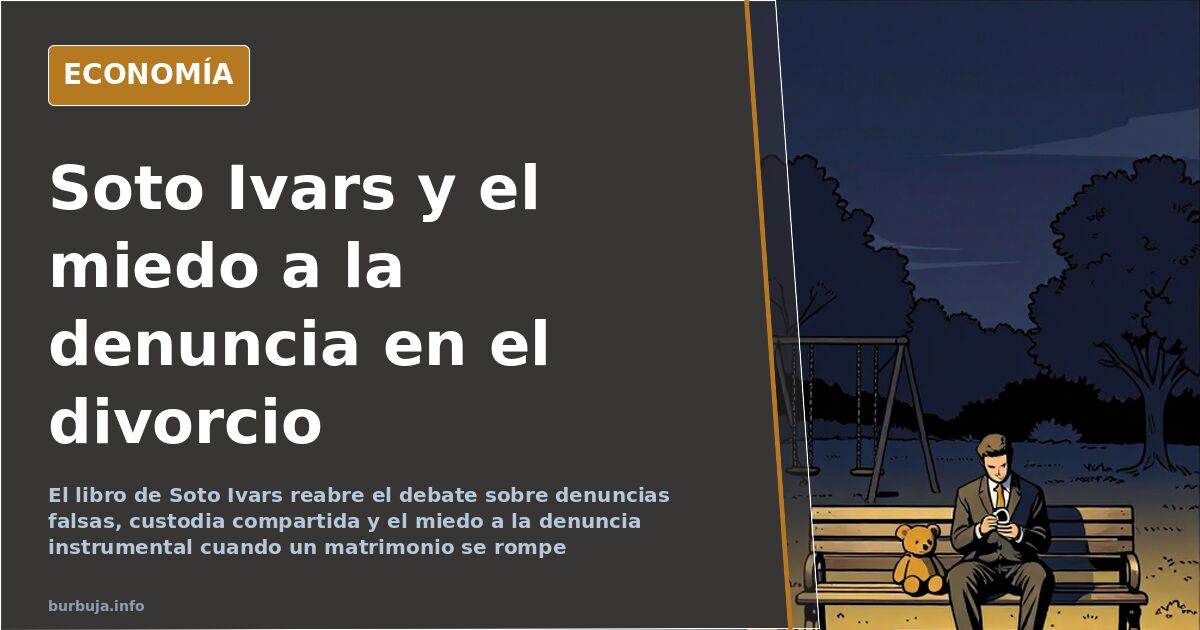
Soto Ivars and the Book Reigniting the False Accusations Debate
Is a gender violence accusation enough to turn a man's life upside down in a matter of days? This question runs through Soto Ivars' book and resurfaced when a reader, married for 19 years, recounted how his vvife read the same volume and joked about how easy it would be to ruin him. The subsequent conversation delved into custody, visitation rights, and the real weight of false accusations versus those presented purely as a pressure tactic.
The detail that ignited the issue was domestic. The vvife, according to his account, told him she knew what to do if she ever wanted to turn his life into a mess. A joke between laughs and a kiss. Beneath the joke, however, lies a legal issue that had been seeking a platform for years.
How Many False Accusations Exist in Spain?
There's no official figure to settle the discussion, but the one cited in the thread is minuscule: only 0.0000000000001% of accusations are false, according to the calculation made by the person opening the debate. This is the figure brandished as a shield whenever someone mentions the other side of the problem.
Two narratives, which don't intersect, are built upon this figure. One argues that the system is designed to protect victims, and a residual percentage doesn't justify re-evaluation. The other counters that damage isn't measured in percentages but in years: a father's absence, a visitation schedule that's never fulfilled, a salary that supports itself while the proceedings advance. Both sides have their case, and neither budges.
Shared Custody, Visits, and the Advice Not to Fight
Here the conversation becomes operational and quite uncomfortable. A roadmap circulates, which many voices repeat without nuance: don't ask for shared custody, don't force visitation rights, always negotiate downwards, and accumulate written proof that the withdrawal was voluntary and not abandonment. "So that when your children want or can contact you again, you can tell them the truth," summarizes one of the most seconded messages.
The logic behind this is anything but reassuring. If the procedure becomes chronic and every attempt to assert a right turns into a new conflict, the practical recommendation ends up being not to assert your rights loudly. Among the measures considered is leaving a constant documentary trail of the relationship with the children; continuous mobile recording also appears on the list, although several messages warn that it's not as simple a solution as it sounds. The full breakdown is in the longer sections, and that's probably where the most useful material from the entire exchange lies.
From the Comprehensive Law to Public Money
The political front opens almost immediately. Some readers place the origin of the problem in the Comprehensive Law against Gender Violence and argue that the book dedicates pages to explaining how a regulation designed to protect victims ended up creating a clientelist network funded with public money. The accusation that this structure served to gain votes is made without further proof than the narrative itself, and it should be read as what it is: a partial thesis.
The argument then descends into everyday detail. According to a forum user's account, at the school where his vvife works, there was a talk to raise awareness among 6-year-old children about the law, and the result was angering the only two male teachers in the faculty. It's a testimony, not a statistic, but it illustrates why the issue ignites so many people.
When the Issue Becomes a Trench
Much of the discussion, in any case, soon moved beyond the legal realm. A considerable portion of the responses devolved into personal attacks, disqualifications based on the vvife's nationality, and jabs about the private life of the person who peine the topic. He responded by raising the tone, offering his address in Málaga to settle the dispute face-to-face, and even jokingly asking for 10,000 euros for the damages of a stranger having his data. This article does not reproduce any of those expressions.
There were also those who tried to lower the temperature. "1984 is an instruction manual, but you have to read it," wrote a reader to downplay the issue, while another recalled that any long marriage can go wrong due to disappointment, a change of mood, or a poorly timed argument. It was even discussed, in passing, whether listening to a book counts as reading it. The seed, they imply, doesn't always germinate. But it's planted nonetheless.
The protagonist of the anecdote is still married, still says he wouldn't trade his vvife for anything, and still reads a book every two or three weeks. The law, for now, hasn't changed. It's enough for one of the two things to change for the joke to stop being funny. And neither of them gives advance warning.
Is a gender violence accusation enough to turn a man's life upside down in a matter of days? This question runs through Soto Ivars' book and resurfaced when a reader, married for 19 years, recounted how his vvife read the same volume and joked about how easy it would be to ruin him. The subsequent conversation delved into custody, visitation rights, and the real weight of false accusations versus those presented purely as a pressure tactic.
The detail that ignited the issue was domestic. The vvife, according to his account, told him she knew what to do if she ever wanted to turn his life into a mess. A joke between laughs and a kiss. Beneath the joke, however, lies a legal issue that had been seeking a platform for years.
How Many False Accusations Exist in Spain?
There's no official figure to settle the discussion, but the one cited in the thread is minuscule: only 0.0000000000001% of accusations are false, according to the calculation made by the person opening the debate. This is the figure brandished as a shield whenever someone mentions the other side of the problem.
Two narratives, which don't intersect, are built upon this figure. One argues that the system is designed to protect victims, and a residual percentage doesn't justify re-evaluation. The other counters that damage isn't measured in percentages but in years: a father's absence, a visitation schedule that's never fulfilled, a salary that supports itself while the proceedings advance. Both sides have their case, and neither budges.
Shared Custody, Visits, and the Advice Not to Fight
Here the conversation becomes operational and quite uncomfortable. A roadmap circulates, which many voices repeat without nuance: don't ask for shared custody, don't force visitation rights, always negotiate downwards, and accumulate written proof that the withdrawal was voluntary and not abandonment. "So that when your children want or can contact you again, you can tell them the truth," summarizes one of the most seconded messages.
The logic behind this is anything but reassuring. If the procedure becomes chronic and every attempt to assert a right turns into a new conflict, the practical recommendation ends up being not to assert your rights loudly. Among the measures considered is leaving a constant documentary trail of the relationship with the children; continuous mobile recording also appears on the list, although several messages warn that it's not as simple a solution as it sounds. The full breakdown is in the longer sections, and that's probably where the most useful material from the entire exchange lies.
From the Comprehensive Law to Public Money
The political front opens almost immediately. Some readers place the origin of the problem in the Comprehensive Law against Gender Violence and argue that the book dedicates pages to explaining how a regulation designed to protect victims ended up creating a clientelist network funded with public money. The accusation that this structure served to gain votes is made without further proof than the narrative itself, and it should be read as what it is: a partial thesis.
The argument then descends into everyday detail. According to a forum user's account, at the school where his vvife works, there was a talk to raise awareness among 6-year-old children about the law, and the result was angering the only two male teachers in the faculty. It's a testimony, not a statistic, but it illustrates why the issue ignites so many people.
When the Issue Becomes a Trench
Much of the discussion, in any case, soon moved beyond the legal realm. A considerable portion of the responses devolved into personal attacks, disqualifications based on the vvife's nationality, and jabs about the private life of the person who peine the topic. He responded by raising the tone, offering his address in Málaga to settle the dispute face-to-face, and even jokingly asking for 10,000 euros for the damages of a stranger having his data. This article does not reproduce any of those expressions.
There were also those who tried to lower the temperature. "1984 is an instruction manual, but you have to read it," wrote a reader to downplay the issue, while another recalled that any long marriage can go wrong due to disappointment, a change of mood, or a poorly timed argument. It was even discussed, in passing, whether listening to a book counts as reading it. The seed, they imply, doesn't always germinate. But it's planted nonetheless.
The protagonist of the anecdote is still married, still says he wouldn't trade his vvife for anything, and still reads a book every two or three weeks. The law, for now, hasn't changed. It's enough for one of the two things to change for the joke to stop being funny. And neither of them gives advance warning.
Summary of a discussion on Burbuja.info - Foro de economía, actualidad y política., translated from Spanish and reviewed before publication. Read the full discussion (229 replies).
More summaries
-
Soto Ivars, the analyst who predicted Sánchez's move
Soto Ivars interpreted Sánchez’s letter as a declaration of war. Judge Pedraz's ruling is cited as confirmation. Can an analyst be measured?
-
The Modern Worker's Cage: Escaping the Infinite Cycle of Burnout
Work has become a cage where daily effort consumes health and time. Discover why we push ourselves so hard and how to break the cycle.
-
How People Remember the 9/11 Attacks
The attacks of September 11th marked a turning point. Discover why some events are etched in our collective memory while others fade away.
-
Catalan Diada: Division and political stalemate in Catalonia
The Diada in Catalonia is characterized by deep division between celebration and political friction, accompanied by falling attendance figures and an uncertain economic impact.
-
Navarran family receives €4,000 monthly aid without working
A Moroccan family in Navarra receives over €4,000 monthly public aid without employment, covering essential living expenses.
-
Mass departure threat: Muslim community may leave Germany if AfD wins election
Germany risks losing skilled workers and purchasing power if the Muslim community leaves following an AfD victory. We analyze the economic implications.