
Solar panels will reach end of life before 2050
Millions of solar panels already installed will reach end of life before 2050, and recycling still doesn't pay off: their likely destination is landfill.
English · Original discussion in Spanish · Published
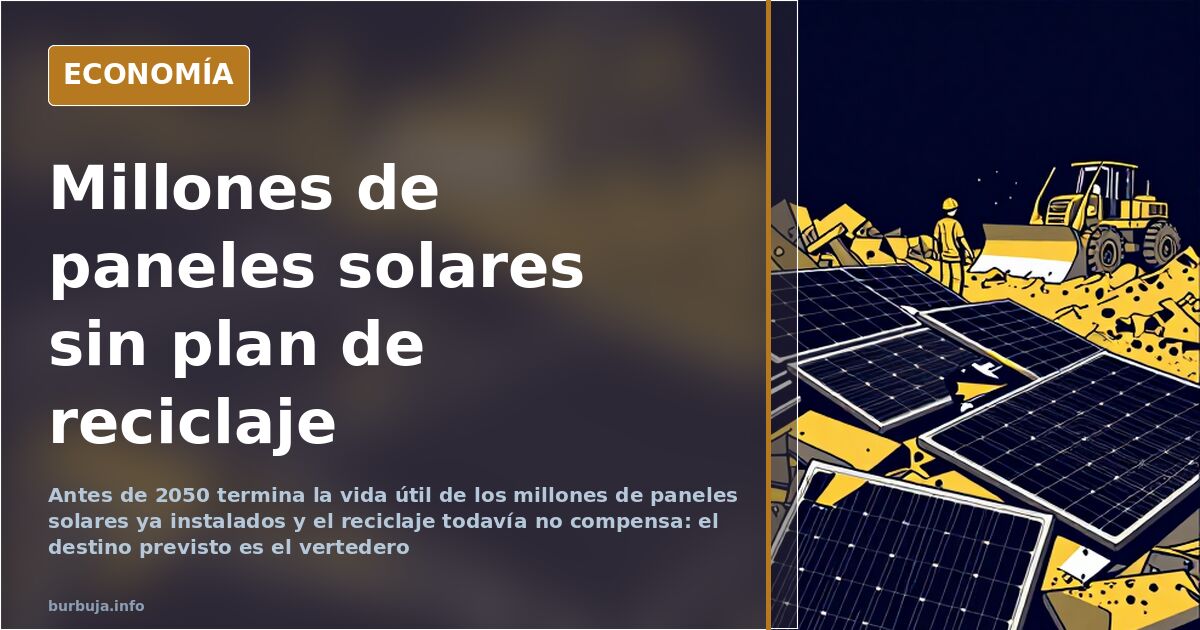
The landfill awaits the solar panels being installed today
What happens to a solar panel when it stops producing electricity? For now, almost nothing. The BBC put figures to the problem in the UK — tens of millions of units already installed — and gave it a date: before 2050 the panels operating today will have reached the end of their useful life, and there is no defined destination for millions of tonnes of photovoltaic waste. They don't implode, they don't burn, they don't disappear. They simply stop paying their way, and then someone has to take them away.
What happens when a solar panel stops being profitable?
The threshold being cited is 25% efficiency. Below that, the installation no longer pays its way and nobody maintains it. Degradation is slower than the alarmism suggests: these are panels that produce less each year, not devices that break all at once. Though there are also ugly exceptions, with modules so battered that water gets in through the seals.
The most optimistic calculation holds that in 25 years the installation has paid for itself several times over at current electricity prices, and that manufacturers now dare to guarantee 30 years of operation, fifteen times more than any household appliance is required by law to offer. The pessimistic scenario does not dispute the payback: it disputes what is done with the material once the guarantee paper has expired.
Why aren't solar panels recycled already?
A panel is a fairly simple sandwich: aluminium frame, glass, crystalline silicon, some copper and tin, traces of plastic and silicone. Almost everything can be recovered separately. The problem is not technical; it is one of scale and money. Today few panels have been retired — most were installed in recent years and are still producing — so setting up a dedicated recycling industry does not pay. Those who try usually ask for public subsidies to get started.
There is a second obstacle that is indeed technical: current processes return lower-quality material, which limits what it can be used for afterwards, and the cost of separating certain components remains too high with available technology. The practical conclusion, for now, is the usual one: they are buried. Not very deep, though.
The chemistry that doesn't appear in the brochure
Here comes the uncomfortable part. To obtain 1 kilo of crystalline silicon, about 4 kilos of silicon tetrachloride are needed, a brutally toxic compound. During manufacturing, silicon particles appear in the air mixed with indium, gallium, selenium dioxide and cadmium. Add to that the energy consumed in producing the panel and the energy later required to recycle it. If both are added together, the panel's green balance narrows considerably.
And transport: moving panels and wind turbine blades is not done with electric trucks or hydrogen ships. Sustainability, in practice, is concentrated in the part of the process that can be seen from the window.
What effect does a solar farm have on its surroundings?
A field of panels is a dark surface that absorbs radiation and heats up. In summer, from mid-morning onwards, some have measured temperatures of more than 60 °C nearby and claim that on a solar farm covering several square kilometres birds do not come near. The objection has its logic: the earth also absorbs heat, but spreads it and acts as a heat sink; a metal sheet does not.
The nuance matters. On a roof or in an industrial building the effect is irrelevant. In an installation stretching for kilometres, it is one more variable that rarely makes it into impact studies.
Blades, batteries and the waste nobody wants to look at
The panel is probably the easy part of the problem. Wind turbine blades are made with epoxy resins, a material that is carcinogenic in its non-solid state, and crushing them in situ requires permits to bring a large shredder into the countryside. The process has been studied, and the paperwork gives pause for thought. Lithium batteries, by cost and volume, are the most expensive waste in the whole chain.
And then there is the detail that throws you: the warning about panels has come from a media outlet that does not usually shoot itself in the foot with the renewable narrative. When the sender of the message changes, it is worth asking why it changes.
The industry estimates that by 2050 there will be enough tonnes for recycling to be a business. By then panels will be more powerful and easier to dismantle, and someone will explain that the problem never existed. Meanwhile, the landfill waits in no hurry.
What happens to a solar panel when it stops producing electricity? For now, almost nothing. The BBC put figures to the problem in the UK — tens of millions of units already installed — and gave it a date: before 2050 the panels operating today will have reached the end of their useful life, and there is no defined destination for millions of tonnes of photovoltaic waste. They don't implode, they don't burn, they don't disappear. They simply stop paying their way, and then someone has to take them away.
What happens when a solar panel stops being profitable?
The threshold being cited is 25% efficiency. Below that, the installation no longer pays its way and nobody maintains it. Degradation is slower than the alarmism suggests: these are panels that produce less each year, not devices that break all at once. Though there are also ugly exceptions, with modules so battered that water gets in through the seals.
The most optimistic calculation holds that in 25 years the installation has paid for itself several times over at current electricity prices, and that manufacturers now dare to guarantee 30 years of operation, fifteen times more than any household appliance is required by law to offer. The pessimistic scenario does not dispute the payback: it disputes what is done with the material once the guarantee paper has expired.
Why aren't solar panels recycled already?
A panel is a fairly simple sandwich: aluminium frame, glass, crystalline silicon, some copper and tin, traces of plastic and silicone. Almost everything can be recovered separately. The problem is not technical; it is one of scale and money. Today few panels have been retired — most were installed in recent years and are still producing — so setting up a dedicated recycling industry does not pay. Those who try usually ask for public subsidies to get started.
There is a second obstacle that is indeed technical: current processes return lower-quality material, which limits what it can be used for afterwards, and the cost of separating certain components remains too high with available technology. The practical conclusion, for now, is the usual one: they are buried. Not very deep, though.
The chemistry that doesn't appear in the brochure
Here comes the uncomfortable part. To obtain 1 kilo of crystalline silicon, about 4 kilos of silicon tetrachloride are needed, a brutally toxic compound. During manufacturing, silicon particles appear in the air mixed with indium, gallium, selenium dioxide and cadmium. Add to that the energy consumed in producing the panel and the energy later required to recycle it. If both are added together, the panel's green balance narrows considerably.
And transport: moving panels and wind turbine blades is not done with electric trucks or hydrogen ships. Sustainability, in practice, is concentrated in the part of the process that can be seen from the window.
What effect does a solar farm have on its surroundings?
A field of panels is a dark surface that absorbs radiation and heats up. In summer, from mid-morning onwards, some have measured temperatures of more than 60 °C nearby and claim that on a solar farm covering several square kilometres birds do not come near. The objection has its logic: the earth also absorbs heat, but spreads it and acts as a heat sink; a metal sheet does not.
The nuance matters. On a roof or in an industrial building the effect is irrelevant. In an installation stretching for kilometres, it is one more variable that rarely makes it into impact studies.
Blades, batteries and the waste nobody wants to look at
The panel is probably the easy part of the problem. Wind turbine blades are made with epoxy resins, a material that is carcinogenic in its non-solid state, and crushing them in situ requires permits to bring a large shredder into the countryside. The process has been studied, and the paperwork gives pause for thought. Lithium batteries, by cost and volume, are the most expensive waste in the whole chain.
And then there is the detail that throws you: the warning about panels has come from a media outlet that does not usually shoot itself in the foot with the renewable narrative. When the sender of the message changes, it is worth asking why it changes.
The industry estimates that by 2050 there will be enough tonnes for recycling to be a business. By then panels will be more powerful and easier to dismantle, and someone will explain that the problem never existed. Meanwhile, the landfill waits in no hurry.
Summary of a discussion on Burbuja.info - Foro de economía, actualidad y política., translated from Spanish and reviewed before publication. Read the full discussion (101 replies).
More summaries
-
The Modern Worker's Cage: Escaping the Infinite Cycle of Burnout
Work has become a cage where daily effort consumes health and time. Discover why we push ourselves so hard and how to break the cycle.
-
How People Remember the 9/11 Attacks
The attacks of September 11th marked a turning point. Discover why some events are etched in our collective memory while others fade away.
-
Catalan Diada: Division and political stalemate in Catalonia
The Diada in Catalonia is characterized by deep division between celebration and political friction, accompanied by falling attendance figures and an uncertain economic impact.
-
Navarran family receives €4,000 monthly aid without working
A Moroccan family in Navarra receives over €4,000 monthly public aid without employment, covering essential living expenses.
-
Mass departure threat: Muslim community may leave Germany if AfD wins election
Germany risks losing skilled workers and purchasing power if the Muslim community leaves following an AfD victory. We analyze the economic implications.
-
Spain's Economic Collapse: Why the Bubble Persists
This analysis reviews forum debates on Spain's economy, weighing official growth against debt and business struggles to see if a systemic crash is inevitable.