
Social Distrust Crisis in Spain: The Cost of Incivility
80-85% of the Spanish population views their fellow citizens as selfish and envious. The economic cost of social distrust and its cultural roots.
English · Original discussion in Spanish · Published
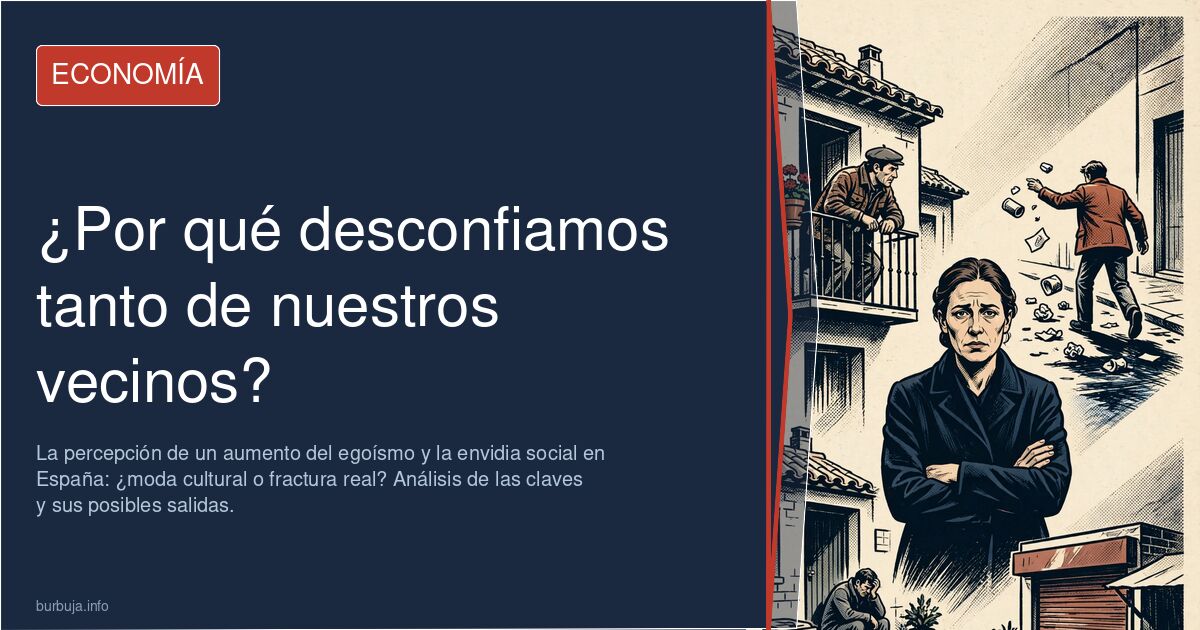
Daily Incivility in Spain: A Portrait of Extreme Individualism
Spain is experiencing a coexistence crisis that many describe as a pressure cooker. Incivility in the workplace, on public transport, or on the street has become normalized to the point where distrust is the norm. The most pessimistic analyses describe a country where 80-85% of the population acts driven by envy or selfishness—a figure that, while based on subjective impressions, reflects a difficult social malaise.
Daily Life as a Battlefield
The complaints trinc a common pattern: people cutting in line, pushing on the bus, blocking doors, or showing up late at work to appear superior. For some, the solution is radical: maintaining no deep affective relationships with anyone, claiming that any display of empathy becomes a weakness exploited by others. The argument is that the environment is so hostile that it is best to develop an emotional armor and respond to incivility with like manner. Distrust also extends to the closest spheres: some recount episodes of betrayal within family or among friends, exacerbating the feeling of isolation.
Envy as a Hidden Driver
Another focus of the debate is envy. The idea that “it’s not about being well, but about others being worse off” summarizes a current view that sees in Spanish society a cultural substratum of bad will. Social media and the workplace become settings where, theoretically, success is celebrated, but in practice, others' downfall is sought. This perspective leads to the analysis that cooperation has been devalued in favor of fierce competition, with direct economic consequences in terms of loss of trust and increased transaction costs.
A Cultural Question or a Historical Cycle?
Some seek cultural roots in classic works: *Lazarillo de Tormes*, *Celestina*, or the Spanish picaresque tradition, where deceit and cunning are presented as ways of survival. The evolution of these archetypes reaches contemporary politics, where some argue that the political class is a mirror of society, reflecting ignorance and irresponsibility. Others believe that this perception of hostility is a historical constant, not a new phenomenon, citing periods like 11-M as a turning point in social cohesion. There is also a current that minimizes the problem: it holds that this attitude is not exclusive to Spain and is observed similarly in other countries, thereby relativizing the diagnosis.
The future of coexistence in Spain is uncertain. If distrust continues to grow, the country could move toward a model of radical individualism that, far from protecting the citizen, isolates them. Analysts warn that in this scenario, collaboration weakens and communal life becomes more expensive and less satisfying. No one seems to have the solution, but the perception that something has broken is increasingly shared.
Summary of a discussion on Burbuja.info - Foro de economía, actualidad y política., translated from Spanish and reviewed before publication. Read the full discussion (119 replies).
More summaries
-
The professions that cashed in on COVID and wouldn't mind another pandemic
An analysis of the sectors that benefited most economically from the COVID-19 pandemic and that might now be interested in a new health crisis.
-
Socialism scores twice the approval of capitalism among US Democrats
Socialism doubles its approval compared to capitalism among US Democrats, according to recent polls. Find out why.
-
Universe 25: the real key to the rat colony's collapse
The Universe 25 experiment showed how overcrowding and chronic stress led to the social collapse of a rat colony. Discover the economic key to its failure.
-
ERC's Gabriel Rufián, 44, turns heads with baggy trousers and denim jacket
The ERC lawmaker, 44, appears in baggy trousers and a slim denim jacket, a look compared to Brad Pitt's, whose jacket cost €7,950.
-
Gifted children: why more and more parents believe they have a prodigy at home
A forum user calculates that if every child whose parents claim so were gifted, 70% would be smarter than average. The label has spiralled out of control.
-
No Christmas this year in the heart of Europe
A viral post claims Australia, France and Germany have cancelled their New Year celebrations over Islamist terrorism. There is no official confirmation.