
Social Cost of Living Alone in a Galician Village
A man moves to rural Galicia, where neighbors interpret his single status as sexual deviance. The social penalty for not pairing up.
English · Original discussion in Spanish · Published
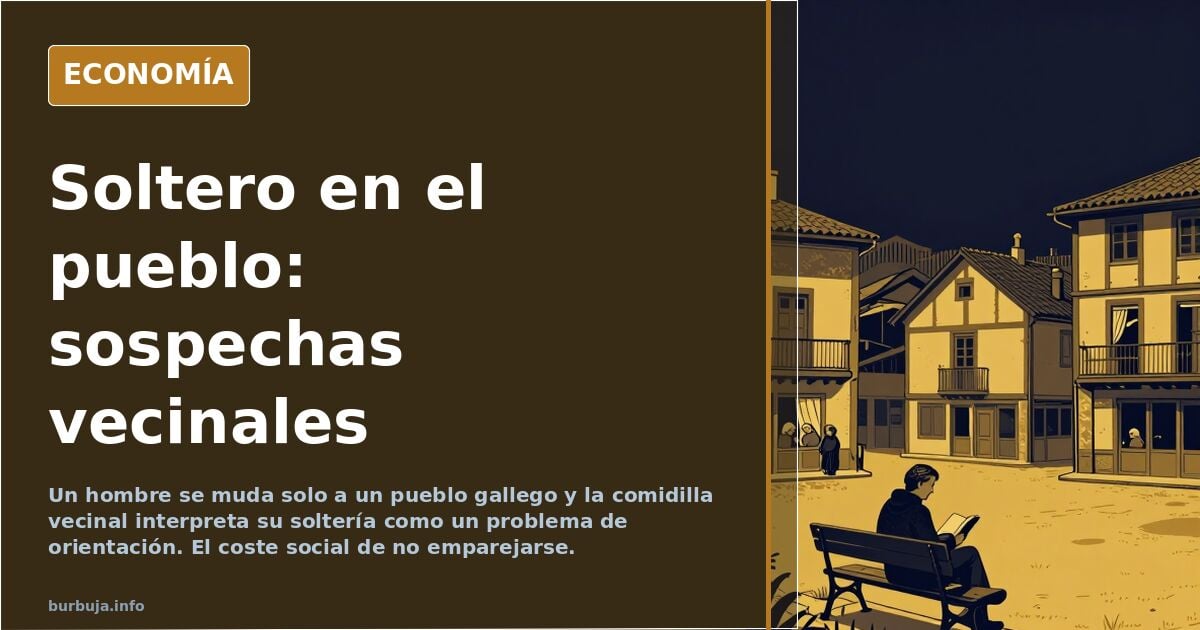
The Social Price of Solitude in Rural Galicia
A man in his fifties sells his Barcelona apartment, buys land and a house in a Galician municipality, and lives alone. Three years later, he notes that women who once flirted with him now marginalize him. Local gossip solved the mystery of his bachelorhood with the simplest hypothesis: he is lgtb. He admits this, preferring travel to A Coruña over dealing with certain neighbors. Beyond the outburst, this describes an old mechanism: in closed environments, breaking norms generates suspicion.
What Happens When You Don’t Pair Up in Small Towns
His story has three acts. First, arrival and courtship: local single or divorced women flirt with him. Second, rejection: he ignores them. Third, social retaliation: they marginalize him. He concludes the community interprets his lack of interest as a sensual orientation issue, not character. "Anyone who doesn't participate is immediately considered a fag," he writes, referring to public opinion. This phrase reflects his perception of others' thoughts, not verified fact.
The thesis isn't original. Several responses suggest no specific assumption about sensual is needed for exclusion. Simply failing to trinc the script suffices. Ostracism requires no explicit accusation, only sustained anomaly. Those who avoid partners, skip celebrations, and give no explanations become conversation topics. Prolonged bachelorhood in villages is a statistical rarity, and rarities are discussed.
Sunday, Potatoes, and the Integration Manual
One highly praised response debates his agricultural schedule, not his orientation. Planting potatoes on Sunday afternoon is deemed unnecessary provocation. "Sunday is sacred; you don't plant potatoes then." The reasoning allows livestock care but condemns tilling land on rest days as an affront to the community. The contributor concludes isolation stems from farming habits, not bedrooms.
This is the most useful contribution because it shifts focus. If the problem were sensual orientation, there would be no remedy. If it’s working while others rest, there is room for adjustment. Other responses emphasize bar-stool sociology: fruta in villages is managed through presence, demonstrated where people gather. Visibility replaces argument.
Half the Neighborhood's Solution: Hire Escorts and Spread Rumors
The most repeated remedy has two versions. The first is obvious: hire company, be seen, and let rumors do their work. "Soon they'll change your label from 'fag' to 'client'," one reply summarizes. The second version involves visiting nearby clubs, greeting neighbors, promising gossip will mysteriously cease.
Counterarguments arrive quickly: rumors accumulate rather than replace. Doing so means carrying both labels. A third, more elaborate option suggests displaying a sheep in the square to prove masculinity. None solve the root problem: validation criteria are set by neighbors, not the individual.
The Real Cost of Moving from Metro Areas to Rural Zones
Beneath the joke lies a measurable economic decision: trading a service-rich city for a two-hundred-inhabitant municipality. He made this switch three years ago, regretting not the property but the neighbors. Housing and land are bought with money; integration is bought with time and unbillable sacrifices.
Some note villages offer more mutual aid but also more social control. Both are true and come together. Outsiders value the first and underestimate the second. When discovering that neighborly solidarity costs permanent private life audits, the contract is already signed.
The issue remains exactly where it started: a man convinced his bachelorhood is an opinion crime in a Galician village, neighbors who said nothing aloud, and many people judging what they’d do without ever having moved.
Also available in: Deutsch
Summary of a discussion on Burbuja.info - Foro de economía, actualidad y política., translated from Spanish and reviewed before publication. Read the full discussion (116 replies).
More summaries
-
A parish's icy silence reveals why rural Spain is emptying out
A post on a Spanish parish's Facebook page sparked a chilling reaction that illustrates the economic cost of social ostracism in small villages and its role in rural depopulation.
-
Latin American vs Muslim integration: economic debate in a Jaén town
Analysis of the debate on integrating Latin American and Muslim communities in a town in Jaén, Spain. What economic and social tensions emerge?
-
Born in a Small Town Without a Surname: The Hidden Cost of Having No Network
Being born in a small Spanish town without rural roots: inherited social capital shapes access to jobs and integration. An analysis of the invisible barriers.
-
Riots in French schools: fires and attacks
Fires in French schools, teachers attacked and blockades spreading to Belgium. The unrest is attributed to the education strike and radical groups.
-
Lavapiés, Madrid: Syringes Return as Taxis Avoid Area at Night
Syringes reappear on Lavapiés sidewalks in Madrid, with taxis reportedly avoiding the area at night amid real estate speculation.
-
Gen Z Rejects Grind Culture in Viral Video
A French Gen Z video sparks debate in Spain, arguing that precarious work fails to provide a livable income.