
Snow Leopard Survives 60-Meter Fall With Goat
A snow leopard falls 60 meters with a goat and survives, highlighting predator risk calculation and physiology.
English · Original discussion in Spanish · Published
The Snow Leopard That Risks a 60-Meter Fall for a Goat
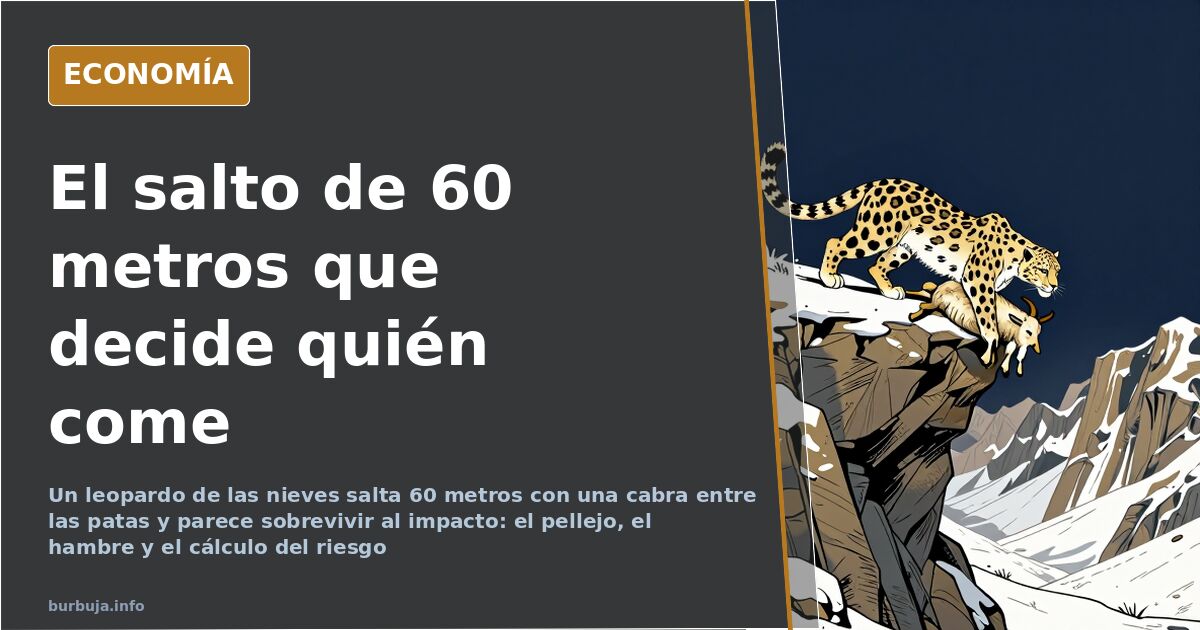
A snow leopard descends a 197-foot rock wall—60 meters for those not using imperial units—with a goat clamped in its paws. The video shared by @Fascinating captures the impact against the slope and the subsequent struggle. The feline never releases its prey during the fall. It appears to survive and, judging by the footage, intends to eat it. The scene resembles an episode of Jackass, but with fangs and no backup camera.
What stands out isn't the animal's recklessness, but the cost in calories and bones of such a jump.
Why Doesn't the Snow Leopard Die Falling From 60 Meters?
Weight works in its favor. According to thread comments, a snow leopard weighs between 25 and 30 kilograms, with much of that mass being thick fur that distributes and cushions the impact. This is the most common explanation: it’s not a car falling, but a bundle of hair and muscle designed to land on rock. Another user notes that the animal knows the terrain, measures the height, and jumps knowing the risks. It’s not recklessness; it’s skill.
The reasonable doubt lies elsewhere. The video is edited for impact, and watching documentaries doesn’t make a 60-meter fall safe practice. Eventually, things go wrong. Mountains don’t forgive.
The Human Body: A Soft Invention
The comparison is natural. As one commenter summarizes, a human would be knocked out by the first hit against rock, requiring no biomechanics expertise to know this. Modest senses, exposed vital parts, no armor, no claws, and little explosive strength: another user lists these physiological shortcomings, which are long and discouraging. Similarly, some argue we are slow, fragile, and soft for our size, possessing only intellect.
This thesis has counterarguments. The thread notes that Cro-Magnon skeletons often show hunting fractures that healed naturally without orthopedics: people broke bones while hunting and returned to the wild. As a species, endurance running surpasses almost any animal, and opposable thumbs allow us to carve rocks, tie them to sticks, and build weapons no claw can match. This tool-making ability made humans apex predators: in North America, Clovis culture is blamed for the continent’s megafauna extinction.
Can Humans Survive a 30-Meter Fall?
Sometimes, yes. In Norway, Ken Stornes, 35, from Harstad and living in Elverum, turns it into routine: he jumps from 30 to 40 meters, three meters from a rock wall. He does it to hit the water, gaining an advantage over stone: fluid yields. He isn’t the only record of absurdly well-resolved falls mentioned. Another user recounts a rabbit surviving a fifth-floor drop by landing on a patio’s terrazzo. Some claim seeing goslings jump entire cliffs without dying.
The difference with the leopard is the margin of error. The feline lands on a slope, not a tiled patio.
Hunger as a Calculator
Here, the recurring joke involves tax authorities. If the IRS chases minimum-wage earners or inspectors catch confused freelancers, swap the predator for the Tax Agency, and the joke holds: the persistence of someone who knows prey won’t escape even if it falls off a cliff. Some place the video in the Economy section to highlight how cheap food is.
Under the humor lies serious cost-benefit logic. Wildlife doesn’t risk for fun; it risks because hunger doesn’t negotiate, and the energy cost of a jump is offset by the caught prey—or nothing else. The other side of this accounting is reproduction, where numbers cited are brutal: according to circulating calculations, a human female had 6 to 8 offspring at best, with only two reaching reproductive age. The rest were consumed along the way.
The goat might not die from the impact. It doesn’t matter: the calorie count is closed, and it pays off.
A snow leopard descends a 197-foot rock wall—60 meters for those not using imperial units—with a goat clamped in its paws. The video shared by @Fascinating captures the impact against the slope and the subsequent struggle. The feline never releases its prey during the fall. It appears to survive and, judging by the footage, intends to eat it. The scene resembles an episode of Jackass, but with fangs and no backup camera.
What stands out isn't the animal's recklessness, but the cost in calories and bones of such a jump.
Why Doesn't the Snow Leopard Die Falling From 60 Meters?
Weight works in its favor. According to thread comments, a snow leopard weighs between 25 and 30 kilograms, with much of that mass being thick fur that distributes and cushions the impact. This is the most common explanation: it’s not a car falling, but a bundle of hair and muscle designed to land on rock. Another user notes that the animal knows the terrain, measures the height, and jumps knowing the risks. It’s not recklessness; it’s skill.
The reasonable doubt lies elsewhere. The video is edited for impact, and watching documentaries doesn’t make a 60-meter fall safe practice. Eventually, things go wrong. Mountains don’t forgive.
The Human Body: A Soft Invention
The comparison is natural. As one commenter summarizes, a human would be knocked out by the first hit against rock, requiring no biomechanics expertise to know this. Modest senses, exposed vital parts, no armor, no claws, and little explosive strength: another user lists these physiological shortcomings, which are long and discouraging. Similarly, some argue we are slow, fragile, and soft for our size, possessing only intellect.
This thesis has counterarguments. The thread notes that Cro-Magnon skeletons often show hunting fractures that healed naturally without orthopedics: people broke bones while hunting and returned to the wild. As a species, endurance running surpasses almost any animal, and opposable thumbs allow us to carve rocks, tie them to sticks, and build weapons no claw can match. This tool-making ability made humans apex predators: in North America, Clovis culture is blamed for the continent’s megafauna extinction.
Can Humans Survive a 30-Meter Fall?
Sometimes, yes. In Norway, Ken Stornes, 35, from Harstad and living in Elverum, turns it into routine: he jumps from 30 to 40 meters, three meters from a rock wall. He does it to hit the water, gaining an advantage over stone: fluid yields. He isn’t the only record of absurdly well-resolved falls mentioned. Another user recounts a rabbit surviving a fifth-floor drop by landing on a patio’s terrazzo. Some claim seeing goslings jump entire cliffs without dying.
The difference with the leopard is the margin of error. The feline lands on a slope, not a tiled patio.
Hunger as a Calculator
Here, the recurring joke involves tax authorities. If the IRS chases minimum-wage earners or inspectors catch confused freelancers, swap the predator for the Tax Agency, and the joke holds: the persistence of someone who knows prey won’t escape even if it falls off a cliff. Some place the video in the Economy section to highlight how cheap food is.
Under the humor lies serious cost-benefit logic. Wildlife doesn’t risk for fun; it risks because hunger doesn’t negotiate, and the energy cost of a jump is offset by the caught prey—or nothing else. The other side of this accounting is reproduction, where numbers cited are brutal: according to circulating calculations, a human female had 6 to 8 offspring at best, with only two reaching reproductive age. The rest were consumed along the way.
The goat might not die from the impact. It doesn’t matter: the calorie count is closed, and it pays off.
Also available in: Deutsch
Summary of a discussion on Burbuja.info - Foro de economía, actualidad y política., translated from Spanish and reviewed before publication. Read the full discussion (131 replies).
More summaries
-
Palma Schools Hit 37°C as Vox Rejects Air Conditioning
Palma classrooms reach 33-37°C. Vox opposes AC in schools, citing 'culture of effort'. Royal Decree 486/1997 sets 27°C max for sedentary work.
-
Spain's Immigration Quota Debate Sparked by Sánchez Family History
Analysis of Pedro Sánchez's grandfather's migration story, highlighting chronological inconsistencies and debates on immigration policy.
-
Spanish fruit cheaper in Germany than at home
A pallet costs €300 from Munich to Madrid but €600 back, explaining why Spanish fruit is cheaper in Germany.
-
Man with record kills ex-partner in Palmeira, Spain
Jhul Príncipe Casahuaman, 25, stabbed his ex-partner in Palmeira after an argument. The case reignites debate on immigration and crime.
-
Feminism and Falling Birth Rates: The Debate
Global birth rates are dropping, turning the diagnosis into a battleground where tax policy, housing, feminism, and pensions clash.
-
Viral Narrative Blames Right-Wing for Maricarmen’s Death
Maricarmen dies before Nov. 29, becoming a political weapon amid unproven accusations and cold electoral calculations.