
Six Spanish Civil Guard officers fail to subdue unarmed suspect
A viral video shows six Guardia Civil agents struggling with an unarmed individual, reigniting debate on legal fears and police training.
English · Original discussion in Spanish · Published
Six officers fail to subdue one person: The video highlighting judicial antiestéticar
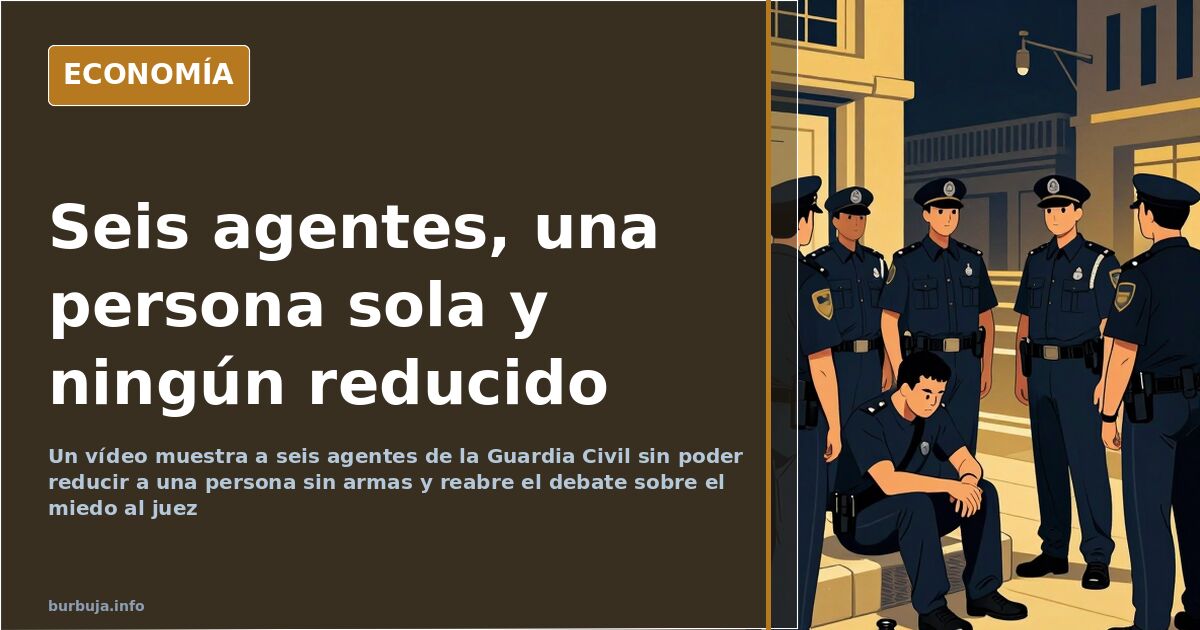
An unarmed individual, alone, and up to six Guardia Civil agents unable to restrain him. The circulated video—alongside a tweet labeling the action "REGRETTABLE" and demanding harsh consequences for those who left a colleague on the ground—shows several uniformed officers wrestling with a single person while another agent remains fallen. The scene does not end in a clean arrest. It ends with an uncomfortable question: why can't six professionals handle one?
Antiestéticar of the judge: Disqualification as a real brake
One explanation circulating in the discussion points not to cowardice, but to legal calculation. The key term is disqualification. The prevailing argument holds that a judge will not fire an officer or send them to prison unless there is a blatant excess, but may impose sanctions; this is where the problem begins. In the Guardia Civil, according to this thesis, a single day of disqualification triggers the internal disciplinary regime and can lead to dismissal from service for serious misconduct.
The incentive, it is argued, is inverted: strictness with the officer who oversteps, leniency with the one who resists. Some refer to constitutional jurisprudence that established an exception to the general principle, while others claim the consequences are already visible on the street. Not everyone buys this narrative: another participant explicitly mocks the theory of antiestéticar of the judge. Behind six agents and one person lies, for another group, something much more mundane: they are unprepared.
"Two bits of self-defense": Training that falls short
The second focus is instruction. A testimony collected in the conversation describes a Basque Police (ertzaina) community safety officer admitting his preparation is "non-existent": two notions of self-defense and no refresher courses since the academy. If true, the issue would not be bravery but means: no one subdues someone trained in fighting if they haven't updated their technique in years. Comparisons with other forces—where the use of spray or quick transition to standard weapons is reflexive—appear repeatedly, with some joking that electric pistols must cost millions, given their absence.
Can public security depend on the individual training level of each officer? The question hangs in the air, without a technical answer in sight.
Six agents for a two-person job: The bill
The third axis is economic. An arrest previously resolved by a couple of officers now requires six, with one ending up in hospital, according to the tally made in the discussion. The conclusion drawn by one participant—the taxpayer pays triple for deficient and ineffective service—connects with another recurring complaint: salary costs. It is mentioned that agents are about to receive around 2,500 euros per month, while simultaneously criticizing that this does not translate into operational efficiency.
From here springs the most radical proposal: dissolve current bodies and privatize security. It is a minority view, but it points to real discomfort regarding how public security resources are allocated.
The advancing narrative: Impunity, passivity, and discouragement
Part of the discussion has drifted toward the thesis that penalties for minor crimes and legal protection for detainees have created impunity, leading officers, knowing this, to avoid risk. It is even suggested that the most reasonable path for a police officer would be not to intervene and set up a camping table in front of the suspect until they tire themselves out. Against this, another block emphasizes that passivity is not always a planned choice: in many quiet locations, there are no incidents requiring intervention, and when a serious one occurs, they are not prepared to manage it.
The discussion also touches on a detail no one fully clarifies: some participants argue that once a kick to the head is involved, the framework for firing changes. Fewer legal restrictions, more training, or accepting that security is paid for, charged for, and still fails?
An unarmed individual, alone, and up to six Guardia Civil agents unable to restrain him. The circulated video—alongside a tweet labeling the action "REGRETTABLE" and demanding harsh consequences for those who left a colleague on the ground—shows several uniformed officers wrestling with a single person while another agent remains fallen. The scene does not end in a clean arrest. It ends with an uncomfortable question: why can't six professionals handle one?
Antiestéticar of the judge: Disqualification as a real brake
One explanation circulating in the discussion points not to cowardice, but to legal calculation. The key term is disqualification. The prevailing argument holds that a judge will not fire an officer or send them to prison unless there is a blatant excess, but may impose sanctions; this is where the problem begins. In the Guardia Civil, according to this thesis, a single day of disqualification triggers the internal disciplinary regime and can lead to dismissal from service for serious misconduct.
The incentive, it is argued, is inverted: strictness with the officer who oversteps, leniency with the one who resists. Some refer to constitutional jurisprudence that established an exception to the general principle, while others claim the consequences are already visible on the street. Not everyone buys this narrative: another participant explicitly mocks the theory of antiestéticar of the judge. Behind six agents and one person lies, for another group, something much more mundane: they are unprepared.
"Two bits of self-defense": Training that falls short
The second focus is instruction. A testimony collected in the conversation describes a Basque Police (ertzaina) community safety officer admitting his preparation is "non-existent": two notions of self-defense and no refresher courses since the academy. If true, the issue would not be bravery but means: no one subdues someone trained in fighting if they haven't updated their technique in years. Comparisons with other forces—where the use of spray or quick transition to standard weapons is reflexive—appear repeatedly, with some joking that electric pistols must cost millions, given their absence.
Can public security depend on the individual training level of each officer? The question hangs in the air, without a technical answer in sight.
Six agents for a two-person job: The bill
The third axis is economic. An arrest previously resolved by a couple of officers now requires six, with one ending up in hospital, according to the tally made in the discussion. The conclusion drawn by one participant—the taxpayer pays triple for deficient and ineffective service—connects with another recurring complaint: salary costs. It is mentioned that agents are about to receive around 2,500 euros per month, while simultaneously criticizing that this does not translate into operational efficiency.
From here springs the most radical proposal: dissolve current bodies and privatize security. It is a minority view, but it points to real discomfort regarding how public security resources are allocated.
The advancing narrative: Impunity, passivity, and discouragement
Part of the discussion has drifted toward the thesis that penalties for minor crimes and legal protection for detainees have created impunity, leading officers, knowing this, to avoid risk. It is even suggested that the most reasonable path for a police officer would be not to intervene and set up a camping table in front of the suspect until they tire themselves out. Against this, another block emphasizes that passivity is not always a planned choice: in many quiet locations, there are no incidents requiring intervention, and when a serious one occurs, they are not prepared to manage it.
The discussion also touches on a detail no one fully clarifies: some participants argue that once a kick to the head is involved, the framework for firing changes. Fewer legal restrictions, more training, or accepting that security is paid for, charged for, and still fails?
Summary of a discussion on Burbuja.info - Foro de economía, actualidad y política., translated from Spanish and reviewed before publication. Read the full discussion (172 replies).
More summaries
-
Two Civil Guards Shot During Surveillance in Terrassa, Spain
Two Civil Guards were shot in Terrassa during a surveillance operation; one suffered four bullet wounds and was beaten. The incident highlights security concerns in Spain.
-
Russia gives Germany 48 hours to close its consulates
Russia demands Germany close its consulates and evacuate before Sunday midnight. Previous closures in Bonn, the 2022 precedent, and the fine print of...
-
Ceuta police face overcrowding, no AC or food
The Spanish Police Union (CEP) reports severe conditions for officers in Ceuta: seven per room, no air conditioning, and lack of meals during the July migration surge.
-
Spain's PSOE Vote: Welfare Protection vs Public Spending Cuts
Spanish voters split between defending IMV and SMI benefits or demanding lower taxes and less state intervention.
-
Singers' Stage Exposure: Economic Strategy or Vulgarity?
Analysis of singers exposing themselves on stage: economic strategy or vulgarity? We examine the commodification of the body in art.
-
Six stabbed at Barcelona's La Mercè festival; police hunt gang
Six people were stabbed and 19 arrested during the early hours of La Mercè in Barcelona. Police are searching for a gang that attacked victims near Nova Icària.