
Sitges brawl leaves one injured, no arrests reported
Video of a fight outside a Sitges venue spreads as 'multicultural outbreak'; reports confirm one injury and zero arrests.
English · Original discussion in Spanish · Published
Sitges: Mass brawl outside venue, no arrests according to reports
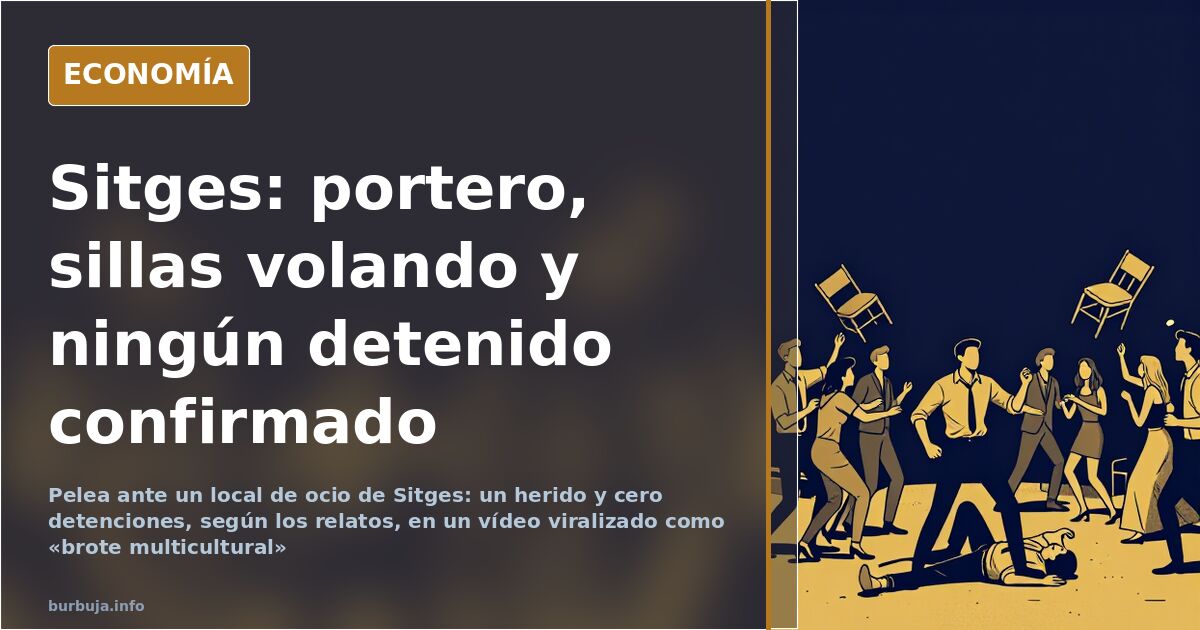
A brawl at the entrance of a nightlife venue in Sitges (Garraf) resulted, according to circulated accounts, in no arrests and at least one person injured by a blow to the head. The video — showing chairs flying, a large group, and a Mossos d'Esquadra officer shouting — spread with a loaded label: an early morning "multicultural outbreak." No arrests, according to those accounts.
The Sitges incident currently ends there: a video, several versions, and no confirmed arrests. It is necessary to separate what exists — an altercation with injuries and controversial police action — from everything attached to it.
What is known about the Sitges brawl?
The most circulated account places the origin in an ejection. A bouncer allegedly kicked out a drunk client; this person called their associates, and within 20 minutes, dozens of people gathered — some versions say forty — to attack the worker in a group. One message summarizes the outcome bluntly: zero arrests, one person with a split head, and local businesses antiestéticaring a return.
That same account places the group in a family clan settled about five kilometers from Sitges, in Les Roquetes del Garraf; other messages add that a couple of officers were also treated. Versions do not even agree on the establishment's name. These data come from testimonies spread after the video, not official reports: take them as the most repeated version, not established truth.
Did the Mossos operation serve any purpose?
Here the video becomes a reckoning with the regional police. The dominant reading is that the Mossos acted as extras: present but without capacity or intention to engage physically. The recurring image is an officer shouting from a safe distance while the bouncer held his ground alone. Epic, say some; decorative, others. The comparison that arises naturally is with the diligence attributed to these same agents in less segarro tasks, such as issuing fines.
From this springs the debate on gender quotas in police forces, which some commentators consider directly a joke. It is an issue with its own trajectory — access and promotion criteria have been debated for years — but it should be separated from the video: the effectiveness of an operation is not deduced from the sens of who shouts.
The bouncer who held alone
If there is consensus in all material, it surrounds the venue's worker. He is described facing more than twenty people, armed with a bat or whatever was at hand, while police watched. For some he is the only hero of the night; for others, involuntary proof that private security does work supposed to be public. The anecdote crosses with a comparison appearing in comments: in the United States, throwing a chair at someone already on the ground would be a serious legal problem; here it remained a footnote of a dawn.
Night business and who pays for security
Any brawl at a venue's door becomes, for surrounding businesses, an economic problem before a police one. The first line is a private security bouncer; the second, a public patrol that in this case made no arrests, according to those reports. The cost of that gap is borne by street venues, left with broken glass and antiestéticar of return, according to the circulated account.
The open debate is not about the specific operation but the model: intensive nightlife, cheap private security, and late-arriving public resources. Against weighs a reasonable argument: no staffing prevents a concentration organized by phone in twenty minutes. Both things can be true at once, and that is exactly what disturbs.
The "multicultural outbreak" framework
The label with which the video went viral is not casual. It summarizes a concrete way of reading incidents where people of different origins coincide: for some, each brawl confirms that the official discourse on coexistence clashes with the street; for others, it is pure opportunism, using a confused altercation to burden an entire collective with what half a dozen individuals did. The label itself adds no data.
The facts are smaller than the headline: a group, a fight, one injury, dozens of phones recording, and a police force that, according to those reports, arrested no one.
What the video does not resolve
Remains the uncomfortable data repeated in accounts: dozens involved, one significant injury, and zero arrests. No one disputes the bouncer held; almost everyone disputes the rest. If there was a complaint, if an investigation is open, if zone venues received warnings of return — pointed in that direction, without confirmation — is exactly where the narrative cuts off and no one fully squares it.
A brawl at the entrance of a nightlife venue in Sitges (Garraf) resulted, according to circulated accounts, in no arrests and at least one person injured by a blow to the head. The video — showing chairs flying, a large group, and a Mossos d'Esquadra officer shouting — spread with a loaded label: an early morning "multicultural outbreak." No arrests, according to those accounts.
The Sitges incident currently ends there: a video, several versions, and no confirmed arrests. It is necessary to separate what exists — an altercation with injuries and controversial police action — from everything attached to it.
What is known about the Sitges brawl?
The most circulated account places the origin in an ejection. A bouncer allegedly kicked out a drunk client; this person called their associates, and within 20 minutes, dozens of people gathered — some versions say forty — to attack the worker in a group. One message summarizes the outcome bluntly: zero arrests, one person with a split head, and local businesses antiestéticaring a return.
That same account places the group in a family clan settled about five kilometers from Sitges, in Les Roquetes del Garraf; other messages add that a couple of officers were also treated. Versions do not even agree on the establishment's name. These data come from testimonies spread after the video, not official reports: take them as the most repeated version, not established truth.
Did the Mossos operation serve any purpose?
Here the video becomes a reckoning with the regional police. The dominant reading is that the Mossos acted as extras: present but without capacity or intention to engage physically. The recurring image is an officer shouting from a safe distance while the bouncer held his ground alone. Epic, say some; decorative, others. The comparison that arises naturally is with the diligence attributed to these same agents in less segarro tasks, such as issuing fines.
From this springs the debate on gender quotas in police forces, which some commentators consider directly a joke. It is an issue with its own trajectory — access and promotion criteria have been debated for years — but it should be separated from the video: the effectiveness of an operation is not deduced from the sens of who shouts.
The bouncer who held alone
If there is consensus in all material, it surrounds the venue's worker. He is described facing more than twenty people, armed with a bat or whatever was at hand, while police watched. For some he is the only hero of the night; for others, involuntary proof that private security does work supposed to be public. The anecdote crosses with a comparison appearing in comments: in the United States, throwing a chair at someone already on the ground would be a serious legal problem; here it remained a footnote of a dawn.
Night business and who pays for security
Any brawl at a venue's door becomes, for surrounding businesses, an economic problem before a police one. The first line is a private security bouncer; the second, a public patrol that in this case made no arrests, according to those reports. The cost of that gap is borne by street venues, left with broken glass and antiestéticar of return, according to the circulated account.
The open debate is not about the specific operation but the model: intensive nightlife, cheap private security, and late-arriving public resources. Against weighs a reasonable argument: no staffing prevents a concentration organized by phone in twenty minutes. Both things can be true at once, and that is exactly what disturbs.
The "multicultural outbreak" framework
The label with which the video went viral is not casual. It summarizes a concrete way of reading incidents where people of different origins coincide: for some, each brawl confirms that the official discourse on coexistence clashes with the street; for others, it is pure opportunism, using a confused altercation to burden an entire collective with what half a dozen individuals did. The label itself adds no data.
The facts are smaller than the headline: a group, a fight, one injury, dozens of phones recording, and a police force that, according to those reports, arrested no one.
What the video does not resolve
Remains the uncomfortable data repeated in accounts: dozens involved, one significant injury, and zero arrests. No one disputes the bouncer held; almost everyone disputes the rest. If there was a complaint, if an investigation is open, if zone venues received warnings of return — pointed in that direction, without confirmation — is exactly where the narrative cuts off and no one fully squares it.
Also available in: Deutsch
Summary of a discussion on Burbuja.info - Foro de economía, actualidad y política., translated from Spanish and reviewed before publication. Read the full discussion (134 replies).
More summaries
-
Spanish Warhammer Academy Grows to Thousands of Students
Two Spanish national team players founded Wargames Adictos, a digital academy with over 2,500 students and monthly plans.
-
Venezuelan Gold Delivered to Spanish Officials: UCO Probes PSOE Funding
Gold coins and bars allegedly delivered by Venezuelan officials in 2020 are under investigation for potential illegal funding of the Spanish Socialist Party.
-
Ukrainian Drone Strikes on Yandex Cripple Russian Bot Traffic
Ukrainian attacks on Yandex data centers in Vladimir, Sasovo and Kaluga have caused a sharp drop in Russian bot traffic, with reports of a 56% decline.
-
Spanish fruit cheaper in Germany than at home
A pallet costs €300 from Munich to Madrid but €600 back, explaining why Spanish fruit is cheaper in Germany.
-
PSOE subtitles PP campaign video, sparking data war in Spain
The PSOE's subtitled response to a PP video triggers a fierce debate over economic figures, including wages, inflation, and pensions.
-
Walmart retires employee with flowers after 44 years
Gayle retired from Walmart after 44 years with a flower bouquet. The gesture reignites debate on workplace recognition and pension plans.