
Sira Rego Confirms Ceuta Minors Will Stay
Sira Rego confirms migrant minors from Ceuta will remain. Costs covered by Personal Income Tax (IRPF); Galicia allocates €2.6 million for regularized immigrants.
English · Original discussion in Spanish · Published
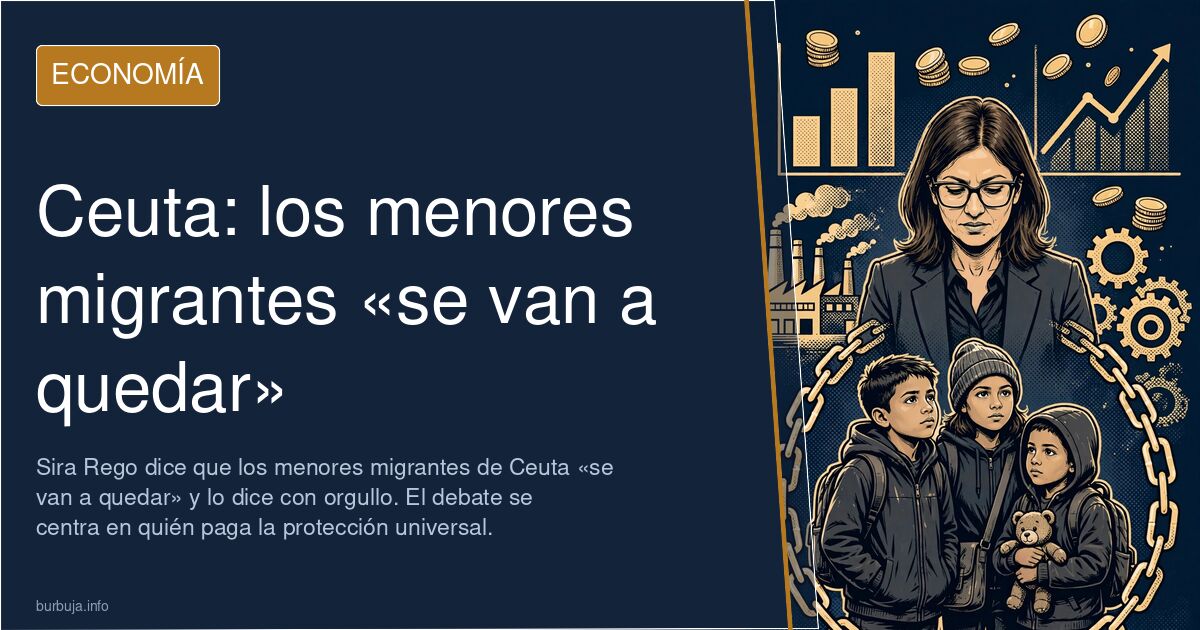
Rego's 'It's a Pride' and the Ceuta Minors' Bill
Who pays for Spain to keep the migrant minors who entered Ceuta? That's the question hovering over every "universal protection" announcement made from an office. Sira Rego, Minister of Youth, settled it with two sentences: "They are going to stay" and "I say it with great pride," according to the clip shared by OKDIARIO. Behind the headline lies an economic discussion that rarely reaches the podium: who signs the check and from which budget line.
What Did Sira Rego Say About the Ceuta Minors?
Rego (Valencia, November 20, 1973) is a nutritionist, a PCE militant, and part of the federal leadership of Izquierda Unida. She was a Member of the European Parliament between 2019 and 2023 and first deputy mayor of Rivas-Vaciamadrid between 2015 and 2019. Since November 2023, she has held the Ministry of Youth portfolio.
There's a detail the political headline often skips: the minister responds to Sumar, not the PSOE, although the announcement was presented as a government-wide initiative. And her key phrase—"in Spain, a child's origin doesn't matter, everyone has the right to universal protection"—is the kind that establishes a position without moving a single euro. The commitment is legal. Funding is another matter.
Who Pays for the Care of Migrant Minors?
The cost is not borne by the announcer but by the taxpayer via IRPF (Personal Income Tax) and by the autonomous communities via transfers. This is where the narrative cracks: a current of analysis holds that this isn't a migration crisis but a transfer of costs from the State to those who still pay the bills. The most repeated formulation: "Money isn't earned, it's collected."
There are three distinct fronts: the guardianship of unaccompanied minors, the administrative controversy over age certification, and the territorial distribution of places. None are resolved by a declaration, but all end up on the same bill.
The Galician Precedent: €2.6 Million for Driving Licenses
While the focus was on Ceuta, another piece of data emerged: the Xunta de Galicia (Galician regional government) is allocating €2.6 million to the employment of regularized immigrants and will pay for driving licenses for those who have obtained regularization. This detail surprises more than a few, especially coming from a party that, in opposition, would have heated up social media with the same issue.
Here, there's no directive against anyone, just accounting: the "investment in employability" by one administration is the "boondoggle" of another. And whoever distributes the budget decides which label to use.
How is the Age of an Unaccompanied Minor Certified?
This is the least segarro yet most cited technical knot. The age determination for unaccompanied minors relies on tests that are not always conclusive, and the margin of doubt determines whether someone falls under guardianship or enters the adult system. Some argue that the lack of homogeneous criteria perpetuates the problem; countered by the fact that no serious protocol can resolve the doubt by decree.
With the bill split between administrations and the narrative divided among ministries, the only truly universal thing, for now, is the discussion.
Who pays for Spain to keep the migrant minors who entered Ceuta? That's the question hovering over every "universal protection" announcement made from an office. Sira Rego, Minister of Youth, settled it with two sentences: "They are going to stay" and "I say it with great pride," according to the clip shared by OKDIARIO. Behind the headline lies an economic discussion that rarely reaches the podium: who signs the check and from which budget line.
What Did Sira Rego Say About the Ceuta Minors?
Rego (Valencia, November 20, 1973) is a nutritionist, a PCE militant, and part of the federal leadership of Izquierda Unida. She was a Member of the European Parliament between 2019 and 2023 and first deputy mayor of Rivas-Vaciamadrid between 2015 and 2019. Since November 2023, she has held the Ministry of Youth portfolio.
There's a detail the political headline often skips: the minister responds to Sumar, not the PSOE, although the announcement was presented as a government-wide initiative. And her key phrase—"in Spain, a child's origin doesn't matter, everyone has the right to universal protection"—is the kind that establishes a position without moving a single euro. The commitment is legal. Funding is another matter.
Who Pays for the Care of Migrant Minors?
The cost is not borne by the announcer but by the taxpayer via IRPF (Personal Income Tax) and by the autonomous communities via transfers. This is where the narrative cracks: a current of analysis holds that this isn't a migration crisis but a transfer of costs from the State to those who still pay the bills. The most repeated formulation: "Money isn't earned, it's collected."
There are three distinct fronts: the guardianship of unaccompanied minors, the administrative controversy over age certification, and the territorial distribution of places. None are resolved by a declaration, but all end up on the same bill.
The Galician Precedent: €2.6 Million for Driving Licenses
While the focus was on Ceuta, another piece of data emerged: the Xunta de Galicia (Galician regional government) is allocating €2.6 million to the employment of regularized immigrants and will pay for driving licenses for those who have obtained regularization. This detail surprises more than a few, especially coming from a party that, in opposition, would have heated up social media with the same issue.
Here, there's no directive against anyone, just accounting: the "investment in employability" by one administration is the "boondoggle" of another. And whoever distributes the budget decides which label to use.
How is the Age of an Unaccompanied Minor Certified?
This is the least segarro yet most cited technical knot. The age determination for unaccompanied minors relies on tests that are not always conclusive, and the margin of doubt determines whether someone falls under guardianship or enters the adult system. Some argue that the lack of homogeneous criteria perpetuates the problem; countered by the fact that no serious protocol can resolve the doubt by decree.
With the bill split between administrations and the narrative divided among ministries, the only truly universal thing, for now, is the discussion.
Summary of a discussion on Burbuja.info - Foro de economía, actualidad y política., translated from Spanish and reviewed before publication. Read the full discussion (159 replies).
More summaries
-
What Business to Start in Ceuta: From Tobacco Shops to Water Taxis
A forum discusses potential businesses in Ceuta, ranging from tobacco shops to funeral homes and water taxis, with one participant claiming 90,000 Africans live there.
-
Euthanasia in Old Age: Autonomy vs. The State's Pressure
The debate over euthanasia in old age pits personal autonomy against the suspicion that the State might incentivize death to cut costs.
-
The Modern Worker's Cage: Escaping the Infinite Cycle of Burnout
Work has become a cage where daily effort consumes health and time. Discover why we push ourselves so hard and how to break the cycle.
-
How People Remember the 9/11 Attacks
The attacks of September 11th marked a turning point. Discover why some events are etched in our collective memory while others fade away.
-
Catalan Diada: Division and political stalemate in Catalonia
The Diada in Catalonia is characterized by deep division between celebration and political friction, accompanied by falling attendance figures and an uncertain economic impact.
-
Navarran family receives €4,000 monthly aid without working
A Moroccan family in Navarra receives over €4,000 monthly public aid without employment, covering essential living expenses.