
Sinwar's Death Sparks Debate on Honor and Propaganda
The release of footage showing wounded Hamas leader Yahya Sinwar throwing a stick at a drone has reignited discussions on honor, propaganda, and narrative control in the Israel-Gaza conflict.
English · Original discussion in Spanish · Published
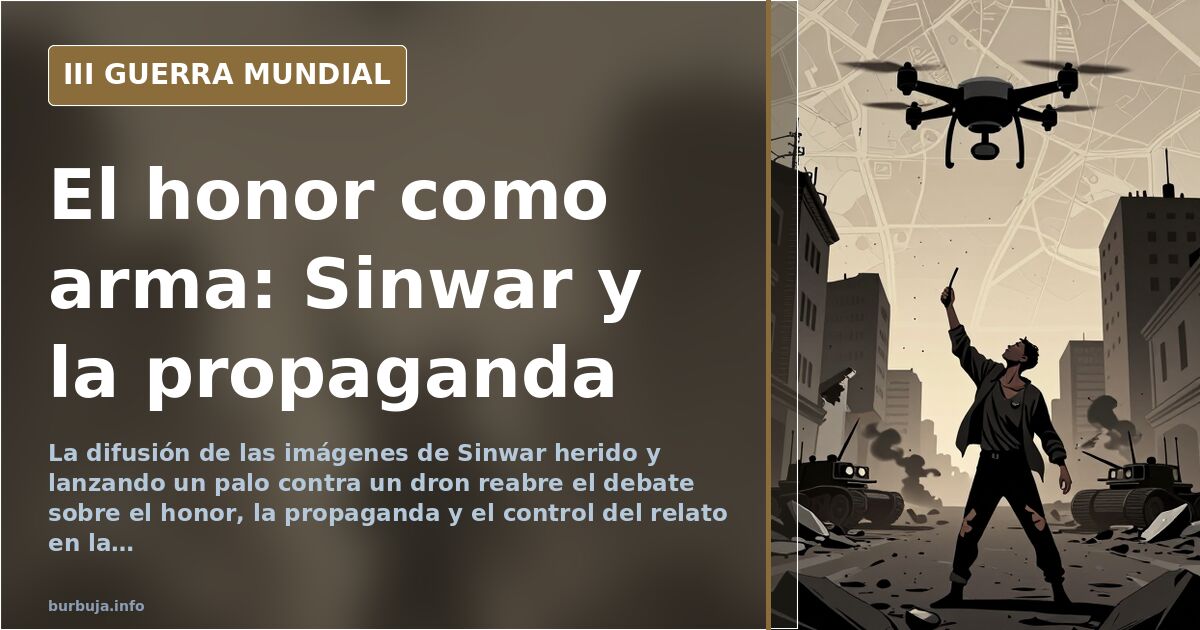
Honor as a Weapon: The Narrative Around Sinwar's Death
The death of Yahya Sinwar, the Hamas leader in Gaza, has peine an uncomfortable debate: what is gained by displaying images of a cornered man who, wounded and unarmed, throws a stick at a drone? The response circulating in certain circles is that disseminating these images does not humiliate him but rather constructs a martyr. The scene, captured by an unmanned device, shows a lone fighter sitting and waiting for the end. For some, it proves humiliating defeat; for others, it confirms stubborn resistance until the last breath.
The issue transcends Sinwar’s specific figure. What is being decided is who controls the narrative of violent death in an asymmetric conflict, and whether the concept of honor still fits into a war fought with remote technology.
What do the released images of Sinwar show?
The circulating material, recorded by a drone, presents an older, wounded man in what appears to be a ruined building. There is no surrender. According to accounts accompanying the images, the individual throws an object—described as a stick—at the filming device. Shortly after, according to those same versions, the building is bombed and the body is found among the rubble.
The sequence has been interpreted in two opposite ways. Some observers argue it was a painful death, that of someone hiding who was killed without causing casualties at the final moment. Another current argues the contrary: that the scene, precisely due to its starkness, turns the deceased into a symbol of resistance. The calculation is simple: if the goal was demoralization, the effect may have been the inverse.
Parallels with other fallen leaders
Comparison with previous episodes arises immediately. The deaths of Bin Laden and Saddam Hussein generated similar controversies over the veracity and appropriateness of displaying evidence. In this case, some point out that publishing the images responds to the need to prevent denial of the death, a pattern repeated in recent conflicts.
The problem is that this logic can backfire against those who apply it. Displaying a cornered enemy does not always produce the intended deterrent effect. Sometimes it produces the opposite: fixing an image in collective memory and turning it into an icon.
The gap between two conceptions of honor
The core of the disagreement is cultural, not tactical. Some argue that the concept of honor, as understood in much of the world, has no equivalent in the adversary’s political and religious tradition. Others reply that this supposed absence is prejudice, and that what is missing is the willingness to recognize it.
The result is a clash of mental frameworks. For some, dying while fighting has intrinsic value, regardless of the cause. For others, that reading romanticizes a incivil. And in the middle, an uncomfortable question: can a society judge another’s honor without applying its own biases?
Human cost and conflict asymmetry
Beyond symbolism, the numbers used in the debate are rough and difficult to verify. Thousands of dead are reported in Gaza, mostly civilians, compared to a much lower number of Israeli victims. This asymmetry is the central argument for those labeling the operation genocide, a term others flatly reject.
In this context, the discussion on honor risks becoming a smokescreen. Behind the images of a man throwing a stick lies a much harsher reality: a trapped population, destroyed infrastructure, and a conflict with no horizon for resolution.
The role of propaganda and war narratives
Both sides use images as ammunition. One side disseminates them to show the enemy’s weakness; the other reworks them to construct a martyr. The underlying question is whether anyone truly controls the message in a war of narratives.
Historical experience suggests no. The most powerful images escape their senders and take on a life of their own. What today is presented as proof of defeat may tomorrow become a poster of resistance. It is a risk that those disseminating such material should weigh.
Conclusion: A symbol nobody fully controls
If anything, this episode demonstrates that modern war is fought as much on screens as on the ground. The death of a leader can be a tactical blow and, simultaneously, a propaganda gift for the opposing cause. Predicting which effect will weigh more is risky. Judging by precedents, it is likely that the image will endure and each side will interpret it according to their needs.
Summary of a discussion on Burbuja.info - Foro de economía, actualidad y política., translated from Spanish and reviewed before publication. Read the full discussion (112 replies).
More summaries
-
Israel kills Hamas leader Sinwar in Gaza
Yahya Sinwar, Hamas's Gaza chief, reportedly killed by Israel. The strike removes key operational command, sparking debate on succession and conflict impact.
-
Gaza viral video: tears, propaganda and unverified claims
A viral clip of a Palestinian grieving a bombing is shared with an unverified claim that he previously celebrated Israeli deaths.
-
Debate on polyurethane foam to seal Gaza tunnels
A forum discusses using expanding polyurethane foam to block Hamas tunnels in Gaza, alongside alternatives like pressurized water and sewage.
-
Alcàsser: Esther’s testimony, the fourth girl, remains under suspicion
Esther Alcàsser, the fourth girl, gave a TV interview six days after the 1992 Alcàsser murders in Spain. Her account and timeline discrepancies fuel ongoing controversy.
-
Brussels buries Nord Stream even if the war ends
The European Commission rules out Nord Stream's return even after the war, as concern grows over the cost of American gas and the resulting bill.
-
Spanish password manager Passwork shares tech ties with Russian counterpart
The Russian company linked to Passwork was certified by an agency of the Russian Ministry of Defense that reviews source code. The Spanish firm denies any relationship.