
Single Women Over 30: The Biological Clock Debate
Average maternity age is around 36, yet some claim women lose appeal after 30.
English · Original discussion in Spanish · Published
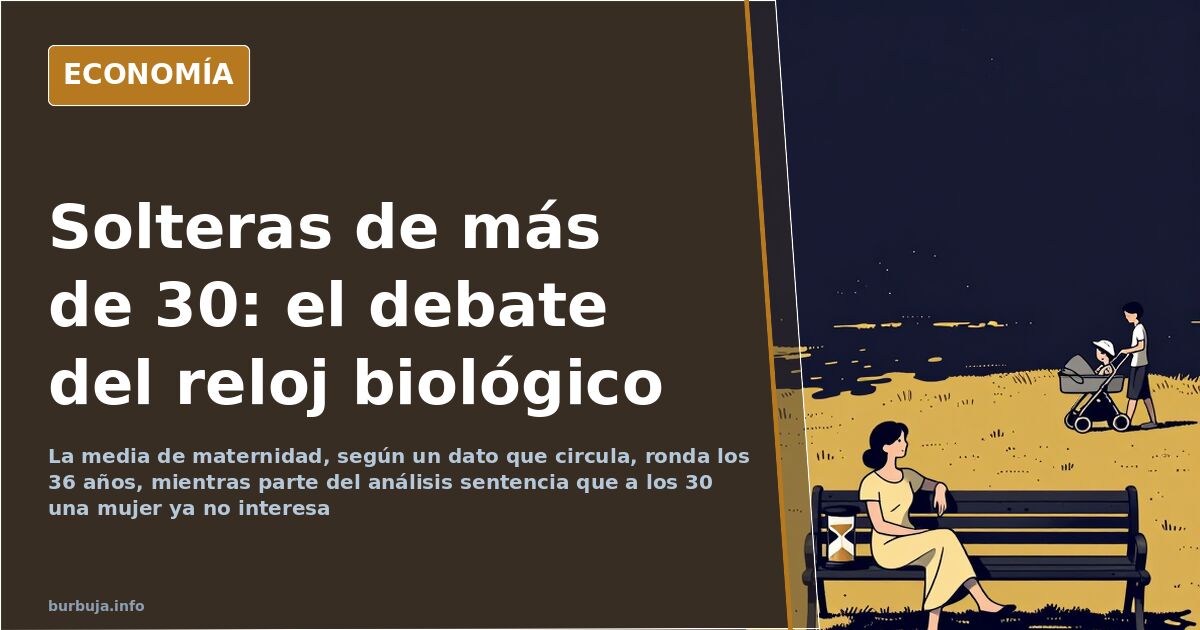
Single Women Over 30: From Ideal to Divisive Calculation
Three attributes — good looks, education, independent income — and an outcome that many read as failure: being one of those single women over 30 who thrive professionally but lack a partner. The opening thesis goes straight to the point: feminism allegedly convinced generations that career and money were the goals, while the promised model — a good man, a family — was left behind. The rebuttal trinc quickly. An attractive thirty-year-old woman, it is argued, remains a highly sought-after prospect. And there the debate turns toxic.
The core issue is not so much beauty as timing. Some define the female window between ages 14 and 28, and the male one from 32 onwards. With that graph in hand, turning thirty would mark the start of decline. Others dismiss this as statistical fantasy: with current life expectancy, thirty is just early youth. The biological clock appears in nearly every message, but each side interprets it to their advantage.
70% Female Presence in Justice, Health, or Education
The most circulated data point is the average age of maternity, hovering around 36 years, according to debaters, compared to grandparents who reportedly had children near 30. For some, this confirms the window has narrowed and waiting carries a cost; for others, it dismantles the narrative, because if the average is 36, those having children at 30 are not late, they are ahead.
The discussion drifts toward the past. It is recalled that a century ago, children arrived when parents were nearly 30, despite much lower life expectancy. Some contrast this figure with the argument that biology cannot be negotiated. The number 36 sits uncomfortably with the idea that thirty is the point of no return.
70% Female Presence in Justice, Health, or Education
Another block focuses on the labor market. There are sectors where female presence reaches or exceeds 70%: justice, pharmacy, healthcare, education, and administration, according to data exchanged in the conversation. If women are the majority in stable, qualified sectors like these, the "trap" theory clashes with measurable reality: they have gained ground in salaried jobs.
What they haven't gained, others retort, is a partner. Here enters the bitterest calculation: those with education, salary, and high expectations raise their bar and narrow their market. "There is no prince for so many princesses," summarizes one comment. The dating market, they insist, does not work like the job market; improving your CV guarantees nothing.
The Other Side: Men Without Options
The counterpoint comes from the other side of the mirror. A 30-year-old woman with attractiveness and status has, it is argued, thousands of candidates around her, many equally educated and visually appealing. The contempt verbalized by some stems, according to its proponents, from the resentment of those who never had options and project their frustration onto those who do.
Also circulating is the idea that many accumulated casual relationships in their twenties and reach thirty with a history that some use as reproach. This is a sarracena judgment, not data, and admits no measurement.
That discomfort has a name abroad: men's movements that renounce seeking partners as a reaction to what they consider a system that penalizes them. In the conversation, they are cited as a minority phenomenon, lacking economic muscle and organizational capacity, though symptomatic of something larger.
The Theory of the Elite That Designed It All
Some attribute the whole situation to a deliberate plan by elites who allegedly pushed women into the labor market to socially devalue them. This claim rests on distrust, not evidence, and functions as a circular closure: any contradicting data is read as part of the manipulation. To be clear: this thesis is not supported by any evidence.
What is verifiable is the disconnect. Female singlehood ceases to be an anomaly and becomes the center of debate, and the numbers used — 36 years average, professionalized sectors, ages of first maternity — are the same ones each side uses to win the argument.
If the average maternity age has risen to 36 while simultaneously claiming that at 30 a woman "no longer interests," the two things do not fit: most births would occur in the very timeframe some declare exhausted. No one has yet explained how this squares.
Three attributes — good looks, education, independent income — and an outcome that many read as failure: being one of those single women over 30 who thrive professionally but lack a partner. The opening thesis goes straight to the point: feminism allegedly convinced generations that career and money were the goals, while the promised model — a good man, a family — was left behind. The rebuttal trinc quickly. An attractive thirty-year-old woman, it is argued, remains a highly sought-after prospect. And there the debate turns toxic.
The core issue is not so much beauty as timing. Some define the female window between ages 14 and 28, and the male one from 32 onwards. With that graph in hand, turning thirty would mark the start of decline. Others dismiss this as statistical fantasy: with current life expectancy, thirty is just early youth. The biological clock appears in nearly every message, but each side interprets it to their advantage.
70% Female Presence in Justice, Health, or Education
The most circulated data point is the average age of maternity, hovering around 36 years, according to debaters, compared to grandparents who reportedly had children near 30. For some, this confirms the window has narrowed and waiting carries a cost; for others, it dismantles the narrative, because if the average is 36, those having children at 30 are not late, they are ahead.
The discussion drifts toward the past. It is recalled that a century ago, children arrived when parents were nearly 30, despite much lower life expectancy. Some contrast this figure with the argument that biology cannot be negotiated. The number 36 sits uncomfortably with the idea that thirty is the point of no return.
70% Female Presence in Justice, Health, or Education
Another block focuses on the labor market. There are sectors where female presence reaches or exceeds 70%: justice, pharmacy, healthcare, education, and administration, according to data exchanged in the conversation. If women are the majority in stable, qualified sectors like these, the "trap" theory clashes with measurable reality: they have gained ground in salaried jobs.
What they haven't gained, others retort, is a partner. Here enters the bitterest calculation: those with education, salary, and high expectations raise their bar and narrow their market. "There is no prince for so many princesses," summarizes one comment. The dating market, they insist, does not work like the job market; improving your CV guarantees nothing.
The Other Side: Men Without Options
The counterpoint comes from the other side of the mirror. A 30-year-old woman with attractiveness and status has, it is argued, thousands of candidates around her, many equally educated and visually appealing. The contempt verbalized by some stems, according to its proponents, from the resentment of those who never had options and project their frustration onto those who do.
Also circulating is the idea that many accumulated casual relationships in their twenties and reach thirty with a history that some use as reproach. This is a sarracena judgment, not data, and admits no measurement.
That discomfort has a name abroad: men's movements that renounce seeking partners as a reaction to what they consider a system that penalizes them. In the conversation, they are cited as a minority phenomenon, lacking economic muscle and organizational capacity, though symptomatic of something larger.
The Theory of the Elite That Designed It All
Some attribute the whole situation to a deliberate plan by elites who allegedly pushed women into the labor market to socially devalue them. This claim rests on distrust, not evidence, and functions as a circular closure: any contradicting data is read as part of the manipulation. To be clear: this thesis is not supported by any evidence.
What is verifiable is the disconnect. Female singlehood ceases to be an anomaly and becomes the center of debate, and the numbers used — 36 years average, professionalized sectors, ages of first maternity — are the same ones each side uses to win the argument.
If the average maternity age has risen to 36 while simultaneously claiming that at 30 a woman "no longer interests," the two things do not fit: most births would occur in the very timeframe some declare exhausted. No one has yet explained how this squares.
Summary of a discussion on Burbuja.info - Foro de economía, actualidad y política., translated from Spanish and reviewed before publication. Read the full discussion (161 replies).
More summaries
-
UNIR Responds to Those Claiming They Are Its Professor: No Evidence Found
UNIR responds to those claiming they are its professor after insults were hurled at a user on X: there is no record that they are an employee.
-
Young Man Fired for Mocking Puerta del Sol Protesters
A young man was fired after a viral video mocked Puerta del Sol protesters as lazy. The case sparks debate on fair dismissal and free speech in Spain.
-
Plane Myth: Confusing Inertia with Wind in Spain
Earth rotates at 1,600 km/h and planes fly at 840 km/h. The error is forgetting that air rotates with the planet.
-
Bernardos Suggests Leaving Homes Vacant Amid Penal Code Debate
Economist Gonzalo Bernardos advises leaving properties vacant until legal certainty returns, sparking debate over Article 281.1 of the Spanish Penal Code.
-
Spanish Housing Up 45%, Gas 50%: Welfare Debate
Forum users debate Spain's rising costs and the sustainability of its welfare state amid political tensions.
-
Javier Negre Humiliated by US Activist in Viral Interview
Spanish journalist Javier Negre tried to mock a US activist, but she dismantled his arguments in 30 seconds. The video he posted went viral.