
Single urban women in their 30s and 40s: wages that no longer cover rent in Spain
Precarious wages, market-rate rents and divorce are pushing Spanish urban women in their 30s and 40s into flatshares. A salary no longer covers living alone.
English · Original discussion in Spanish · Published
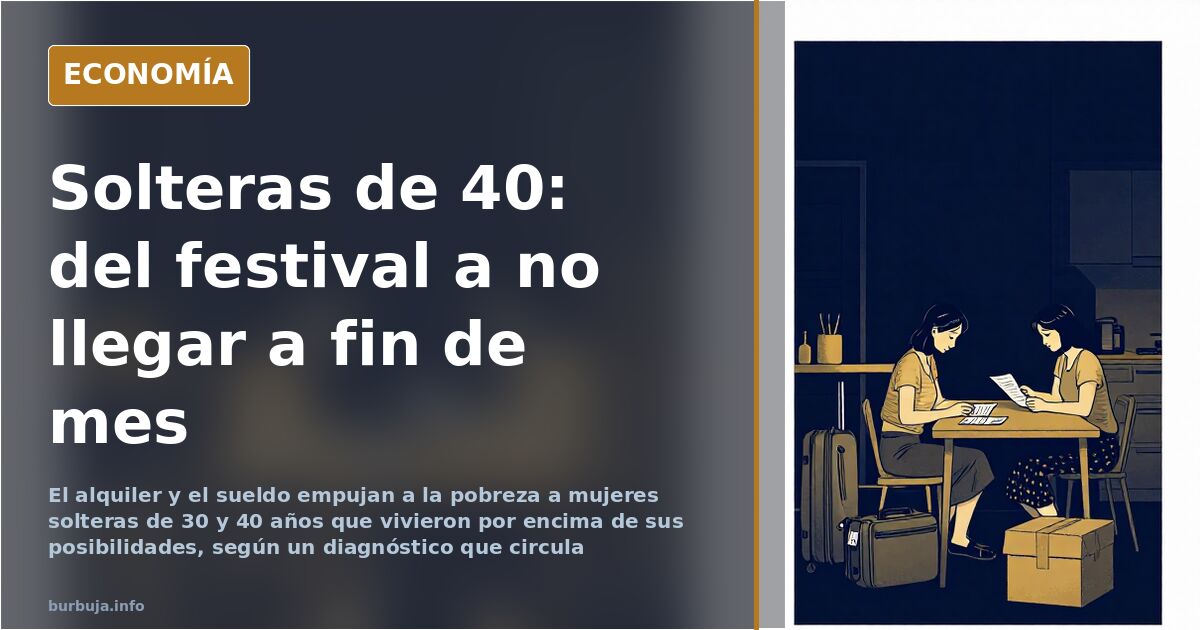
When your salary no longer covers rent: the economic hangover of female singlehood
There is a scene that repeats itself on the terraces of any Spanish city, and it is no longer what it used to be. Women who four or five years ago were juggling trips, festivals and dinners on someone else's tab are now sharing flats, staying in and counting the days to payday. This is not dinner-table anecdote: it is a pattern taking hold among urban women in their 30s and 40s, and it has three proper names —wages, rent and divorce— operating as a triumvirate that shows no mercy.
The diagnosis making the rounds is blunt: a mass of women around 40 with everything spent, no savings and no family safety net, returning to the shared housing market just as their earning power stalls. The question is not whether it is happening, but how much of it is a structural phenomenon and how much a self-serving narrative.
A salary that falls short for a one-person home
The arithmetic is unforgiving. A precarious salary and a market-rate rent cannot fit into the same payslip without something breaking. And what breaks is the project of living alone. For years, that gap was bridged by an informal network of treats —dinners, drinks, getaways— that worked as a hidden subsidy for women's leisure. When that network runs dry, the void appears.
The pattern described trinc a recognizable sequence: first leisure gets cut, then comes flatsharing, and finally the search for a partner becomes urgent. Not out of romance, but out of the need for a second income. Some put it bluntly: people no longer ask for dinners or experiences, they ask for help with the rent.
Divorce as an accelerator of the fall
Divorce appears in this account as the most frequently cited trigger. After a separation, the standard of living is divided but the fixed costs are not. Someone who lived in a flat with the rent split in two discovers that alone, she cannot sustain it. And here a factor comes into play that the debate stresses insistently: the lack of financial planning. Against a male pattern that, the argument goes, tends to secure a roof and some savings, it describes a mass of women who reached 40 with no cushion.
The comparison is debatable, and the material itself half admits it. Not every case fits: there are divorced businesswomen with assets of their own, single mothers with a house and a salary, and profiles that break the mold. But the dominant narrative insists on the stereotype of a carousel winding down with no safety net beneath it.
The dating market as a housing market
The most uncomfortable twist is how the search for a partner blends with the search for solvency. It describes the strategy of mentioning on a first date that your flat is paid off and watching how the other person's attitude changes. The reaction, the story goes, is immediate: more interest, more attention, more enthusiasm for the conversation.
That turns the date into a disguised real-estate negotiation. And on the other side, the openly stated antiestéticar is ending up financing a life you did not choose. The result is a market where both sides do the math, and where mutual distrust feeds on itself.
The demographic figure under dispute
Beneath the noise there is a figure that frames the debate: 200,000 fewer births in 2025 than in 2008, according to a calculation circulating in the thread. Compressed wages, scarce housing and three million more inhabitants over the past five years sketch out a country where starting a family or living alone has become a luxury. Late female singlehood is not the cause; it is one of the visible consequences.
The prediction, with every caveat, is that the phenomenon will not fix itself. As long as rent keeps eating the paycheck and saving remains a privilege, there will be more flatshares at 45 and more dates that start by talking about mortgages. Whether that is empowerment or a simple hangover is for the reader to decide.
Also available in: Deutsch
Summary of a discussion on Burbuja.info - Foro de economía, actualidad y política., translated from Spanish and reviewed before publication. Read the full discussion (425 replies).
More summaries
-
The math comparing the cost of a girlfriend with paying for sex
A calculation circulating on a forum compares the cost of a girlfriend, a wife and a divorce with paying for encounters: 81,000 euros versus 51,000 over five years.
-
Ukrainian Drone Strikes on Yandex Cripple Russian Bot Traffic
Ukrainian attacks on Yandex data centers in Vladimir, Sasovo and Kaluga have caused a sharp drop in Russian bot traffic, with reports of a 56% decline.
-
€2,454 a month in benefits for a family of six children in Vitoria, Spain
A family with six children receives €2,454.18 a month in benefits in Vitoria, Spain, and now faces eviction after five years of litigation with the landlord.
-
Navarra, Spain: family with two children receives €4,000 a month in benefits
A family with two children in Navarra, Spain, receives over €4,000 a month in subsidies and pays just €125 in social rent, according to a calculation published by economist Gonzalo Bernardos.
-
Spain's minimum income scheme: no counter to charm, only online forms
Spain's IMV minimum income is not granted by talking to a clerk: it must be applied for online with a digital certificate, and the file is cross-checked by the Tax Agency and Social Services.
-
What Spain faces if Perro Xanse stays in Moncloa
Public debt nears €35,399 per Spaniard and buying a home costs 74% more than in 2018. These are the figures that sum up the term.