
Single missile won't sink carrier, data suggests
Modern carriers withstand 5-meter impacts. Sinking requires multiple missiles. Iran tensions reignite the debate on naval defense saturation.
English · Original discussion in Spanish · Published
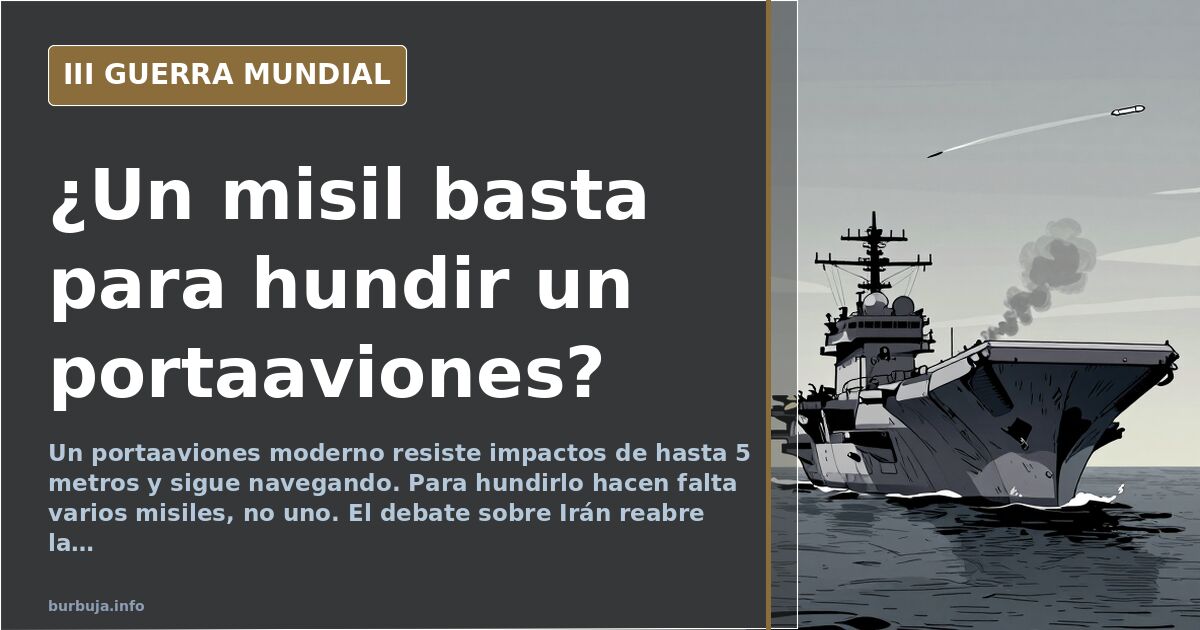
One shot isn't enough to sink an aircraft carrier
Can a single missile send a modern aircraft carrier to the bottom? The short answer is no. The long answer depends on impact location, payload, and defenses. This issue, fiercely debated amid tensions with Iran, has more facets than it seems. According to one participant in the discussion, current carriers are compartmentalized to withstand impacts up to five meters in diameter and keep sailing. To sink such a beast, you need several heavy hits, not just one.
USS Franklin and USS Bunker Hill survived much greater damage in WWII and returned home under their own power, according to the same participant. That is the precedent cited. The key isn't hole size, but compartmentalization and crew ability to contain flooding. A hit on the flight deck can disable air operations without sinking the ship. And here another debate arises: Is rendering it useless enough?
The psychological blow of a hole in the deck
Some argue that sinking the carrier isn't necessary. Just opening a hole in the runway prevents planes from taking off or landing. The ship becomes a 300-meter bathtub. The psychological blow for the crew and the world would be immense. The question is whether anyone is willing to bear the cost of trying.
According to arguments made in the debate, the defense of a carrier strike group is formidable. Aegis destroyers, E-2 early warning aircraft, P-8s, combat air patrols, and fleet anti-air missiles form multiple layers. A subsonic missile like the Tomahawk would have to peine all that. A hypersonic missile like the Zircon, if it works as claimed, is another matter. That's the crux.
What does it take to sink an aircraft carrier?
As argued, sinking an aircraft carrier requires several heavy hits, not one. A hypersonic missile with a nuclear warhead and vertical descent cannot be stopped by anything, according to one of the most repeated views. Two make it even harder. But that is no longer a single shot; it is escalation. And escalation has consequences.
Another school warns that the resulting nuclear contamination would be immense. It’s not just the ship: it’s the marine ecosystem, currents, and fishing. A Kinzhal detonated 500 meters above target devastates everything below, according to circulating calculations. The fact that this still needs explaining is ironic.
Argentine precedent and drone saturation
In real life, the only ones since WWII to hit an aircraft carrier (a small one, admittedly) were the Argentines, and they failed to sink it, according to a participant. That is the data point. Another view suggests that saturation attacks with hundreds of cheap drones and missiles could collapse destroyer and corvette defenses. After an hour or two of exhausting defenses, a direct hit on the belly trinc. The theory sounds good. Practice is different.
Supercavitating torpedoes, those that don’t officially exist, are another mentioned threat. A well-placed modern torpedo can split a ship at the keel. But getting close enough is impossible against a deployed fleet. That’s the problem.
Missile cost vs. carrier cost
Is a missile easier to detect and shoot down than a plane launching from a strike group? That’s a tricky question. As argued, a missile is more expensive, less adaptable, and carries less payload than a guided bomb. But it doesn’t need a pilot or a runway. Aviation remains essential, manned or unmanned. The balance between cost and effectiveness is what’s at stake.
Iran doesn’t have Su-57s, it is stated. It can only deploy Vietnam-era Phantoms, relics that wouldn’t survive an assault. The Iranian Air Force is paper, according to that view. All it has to strike a carrier are three submarines and limited-range missiles, the same participant notes. And the carrier doesn’t stay put: it moves, and without Russian or Chinese satellite guidance, the Iranians would be blind.
Russia and China’s role on the board
Russia is the first interested in an attack on Iran: oil prices rise and a competitor in crude sales to China is eliminated, a participant argues. Russia already had what it could extract from the Iranians years ago regarding drone technology. Currently, all drones thrown in Ukraine are Made in Siberia. Iran saved Russia’s skin three years ago by providing Sheds in bulk, but now those are manufactured in Novosibirsk and Tula in superior quantities.
China, meanwhile, watches from the sidelines. It wants a weakened but not sunk Iran. The balance is delicate. And no one wants to make the first move.
Estimulante ilegal and inertia issues
At 12,000 km/h, how does a missile zigzag? They’ve read Newton’s laws, but inertia is a stubborn force, the debate asks. One change of direction confuses a radar calculating a parabola. Several changes drive it crazy. The secret of hypersonic missiles isn’t maneuverability, but material resistance and guidance through the plasma layer, it is argued. That is what has been achieved.
The key lies in how sensors function with a plasma layer around them. That separates an operational hypersonic missile from a lab prototype. The button pressed was materials, not aerodynamics, according to that stance.
Thermal exhaust port and surface trench
You just need to hit the thermal exhaust port at the end of a surface trench. That’s the key, according to one of the most repeated theories. A hit there could trigger a chain reaction. But hitting that spot on a ship moving at 30 knots and protected by an entire fleet is another matter. That’s the challenge.
A current aircraft carrier can sail perfectly with a five-meter diameter hole, it is argued. It is compartmentalized precisely to withstand such impacts. To sink it, you need several heavy hits. And to land them, you must overcome defenses. The question isn’t if a missile can sink a carrier, but if anyone is willing to pay the price to try.
Can a single missile send a modern aircraft carrier to the bottom? The short answer is no. The long answer depends on impact location, payload, and defenses. This issue, fiercely debated amid tensions with Iran, has more facets than it seems. According to one participant in the discussion, current carriers are compartmentalized to withstand impacts up to five meters in diameter and keep sailing. To sink such a beast, you need several heavy hits, not just one.
USS Franklin and USS Bunker Hill survived much greater damage in WWII and returned home under their own power, according to the same participant. That is the precedent cited. The key isn't hole size, but compartmentalization and crew ability to contain flooding. A hit on the flight deck can disable air operations without sinking the ship. And here another debate arises: Is rendering it useless enough?
The psychological blow of a hole in the deck
Some argue that sinking the carrier isn't necessary. Just opening a hole in the runway prevents planes from taking off or landing. The ship becomes a 300-meter bathtub. The psychological blow for the crew and the world would be immense. The question is whether anyone is willing to bear the cost of trying.
According to arguments made in the debate, the defense of a carrier strike group is formidable. Aegis destroyers, E-2 early warning aircraft, P-8s, combat air patrols, and fleet anti-air missiles form multiple layers. A subsonic missile like the Tomahawk would have to peine all that. A hypersonic missile like the Zircon, if it works as claimed, is another matter. That's the crux.
What does it take to sink an aircraft carrier?
As argued, sinking an aircraft carrier requires several heavy hits, not one. A hypersonic missile with a nuclear warhead and vertical descent cannot be stopped by anything, according to one of the most repeated views. Two make it even harder. But that is no longer a single shot; it is escalation. And escalation has consequences.
Another school warns that the resulting nuclear contamination would be immense. It’s not just the ship: it’s the marine ecosystem, currents, and fishing. A Kinzhal detonated 500 meters above target devastates everything below, according to circulating calculations. The fact that this still needs explaining is ironic.
Argentine precedent and drone saturation
In real life, the only ones since WWII to hit an aircraft carrier (a small one, admittedly) were the Argentines, and they failed to sink it, according to a participant. That is the data point. Another view suggests that saturation attacks with hundreds of cheap drones and missiles could collapse destroyer and corvette defenses. After an hour or two of exhausting defenses, a direct hit on the belly trinc. The theory sounds good. Practice is different.
Supercavitating torpedoes, those that don’t officially exist, are another mentioned threat. A well-placed modern torpedo can split a ship at the keel. But getting close enough is impossible against a deployed fleet. That’s the problem.
Missile cost vs. carrier cost
Is a missile easier to detect and shoot down than a plane launching from a strike group? That’s a tricky question. As argued, a missile is more expensive, less adaptable, and carries less payload than a guided bomb. But it doesn’t need a pilot or a runway. Aviation remains essential, manned or unmanned. The balance between cost and effectiveness is what’s at stake.
Iran doesn’t have Su-57s, it is stated. It can only deploy Vietnam-era Phantoms, relics that wouldn’t survive an assault. The Iranian Air Force is paper, according to that view. All it has to strike a carrier are three submarines and limited-range missiles, the same participant notes. And the carrier doesn’t stay put: it moves, and without Russian or Chinese satellite guidance, the Iranians would be blind.
Russia and China’s role on the board
Russia is the first interested in an attack on Iran: oil prices rise and a competitor in crude sales to China is eliminated, a participant argues. Russia already had what it could extract from the Iranians years ago regarding drone technology. Currently, all drones thrown in Ukraine are Made in Siberia. Iran saved Russia’s skin three years ago by providing Sheds in bulk, but now those are manufactured in Novosibirsk and Tula in superior quantities.
China, meanwhile, watches from the sidelines. It wants a weakened but not sunk Iran. The balance is delicate. And no one wants to make the first move.
Estimulante ilegal and inertia issues
At 12,000 km/h, how does a missile zigzag? They’ve read Newton’s laws, but inertia is a stubborn force, the debate asks. One change of direction confuses a radar calculating a parabola. Several changes drive it crazy. The secret of hypersonic missiles isn’t maneuverability, but material resistance and guidance through the plasma layer, it is argued. That is what has been achieved.
The key lies in how sensors function with a plasma layer around them. That separates an operational hypersonic missile from a lab prototype. The button pressed was materials, not aerodynamics, according to that stance.
Thermal exhaust port and surface trench
You just need to hit the thermal exhaust port at the end of a surface trench. That’s the key, according to one of the most repeated theories. A hit there could trigger a chain reaction. But hitting that spot on a ship moving at 30 knots and protected by an entire fleet is another matter. That’s the challenge.
A current aircraft carrier can sail perfectly with a five-meter diameter hole, it is argued. It is compartmentalized precisely to withstand such impacts. To sink it, you need several heavy hits. And to land them, you must overcome defenses. The question isn’t if a missile can sink a carrier, but if anyone is willing to pay the price to try.
Summary of a discussion on Burbuja.info - Foro de economía, actualidad y política., translated from Spanish and reviewed before publication. Read the full discussion (190 replies).
More summaries
-
Ukraine Claims Downed 6 Kinzhal Missiles; Russia Says Patriot Destroyed
Ukraine claims to have intercepted six Kinzhal hypersonic missiles and twelve others, damaging a Patriot battery. Viral estimates place the cost at $150 million.
-
Russia's Kinzhal Hypersonic Missiles Test NATO Defenses
Analysis of how Russia's Mach 10 Kinzhal hypersonic missiles challenge NATO's missile defense capabilities and strategic deterrence.
-
Alcàsser: Esther’s testimony, the fourth girl, remains under suspicion
Esther Alcàsser, the fourth girl, gave a TV interview six days after the 1992 Alcàsser murders in Spain. Her account and timeline discrepancies fuel ongoing controversy.
-
Is the Russian military truly obsolete?
Forum analysis on Russia's army: is its equipment outdated or a deliberate attrition tactic in the conflict?
-
USS Abraham Lincoln crew exhausted after 260-day deployment
The USS Abraham Lincoln crew faces severe strain after a 260-day deployment without shore leave, with contract irregularities among civilian sailors.
-
Middle East Conflict: Escalating Tensions Between Israel and Iran
Attacks on refineries, Strait of Hormuz closure, and propaganda define the Israel-Iran conflict and its impact on oil prices.