
Singer Martirio, 71, reveals she doesn't own a home and lives on rent
At 71, Martirio admits she doesn't own a home, having sold her property in Málaga and now rents after spending her income on records and outfits.
English · Original discussion in Spanish · Published
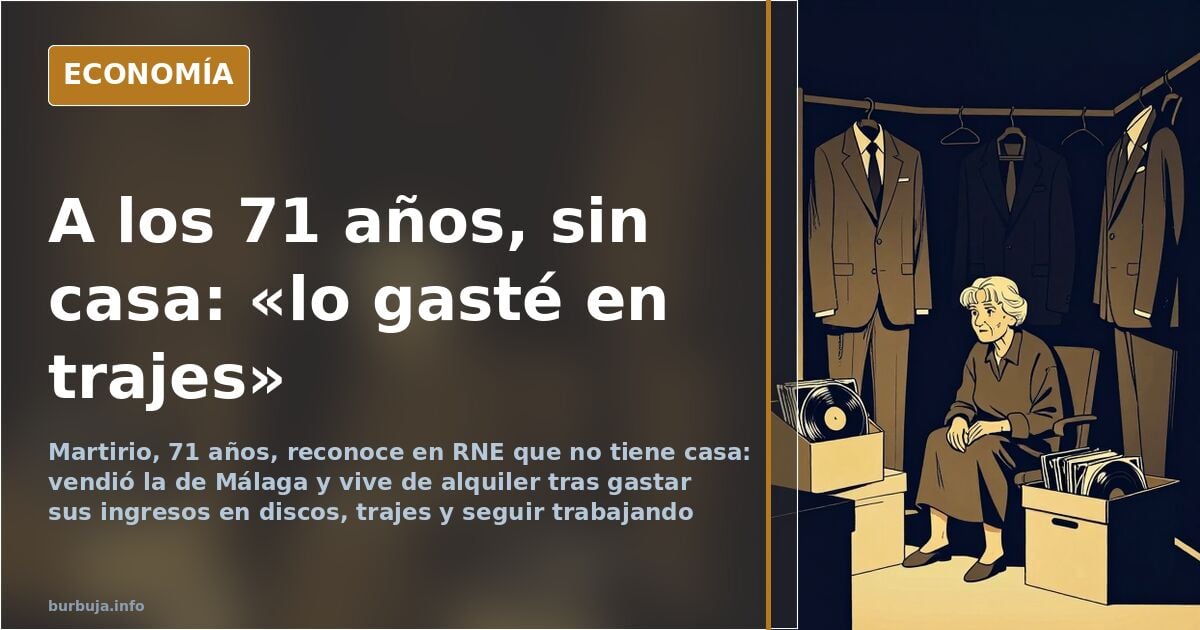
Martirio: "I had a house in Málaga, but I sold it"
"I had a house in a small town in Málaga, but since I wasn't going there, I sold it. I live on rent." The statement comes from Martirio, Maribel Quiñones, 71, who made it on El último tren, Isabel Gemio's show on RNE, broadcast weekdays between 11:30 PM and 2:00 AM. The singer, who turns 72 on March 21st, does not own any property. She shared this fact without drama, as if reciting a familiar lyric. Her natural delivery dispelled any attempt to frame the interview as a plea about unprotected elderly people.
Why Martirio Lives on Rent at 71
The explanation she gave on air is so simple it's disarming: the money she earned went entirely into continuing her work. "I've tried to live well, I've tried to help those around me, and that's it," she summarized. Not a brick to her name. Records financed out of her own pocket, stage costumes, tours, her band. Throughout her life, the singer has operated like a sole proprietorship, reinvesting every euro into the next project.
Gemio attempted to spark outrage. "What is it that happens for a woman with your experience, your success, your audience, who travels the world, not to have her own home? Tell me, what's happening in this country?" she asked. The response wasn't a diagnosis of the housing market: "Well, I don't know." The journalist let slip "It's incredible." And that was the end of that script.
From Jarcha to Rap: The Career She Funded Herself
Martirio started with Jarcha at age 25—she recalled this in the interview—and since then has explored copla, sevillanas, flamenco-jazz, bolero, jazz, pop, rock, tango, and even rap. This versatility wasn't financed by a multinational corporation; she paid for it herself. "I've never done anything I didn't like," she insisted. The price of that freedom, as she herself put it, is not owning property in old age.
The full accounting of her career—decades of live performances, her own albums, a persona built on the peineta, fan, and sunglasses—is precisely the kind of detailed breakdown that doesn't fit into a radio interview. What is clear is her order of priorities: artistic control first, then a home.
The George Best Case and Spending Patterns
The most cited comparison is with footballer George Best, who, when asked what he'd done with his millions, replied: "I spent a lot of money on alcohol, women, and fast cars. The rest I squandered." Substitute alcohol for suits and cars for self-financed records, and the framework is the same: immediate spending over saving. The fundamental difference is that Best said it with self-destructive sarcasm, while Martirio presents it as a philosophy, not a regret.
This is where the real disagreement begins. Some see her case as an example of integrity, while others see a bill that will come due with age. Both groups read the same facts and draw opposite conclusions.
Cicadas and Ants: The Generational Rebuke
The conversation quickly turned into a reckoning between generations. It's argued that those who didn't save during the good times now demand solidarity during the lean times, while those who did save are labeled as privileged. The inverse argument: living on rent doesn't miccionan being poor, and no one should be held accountable for how they manage their money.
The most common counter-argument suggests that such cases often end up appealing to the system. The rebuttal: the interviewee didn't ask for anything, didn't complain, and isn't seeking pity; she simply stated her life and moved on. Even those who disagree with her choices concur on this point.
What Does She Really Have at 71?
Little is known for certain, and that's also part of the issue. It's suggested that she maintains professional activity and that her son, Raúl Rodríguez Quiñones, is a partner in her music business. If this is the case, her situation would be far from the destitution some attribute to her. There are also no public figures for her pension, royalties, or available savings.
The singer herself identified her ultimate achievement as freedom: "When I had money, I earned it, I made a record, I tried to live well." At 72, with a rented home and her own career, the unanswered question is how much of this is choice and how much is what remained after all the choices were made. The debate gets stuck right there.
"I had a house in a small town in Málaga, but since I wasn't going there, I sold it. I live on rent." The statement comes from Martirio, Maribel Quiñones, 71, who made it on El último tren, Isabel Gemio's show on RNE, broadcast weekdays between 11:30 PM and 2:00 AM. The singer, who turns 72 on March 21st, does not own any property. She shared this fact without drama, as if reciting a familiar lyric. Her natural delivery dispelled any attempt to frame the interview as a plea about unprotected elderly people.
Why Martirio Lives on Rent at 71
The explanation she gave on air is so simple it's disarming: the money she earned went entirely into continuing her work. "I've tried to live well, I've tried to help those around me, and that's it," she summarized. Not a brick to her name. Records financed out of her own pocket, stage costumes, tours, her band. Throughout her life, the singer has operated like a sole proprietorship, reinvesting every euro into the next project.
Gemio attempted to spark outrage. "What is it that happens for a woman with your experience, your success, your audience, who travels the world, not to have her own home? Tell me, what's happening in this country?" she asked. The response wasn't a diagnosis of the housing market: "Well, I don't know." The journalist let slip "It's incredible." And that was the end of that script.
From Jarcha to Rap: The Career She Funded Herself
Martirio started with Jarcha at age 25—she recalled this in the interview—and since then has explored copla, sevillanas, flamenco-jazz, bolero, jazz, pop, rock, tango, and even rap. This versatility wasn't financed by a multinational corporation; she paid for it herself. "I've never done anything I didn't like," she insisted. The price of that freedom, as she herself put it, is not owning property in old age.
The full accounting of her career—decades of live performances, her own albums, a persona built on the peineta, fan, and sunglasses—is precisely the kind of detailed breakdown that doesn't fit into a radio interview. What is clear is her order of priorities: artistic control first, then a home.
The George Best Case and Spending Patterns
The most cited comparison is with footballer George Best, who, when asked what he'd done with his millions, replied: "I spent a lot of money on alcohol, women, and fast cars. The rest I squandered." Substitute alcohol for suits and cars for self-financed records, and the framework is the same: immediate spending over saving. The fundamental difference is that Best said it with self-destructive sarcasm, while Martirio presents it as a philosophy, not a regret.
This is where the real disagreement begins. Some see her case as an example of integrity, while others see a bill that will come due with age. Both groups read the same facts and draw opposite conclusions.
Cicadas and Ants: The Generational Rebuke
The conversation quickly turned into a reckoning between generations. It's argued that those who didn't save during the good times now demand solidarity during the lean times, while those who did save are labeled as privileged. The inverse argument: living on rent doesn't miccionan being poor, and no one should be held accountable for how they manage their money.
The most common counter-argument suggests that such cases often end up appealing to the system. The rebuttal: the interviewee didn't ask for anything, didn't complain, and isn't seeking pity; she simply stated her life and moved on. Even those who disagree with her choices concur on this point.
What Does She Really Have at 71?
Little is known for certain, and that's also part of the issue. It's suggested that she maintains professional activity and that her son, Raúl Rodríguez Quiñones, is a partner in her music business. If this is the case, her situation would be far from the destitution some attribute to her. There are also no public figures for her pension, royalties, or available savings.
The singer herself identified her ultimate achievement as freedom: "When I had money, I earned it, I made a record, I tried to live well." At 72, with a rented home and her own career, the unanswered question is how much of this is choice and how much is what remained after all the choices were made. The debate gets stuck right there.
Summary of a discussion on Burbuja.info - Foro de economía, actualidad y política., translated from Spanish and reviewed before publication. Read the full discussion (205 replies).
More summaries
-
Maricarmen decree: expropriate homes from tenants over 70
Sumar's draft decree would let authorities expropriate a home if the tenant is over 70. The industry warns: fewer rentals for older people.
-
Paychecks that run out before the 20th and under-the-table jobs that go undeclared
Long-serving employees who can't make it to month's end, off-the-books jobs and terraces where two beers last six hours: the 2026 map.
-
Euthanasia in Old Age: Autonomy vs. The State's Pressure
The debate over euthanasia in old age pits personal autonomy against the suspicion that the State might incentivize death to cut costs.
-
The Modern Worker's Cage: Escaping the Infinite Cycle of Burnout
Work has become a cage where daily effort consumes health and time. Discover why we push ourselves so hard and how to break the cycle.
-
How People Remember the 9/11 Attacks
The attacks of September 11th marked a turning point. Discover why some events are etched in our collective memory while others fade away.
-
Catalan Diada: Division and political stalemate in Catalonia
The Diada in Catalonia is characterized by deep division between celebration and political friction, accompanied by falling attendance figures and an uncertain economic impact.