
Silvio Rodríguez Draws Crowds in Madrid Amid Attendance Disputes
Silvio Rodríguez fills Madrid with disputed attendance figures and €45 tickets, as debates on the Cuba blockade and censorship continue.
English · Original discussion in Spanish · Published
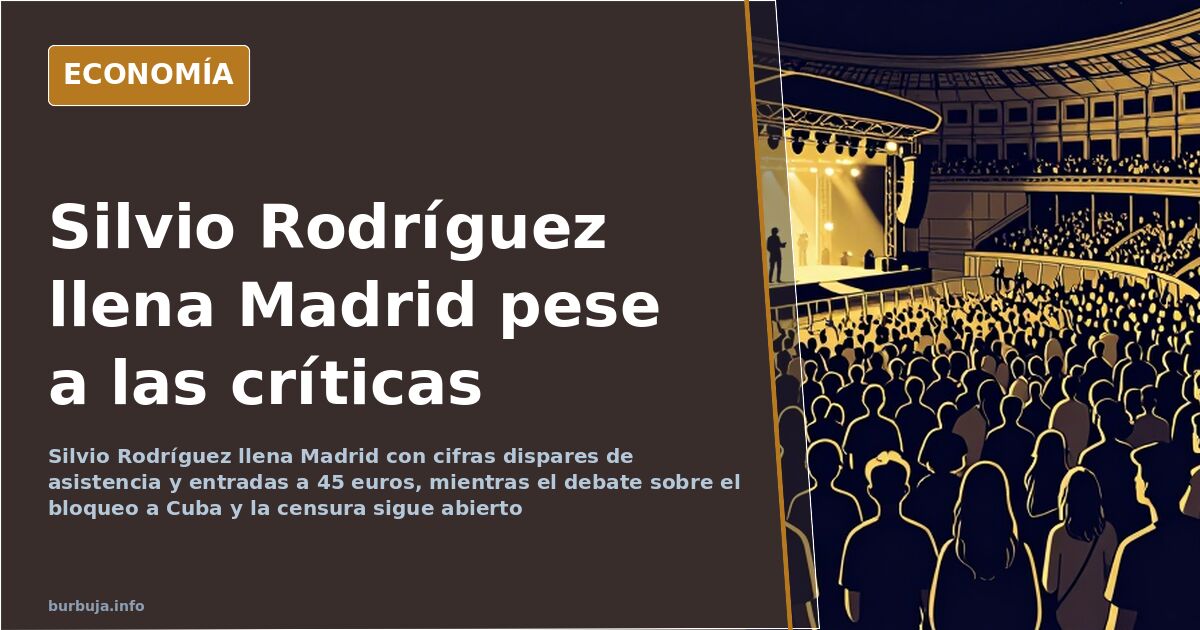
Silvio Rodríguez Draws Crowds in Madrid Amid Attendance Disputes
Silvio Rodríguez's return to Madrid has left a figure that summarizes the situation: 15,000 attendees, according to organizers, at a public venue in a city governed by the right. This data, repeated like a slogan in public discussion, clashes with another figure used by those tempering enthusiasm: 8,000 people and tickets costing €45. The discrepancy is significant. It defines whether we are facing a mass phenomenon or a well-funded niche event.
What is striking is not that a communist singer-songwriter fills a venue. It is that he does so without anyone preventing him. One participant summarized the paradox precisely: a communist sings without issue in public facilities of a city where the right rules, while the left always finds excuses to prevent right-wing performances. The question, thrown into the air, still lacks a convincing answer.
Who Censors Whom? The Double Standard Argument
The first front of the matter is censorship. The initial thesis held that the concert took place despite threats from the far-right. The response was immediate: if the PP (People's Party) has canceled Luis Pastor's concerts in Aravaca, the accusation of censorship changes sides. The provided links —EFE, Telemadrid, Diario Crítico— support this line. It is not an impression: it is a list of cases.
The counterargument has its own logic. That a local government cancels an event is not equivalent to a state apparatus of censorship. And that Silvio sings in Madrid proves nothing about Cuba. These are two distinct planes that the discussion mixes without shame.
The Blockade, the Embargo, and Aid for the Cuban People
The premise of the initial message was that the concert profits would help the Cuban people, who suffer the blockade. There, the deepest rift peine. Some participants deny the major premise: there is no blockade, only an embargo. The distinction is not semantic. A blockade implies total isolation; an embargo involves partial restrictions with humanitarian exceptions.
The disorienting question is about rafts. Do they go from Cuba to Florida or from Florida to Cuba? If the socialist paradise works, why do people cross an ocean in precarious boats? The official answer convinces no one who looks at the data. And the data is stubborn: emigration does not stop.
The Communist Singer Who Lives Like a Capitalist
Here the matter becomes uncomfortable for everyone. An artist who declares himself communist, defends a regime that has impoverished his country, charges €45 per ticket, and lives better than the average Cubans he claims to represent. The comparison with Amancio Ortega appeared quickly: the businessman does not declare himself communist nor writes songs praising the regime. Coherence, it is argued, requires donating assets to the Cuban State.
The defense is weaker than it seems. That capitalism kills millions does not make virtuous a system that has produced misery and exile. And that all countries have contradictions does not excuse one's own.
What the Attendance Figure Hides
The figure of 15,000 attendees deserves a cold analysis. If organizers speak of 15,000 and critics of 8,000, the range is wide. With tickets at €45, gross revenue fluctuates between €360,000 and €675,000. It is not a perfect business, but neither is it a ruin. The public venue adds a layer of complexity: who pays for maintenance?
The audience also had a clear profile. The recurring joke was about age: was there anyone under 65? This is not a minor detail. Most of the audience belongs to a generation that no longer fills stadiums on its own. If generational replacement does not arrive, the Silvio phenomenon is an epilogue, not a prologue.
The Cuban Dictatorship and the Spanish Mirror
The matter drifted toward the Cuban regime. It is maintained that the Communist Party tyrannizes the people, that individuals are property of the State, and that communism is imposed only through dictatorship because it is incompatible with democracy. These are broad statements, but formulated as analysis, not insult.
The response from the other side is that savage capitalism also kills, that most citizens of capitalist countries do not live like Amancio Ortega, and that the comparison is deceptive. The problem is that the comparison works both ways: if Cuban communism is a disaster, neoliberal capitalism also has its corpses.
The exact point where the analysis stalls is this: no one has explained why a singer denouncing imperialism gets paid in euros, in a public venue, in the capital of a NATO country, and does so without anyone stopping him. The contradiction is not the singer's. It belongs to those who need to believe the concert means more than a night of nostalgia.
Also available in: Deutsch
Summary of a discussion on Burbuja.info - Foro de economía, actualidad y política., translated from Spanish and reviewed before publication. Read the full discussion (107 replies).
More summaries
-
Amancio Ortega Donates €100M to Spanish Flood Victims
The Amancio Ortega Foundation pledges €100 million to municipalities hit by Spain's DANA floods, sparking fiscal and political debate.
-
Feijóo Criticizes Free Cinema Subsidies for Spain's Richest
Feijóo opposes universal subsidies for cinema and trains, arguing they benefit billionaires like Amancio Ortega rather than those in need.
-
PP's CGPJ Deal Sparks Voter Backlash in Spain
The PP and PSOE agreed to renew the Spanish judicial council, a move critics call a betrayal of conservative voters.
-
PSOE ministers hold 30+ properties while attacking landlords
Spanish ministers declared over 30 properties, including seven for Isabel Rodríguez, contradicting the PSOE's anti-landlord rhetoric.
-
Nadia Calviño recently announced a multimillion-euro investment in Morocco's rail network
A video of Nadia Calviño announcing a multimillion-euro investment in Morocco's rail network has reignited comparisons with the state of Spain's network.
-
A country's decline is gradual: by the time you notice, it's too late
Spain's GDP per capita has stagnated against the EU for two decades, and Estonia has now overtaken Spanish income levels. Compound interest explains why.