
Silver Savings: From Two Ounces Monthly to Hundreds in Storage
Buying two or three silver ounces monthly for years accumulates hundreds of pieces. The ounce costs around €30, but VAT deters some buyers.
English · Original discussion in Spanish · Published
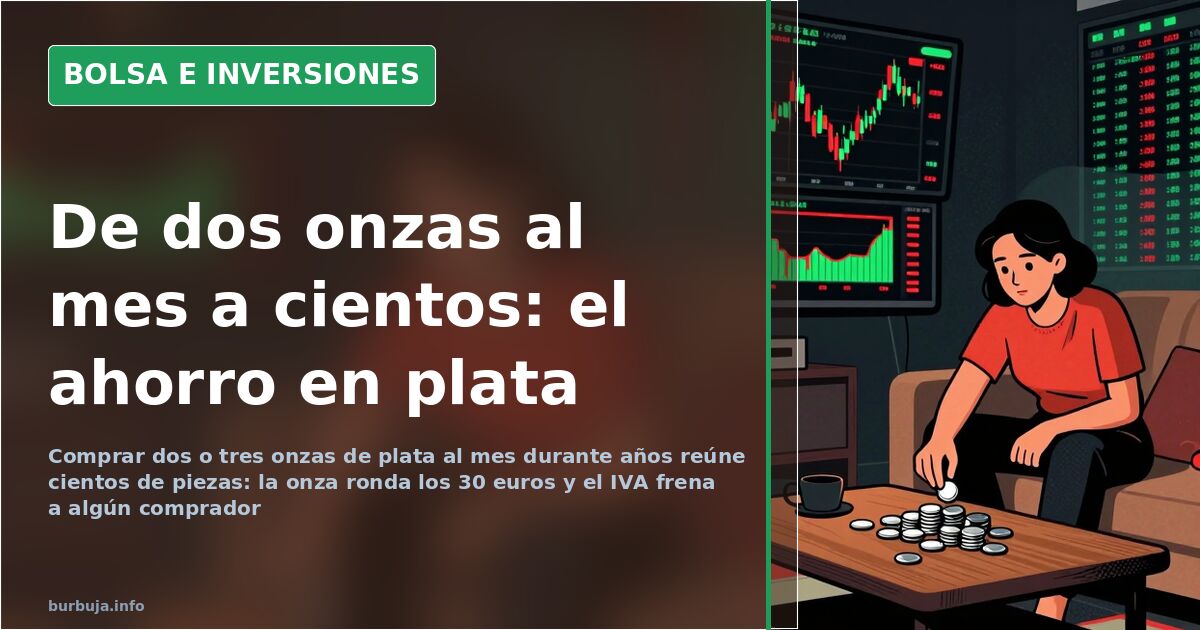
Buying Two Silver Ounces a Month: The Silent Saving
Purchasing two or three silver ounces each month works as a savings system. Those who do this for years end up with hundreds of ounces without making complex decisions: no management fees, endless analysis, or colorful screens. The bill appears when checking the price. The ounce moves around €30, and the metal carries the label of being the poor man's gold.
The arithmetic explains the appeal. Three ounces monthly for five years equal 180 ounces; at €30, that is about €5,400. A forum user who started in 2019 claims to have many purchases between €19 and €22 per ounce, though not all, and also bought at €15 or €16 online when prices dropped sharply in 2020. Same discipline, very different results. That uncertainty—buying without knowing tomorrow's price—is what separates believers from those who ignore it.
How Much Does a Silver Ounce Cost Today?
The reference price cited by online specialized store buyers is around €30 including VAT. Formats fall within narrow ranges:
VAT is the main filter. A saver with nearly four kilos accumulated admits stopping position expansion due to this tax: VAT stung me. Hence, part of the hobby shifts toward old coins, where price is negotiated by weight and the piece matters more than the certificate, though another user warns that buying from individuals isn't necessarily cheaper and that, whether called VAT, premium, or whatever, the final price ends up similar.
How Many Ounces Are Really Bought Monthly?
Answers range from absolute zero to those dedicating everything they can to silver. Among the most repeated are two or three ounces monthly, the formula for those who don't want to track daily prices. Some declare between 25 and 50 ounces a year. At the opposite extreme, someone buys a gram of gold and two silver ounces each month, while others buy nothing and say so without shame: zero.
Some don't trinc a calendar. They buy when prices drop or when a piece interests them. Random buying has bad press among dollar-cost averaging advocates but is presented as a way to avoid the classic error: buying during a rally, which happens exactly when metal rises and everyone remembers it.
From Collecting to Bulk Metal
Collecting is another sport. Some acquire the same twenty coins yearly—koalas, pandas, elephants, eagles, maples—and admit they don't stress over the calendar. Criticism comes fast: these pieces carry higher premiums. Defense trinc: among common investment series, the difference can be €2 per unit, and with twenty coins a year, the whim holds without breaking the budget.
Another profile rejects store ounces in favor of granules and old coins, both for price and quick exchange in the industrial market. And a non-monetary curiosity appears: there are silver pieces from twenty years ago that still shine like day one, something no indexed fund can display in a showcase.
The Problem Isn't Buying Silver, It's Selling It
Here almost everyone agrees, including buyers. The second-hand market is narrow, and prices outside specialized circuits plummet: one case cites a piece ending up paid at €0.50 in a metal dealer when enthusiasts value it at €0.70 or €0.80. Liquidity comes with volume. Groups with hundreds of buyers exist where certain pieces sell quickly, though the condition for them to fly is precisely that the price is below market.
A frugal, haggling buyer profile is also noted: a few euros discount suffice for them to take the whole lot. Casual investors, however, discover upon selling that no one offers what they expected and that old silver lacks the promised market.
Gold, Platinum, and Bitcoin: Emerging Alternatives
Gold wins big when switching is proposed. A user argues buying a sovereign monthly, pieces he places near €500, leaves an annual accumulation of at least €7,000. The figure appeals because it sounds like extra salary; the fine print requires twelve disciplined purchases and patience to sell higher than paid.
Platinum has slipped in as a recent bet. Some open accounts on platforms like BullionVault to add €100 monthly with metal under $900, expecting a prolonged range between $750 and $950, limited losses, and long-term upside. Real estate and bitcoin complete the portfolio of those who mention it, usually viewing silver as a hobby rather than a pillar.
Will Silver Prices Rise?
One user is clear: when silver starts being used as a store of value, prices will soar. Another replies they've waited decades: the metal was demonetized, today it's just another industrial raw material, and the system needs it cheap; betting otherwise enters gambling territory. Between these positions, some decided not to lose sleep: if nothing happens, the pieces remain for their children.
Purchasing two or three silver ounces each month works as a savings system. Those who do this for years end up with hundreds of ounces without making complex decisions: no management fees, endless analysis, or colorful screens. The bill appears when checking the price. The ounce moves around €30, and the metal carries the label of being the poor man's gold.
The arithmetic explains the appeal. Three ounces monthly for five years equal 180 ounces; at €30, that is about €5,400. A forum user who started in 2019 claims to have many purchases between €19 and €22 per ounce, though not all, and also bought at €15 or €16 online when prices dropped sharply in 2020. Same discipline, very different results. That uncertainty—buying without knowing tomorrow's price—is what separates believers from those who ignore it.
How Much Does a Silver Ounce Cost Today?
The reference price cited by online specialized store buyers is around €30 including VAT. Formats fall within narrow ranges:
- €30 for a bullion ounce in an online store, tax included.
- €27, according to one user, for ounces minted within a buyer group.
- €0.70, €0.75, and €0.80 per old silver coin—pacos and duros—bought from individuals or at numismatic conventions.
VAT is the main filter. A saver with nearly four kilos accumulated admits stopping position expansion due to this tax: VAT stung me. Hence, part of the hobby shifts toward old coins, where price is negotiated by weight and the piece matters more than the certificate, though another user warns that buying from individuals isn't necessarily cheaper and that, whether called VAT, premium, or whatever, the final price ends up similar.
How Many Ounces Are Really Bought Monthly?
Answers range from absolute zero to those dedicating everything they can to silver. Among the most repeated are two or three ounces monthly, the formula for those who don't want to track daily prices. Some declare between 25 and 50 ounces a year. At the opposite extreme, someone buys a gram of gold and two silver ounces each month, while others buy nothing and say so without shame: zero.
Some don't trinc a calendar. They buy when prices drop or when a piece interests them. Random buying has bad press among dollar-cost averaging advocates but is presented as a way to avoid the classic error: buying during a rally, which happens exactly when metal rises and everyone remembers it.
From Collecting to Bulk Metal
Collecting is another sport. Some acquire the same twenty coins yearly—koalas, pandas, elephants, eagles, maples—and admit they don't stress over the calendar. Criticism comes fast: these pieces carry higher premiums. Defense trinc: among common investment series, the difference can be €2 per unit, and with twenty coins a year, the whim holds without breaking the budget.
Another profile rejects store ounces in favor of granules and old coins, both for price and quick exchange in the industrial market. And a non-monetary curiosity appears: there are silver pieces from twenty years ago that still shine like day one, something no indexed fund can display in a showcase.
The Problem Isn't Buying Silver, It's Selling It
Here almost everyone agrees, including buyers. The second-hand market is narrow, and prices outside specialized circuits plummet: one case cites a piece ending up paid at €0.50 in a metal dealer when enthusiasts value it at €0.70 or €0.80. Liquidity comes with volume. Groups with hundreds of buyers exist where certain pieces sell quickly, though the condition for them to fly is precisely that the price is below market.
A frugal, haggling buyer profile is also noted: a few euros discount suffice for them to take the whole lot. Casual investors, however, discover upon selling that no one offers what they expected and that old silver lacks the promised market.
Gold, Platinum, and Bitcoin: Emerging Alternatives
Gold wins big when switching is proposed. A user argues buying a sovereign monthly, pieces he places near €500, leaves an annual accumulation of at least €7,000. The figure appeals because it sounds like extra salary; the fine print requires twelve disciplined purchases and patience to sell higher than paid.
Platinum has slipped in as a recent bet. Some open accounts on platforms like BullionVault to add €100 monthly with metal under $900, expecting a prolonged range between $750 and $950, limited losses, and long-term upside. Real estate and bitcoin complete the portfolio of those who mention it, usually viewing silver as a hobby rather than a pillar.
Will Silver Prices Rise?
One user is clear: when silver starts being used as a store of value, prices will soar. Another replies they've waited decades: the metal was demonetized, today it's just another industrial raw material, and the system needs it cheap; betting otherwise enters gambling territory. Between these positions, some decided not to lose sleep: if nothing happens, the pieces remain for their children.
Also available in: Deutsch
Summary of a discussion on Burbuja.info - Foro de economía, actualidad y política., translated from Spanish and reviewed before publication. Read the full discussion (106 replies).
More summaries
-
UK gold buyer paid €25 per gram for 18-karat jewellery
A gold buyer paid €25 per gram for 18-karat jewellery from a user. He claims the metal was trading at €43 per gram.
-
Spanish investor recovers from two-year loss to gain 26%
A Spanish MSCI World investor endured a -5% loss for two years before reaching a 26% return, highlighting DCA resilience against IBEX and inflation.
-
US Treasuries at 4%: Barriers for Spanish Investors
Non-residents cannot buy US Treasury bonds directly; Tax ID requirements, fees, and currency risks block the transaction.
-
From Panic to Diversification: A Spanish Investor's Journey
A 25-year-old Spanish investor reflects on his first year, moving from a risky Santander-heavy portfolio to a diversified mix of 16 stocks.
-
Forum debate: All-in on Santander at €2
A user proposes betting everything on Santander at €2. Others cite Banco Popular, GM, and falling value. The bank canceled dividends in 2020 and traded at €1.83.
-
Digital Euro: The Plan for 2027
The digital euro is planned for 2027 under ECB President Lagarde. Cash usage declines in Sweden, Netherlands, and Spanish transport.