
Shaving Your Head: A Bald Man’s Social Life Story
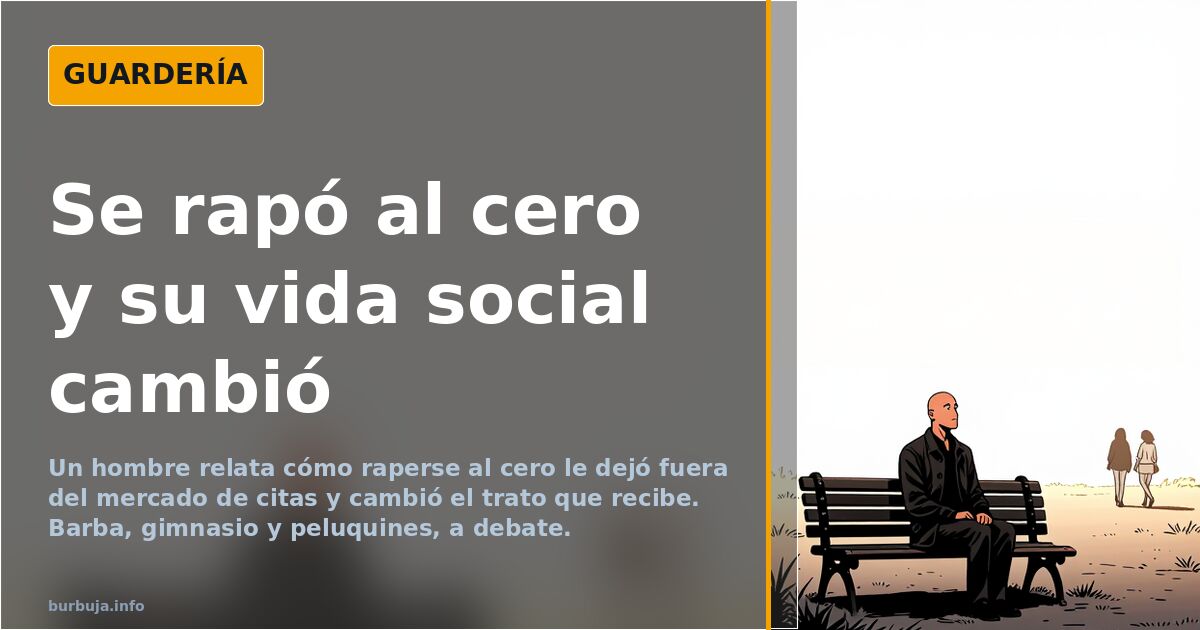
A man describes how shaving his head removed him from the dating market and changed how he is treated. Beard, gym, and hairpieces are debated.
English · Original discussion in Spanish · Published
Shaving Your Head: When Baldness Stops Being a Hair Problem
Shaving your head doesn’t fix baldness; it makes it visible. That’s the core of one man’s story who, after years trying to hide a receding hairline with increasingly forced comb-overs, decided to buzz it all off. “No problems,” he summarizes. The status of being a shaved bald man is quickly accepted, and he adds that no one focuses more than necessary on what he calls his “hair disability.” The real issue came later, and it had nothing to do with the mirror.
What changed wasn’t the hair, but the treatment. According to his experience, before shaving, he received female attention; afterward, he got “totally neutral” treatment. He attributes this to a dating market he describes with a mix of humor and resignation: competition is fierce, and certain traits act as automatic filters. The upside, he says, is that other men accept him better than before. His reason is uncomfortable: by not being competition, he stops being a threat.
What Happens When You Shave Your Head and Stop Trying to Hide It
The initial post isn’t asking for advice. It’s a testimony. A man shares that he prolonged the transition longer than necessary, “like pre-teen boys who don’t shave their peach fuzz,” and things got out of hand when inquisitive stares and laughter started. Shaving was a surrender, but also a liberation: the comb-overs and profile mirrors ended.
From there, the narrative becomes economic. He talks about being priced out of the market, the difficulty of getting dates as a heterosenshetero man in Spain, and competition he describes as inflationary. He offers no figures, but the diagnosis is clear: there is a before and after in how people look at you. And it’s not the hair, it’s the label.
Beard, Gym, and Clothes: The Repeated Advice
The collective response divides between support, mockery, and instruction manuals. One of the most repeated recipes is a full beard, considered “baldness 101.” Another is the gym: getting strong, improving posture, and dressing well. Those who write this claim these things work and that the problem isn’t lack of hair, but the attitude with which it is faced.
The original poster replies that he already has a beard, is fit, dresses well, and walks upright. His conclusion is bitter: “Life has treated me badly because I have style, yes.” The irony doesn’t hide the core issue: self-improvement advice clashes with a reality he perceives as a wall.
Hair Systems, Medication, and Antiestéticar of Relying on Remedies
Then the pharmacological and prosthetic route appears. One participant mentions using dutasteride, saw palmetto, and minoxidil, noting it took months to see results. Another shares his experience with a hair system: the change was “spectacular,” going from invisible to receiving stares, though he admits the front line is noticeable and maintenance costs money. He even offers a messaging group to answer questions.
The original poster rejects that path. He explains he suffered so much side effects—dizziness and lack of concentration—that he promised never to take medication unless truly ill. The line between improving appearance and medicalizing life is crossed here. It’s not an aesthetic decision: it’s a decision about what price one is willing to pay.
Wigs, Dignity, and the Appearance Market
Wigs generate their own sub-debate. Some argue that if the appearance industry works that way, there’s no reason not to use them: if they don’t see you bald, you aren’t bald. Others warn that deception doesn’t hold up with those who know you, and ultimately you deceive yourself. The dignity of the shaved bald man, without caps or artifices, appears as an explicit stance in the original post.
The conversation shifts toward attractiveness and status. Cases are mentioned of bald men who attract attention due to their position, physique, or authority. The recurring conclusion, with various examples, is that hair is just one factor among many, but denying its weight in first impressions would be hypocrisy.
Humor as Therapy: Associations, Conspiracies, and Lottery
The tone never abandons banter. There are jokes about an association against bald-phobia, an international conspiracy of bald men, and making money selling books and talks. Also about gender transitioning while still having hair, or becoming a comic book villain like the great bald antagonists of pop culture.
Between jokes, the original poster insists his problem isn’t baldness itself, but losing a place in the attention market. Humor doesn’t cover up the diagnosis: it makes it digestible.
What to Expect: Between Adaptation and Surrender
The evolution of the conversation goes from practical advice to reflection on attractiveness, ending in jokes. There is no closure. The original poster doesn’t announce he has recovered his previous social life, nor that he found a magic solution. Nor does he give up anything: he says he doesn’t wear a cap and is a dignified bald man.
If the story clarifies anything, it’s that baldness isn’t just a physical trait. It’s a label that reorganizes how you are treated, for better and worse. The prediction, with all reservations, is that the debate will remain alive as long as hair remains an asset in the appearance market. And that every bald man will find his own way to manage it, or laugh about it.
Shaving your head doesn’t fix baldness; it makes it visible. That’s the core of one man’s story who, after years trying to hide a receding hairline with increasingly forced comb-overs, decided to buzz it all off. “No problems,” he summarizes. The status of being a shaved bald man is quickly accepted, and he adds that no one focuses more than necessary on what he calls his “hair disability.” The real issue came later, and it had nothing to do with the mirror.
What changed wasn’t the hair, but the treatment. According to his experience, before shaving, he received female attention; afterward, he got “totally neutral” treatment. He attributes this to a dating market he describes with a mix of humor and resignation: competition is fierce, and certain traits act as automatic filters. The upside, he says, is that other men accept him better than before. His reason is uncomfortable: by not being competition, he stops being a threat.
What Happens When You Shave Your Head and Stop Trying to Hide It
The initial post isn’t asking for advice. It’s a testimony. A man shares that he prolonged the transition longer than necessary, “like pre-teen boys who don’t shave their peach fuzz,” and things got out of hand when inquisitive stares and laughter started. Shaving was a surrender, but also a liberation: the comb-overs and profile mirrors ended.
From there, the narrative becomes economic. He talks about being priced out of the market, the difficulty of getting dates as a heterosenshetero man in Spain, and competition he describes as inflationary. He offers no figures, but the diagnosis is clear: there is a before and after in how people look at you. And it’s not the hair, it’s the label.
Beard, Gym, and Clothes: The Repeated Advice
The collective response divides between support, mockery, and instruction manuals. One of the most repeated recipes is a full beard, considered “baldness 101.” Another is the gym: getting strong, improving posture, and dressing well. Those who write this claim these things work and that the problem isn’t lack of hair, but the attitude with which it is faced.
The original poster replies that he already has a beard, is fit, dresses well, and walks upright. His conclusion is bitter: “Life has treated me badly because I have style, yes.” The irony doesn’t hide the core issue: self-improvement advice clashes with a reality he perceives as a wall.
Hair Systems, Medication, and Antiestéticar of Relying on Remedies
Then the pharmacological and prosthetic route appears. One participant mentions using dutasteride, saw palmetto, and minoxidil, noting it took months to see results. Another shares his experience with a hair system: the change was “spectacular,” going from invisible to receiving stares, though he admits the front line is noticeable and maintenance costs money. He even offers a messaging group to answer questions.
The original poster rejects that path. He explains he suffered so much side effects—dizziness and lack of concentration—that he promised never to take medication unless truly ill. The line between improving appearance and medicalizing life is crossed here. It’s not an aesthetic decision: it’s a decision about what price one is willing to pay.
Wigs, Dignity, and the Appearance Market
Wigs generate their own sub-debate. Some argue that if the appearance industry works that way, there’s no reason not to use them: if they don’t see you bald, you aren’t bald. Others warn that deception doesn’t hold up with those who know you, and ultimately you deceive yourself. The dignity of the shaved bald man, without caps or artifices, appears as an explicit stance in the original post.
The conversation shifts toward attractiveness and status. Cases are mentioned of bald men who attract attention due to their position, physique, or authority. The recurring conclusion, with various examples, is that hair is just one factor among many, but denying its weight in first impressions would be hypocrisy.
Humor as Therapy: Associations, Conspiracies, and Lottery
The tone never abandons banter. There are jokes about an association against bald-phobia, an international conspiracy of bald men, and making money selling books and talks. Also about gender transitioning while still having hair, or becoming a comic book villain like the great bald antagonists of pop culture.
Between jokes, the original poster insists his problem isn’t baldness itself, but losing a place in the attention market. Humor doesn’t cover up the diagnosis: it makes it digestible.
What to Expect: Between Adaptation and Surrender
The evolution of the conversation goes from practical advice to reflection on attractiveness, ending in jokes. There is no closure. The original poster doesn’t announce he has recovered his previous social life, nor that he found a magic solution. Nor does he give up anything: he says he doesn’t wear a cap and is a dignified bald man.
If the story clarifies anything, it’s that baldness isn’t just a physical trait. It’s a label that reorganizes how you are treated, for better and worse. The prediction, with all reservations, is that the debate will remain alive as long as hair remains an asset in the appearance market. And that every bald man will find his own way to manage it, or laugh about it.
Summary of a discussion on Burbuja.info - Foro de economía, actualidad y política., translated from Spanish and reviewed before publication. Read the full discussion (142 replies).
More summaries
-
Pregnant influencer demands paternity test
Two possible fathers, two excuses, and a paternity test announced: the scandal of the influencer who doesn't know who the father is.
-
Six Months Without Sex at 31: When Love Remains but Desire Fades
A 31-year-old man faces six months of sexual abstinence as his partner’s desire vanishes, sparking debate on whether lost attraction can be recovered.
-
Casillas chat leak: €150m fortune doesn't buy discretion
Kiko Matamoros mocks Iker Casillas' private messages, sparking debate on expectations for football icons with vast wealth.
-
Classic Car Ownership Costs: Maintenance, Batteries, and Anxiety
Rotating classic cars hides costs like batteries, fuel pumps, insurance, and inspections. Three vehicles appear to be the practical limit.
-
ElXokas Buys Madrid Duplex for €2.2M, Lacks Upstairs Bathrooms
Spanish streamer ElXokas paid up to €2.2 million for a 176 m² Madrid duplex featuring three bathrooms downstairs and none upstairs.
-
Viral Reality Clip Reignites Debate Over Trash TV in Spain
A viral clip from a private reality show has reopened the debate on trash TV: who broadcasts it, who watches it, and what incentives drive it.