
Selling Up at 50 and Moving to Indonesia: The Numbers Behind the Plan
Retiring to Indonesia at 50: Spanish couple sells property, plans business. Financial planning for relocation, healthcare costs, and property ownership.
English · Original discussion in Spanish · Published
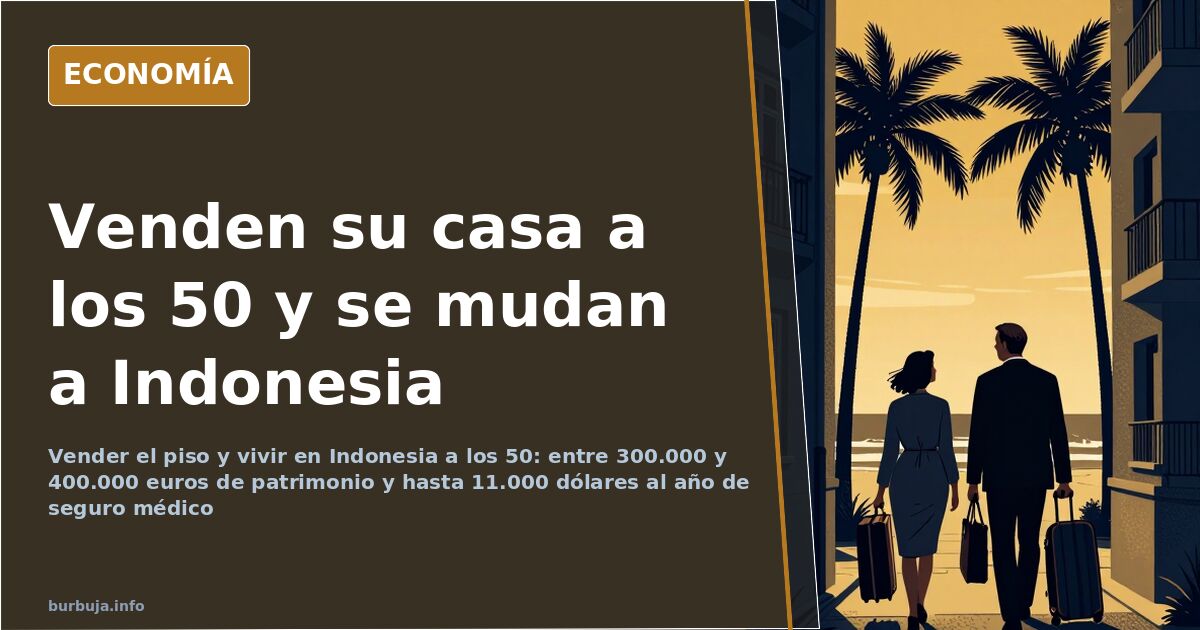
Selling the flat and moving to Indonesia at 50: the figures
A Spanish couple in their early 50s are selling their home, leaving their jobs, and arriving this month in Lombok, the Indonesian island next to Bali, with the idea of setting up a business there. Their son, who has lived in the area for three years, tells the story, and the reaction hasn't been astonishment: it's been a calculator. How much is needed to live in Indonesia without working? And how much does it cost to grow old there?
The case has a component that goes beyond that family. In Kuta Lombok, where they live, the Spanish community has grown from about 30 people to nearly 1,000 in three years. No campaigns or headlines: they come for seasons, try it out, some stay and set up businesses. It's called a silent movement, and seen from the inside, it looks like a trend.
From 30 to 1,000 Spaniards in Kuta Lombok in three years
The story of this displacement isn't about another tourist destination, but a self-sustaining network. Friends settling down, acquaintances from the same hometown suddenly appearing, two or three newcomers every week. The recurring trigger is economic: the feeling that the center of gravity of activity has shifted to Asia, with cities growing rapidly and Europe moving more slowly.
The protagonists of this case are not retirees with foreign pensions. They have left their jobs and want to generate income. That detail changes the entire financial analysis: it's no longer about how much I need to not work, but how long I can last until the business takes off.
How much money is needed to live off investments in Asia?
The optimistic arithmetic is simple: sell the flat in a medium-sized city for 300,000 to 400,000 euros, add savings, severance pay, and unemployment benefits, invest it in dividend-paying stocks, and get 20,000 to 25,000 euros per year. With that, the argument goes, you can live in perpetual vacation in Southeast Asia and still have money left for private insurance.
The conservative scenario corrects this calculation three times. First, the price: a flat in a provincial capital isn't worth 400,000 euros, it's worth half if it's not in the center. Second, the exit: those who leave voluntarily don't always receive compensation or unemployment benefits, although there is disagreement on the details of what is liquidated. Third, the rule: withdrawing 25,000 net per year requires assets close to 800,000 euros applying the well-known 4% rule. The conclusion of the hard calculation is different: 350,000 clear, a reserve cushion, and hope for the best. On the other hand, the argument is that working in Europe with the same amount is a worse deal.
Medical insurance and healthcare: the bill that reaches 60
Where almost everyone agrees is on the most expensive and least photographed point. From the age of 60, a policy that truly covers you skyrockets to 11,000 dollars per year or more, and over the years can exceed 1,000 euros per month. Added to this are the fine print of contributions: with 15 years paid in Spain, there is a right to a pension; with 15 years without contributions, the floor is the minimum or non-contributory pension.
From this arises the Plan B that everyone has in mind: if the problem is serious, they will return. Spanish public healthcare functions as a last resort for a migration project that, in reality, is never fully settled. Not everyone accepts the premise: some argue that Spanish healthcare is much worse than proclaimed and that returning isn't the paradise one imagines from the beach.
Can you buy a house in Indonesia as a foreigner?
On paper, no. A foreigner cannot own land in any Southeast Asian country, with exceptions linked to premium visas in Malaysia. You can buy an apartment, yes, but for land, the route is through the right of use—up to 99 years—, the right to build, or purchase through a local company.
The corollary is more unsettling than the rule: those who boast of having bought a house in the area usually have it registered in the name of a third party, typically a local spouse. If the relationship breaks down, the papers are in someone else's hands. In a conversation full of profitability projections, this detail clarifies more than any spreadsheet.
The clash of expectations: beach, language, and competition
Daily life is not a postcard. The list of complaints is repeated: only beaches, few cultural activities, expatriate communities that drive up prices, and difficult adaptation due to language, climate, and customs. Those who have tried it warn that, when moving from tourist to resident, the initial friendliness turns into something else. And the competition plays in another league: local businesses with marathon working hours and regional capital on the same street.
There are also those who defend the opposite: that the island is where Bali was twenty years ago, that there is room, and that development will trinc the same curve. The fundamental disagreement is not geographical, it's about perspective. Those who look five years ahead see opportunity; those who look twenty years ahead see a return ticket.
There's one calculation that no one disputes: the return flight is much cheaper than a health insurance policy at 65. And, curiously, it's the only number in the plan that everyone seems to have already looked up.
A Spanish couple in their early 50s are selling their home, leaving their jobs, and arriving this month in Lombok, the Indonesian island next to Bali, with the idea of setting up a business there. Their son, who has lived in the area for three years, tells the story, and the reaction hasn't been astonishment: it's been a calculator. How much is needed to live in Indonesia without working? And how much does it cost to grow old there?
The case has a component that goes beyond that family. In Kuta Lombok, where they live, the Spanish community has grown from about 30 people to nearly 1,000 in three years. No campaigns or headlines: they come for seasons, try it out, some stay and set up businesses. It's called a silent movement, and seen from the inside, it looks like a trend.
From 30 to 1,000 Spaniards in Kuta Lombok in three years
The story of this displacement isn't about another tourist destination, but a self-sustaining network. Friends settling down, acquaintances from the same hometown suddenly appearing, two or three newcomers every week. The recurring trigger is economic: the feeling that the center of gravity of activity has shifted to Asia, with cities growing rapidly and Europe moving more slowly.
The protagonists of this case are not retirees with foreign pensions. They have left their jobs and want to generate income. That detail changes the entire financial analysis: it's no longer about how much I need to not work, but how long I can last until the business takes off.
How much money is needed to live off investments in Asia?
The optimistic arithmetic is simple: sell the flat in a medium-sized city for 300,000 to 400,000 euros, add savings, severance pay, and unemployment benefits, invest it in dividend-paying stocks, and get 20,000 to 25,000 euros per year. With that, the argument goes, you can live in perpetual vacation in Southeast Asia and still have money left for private insurance.
The conservative scenario corrects this calculation three times. First, the price: a flat in a provincial capital isn't worth 400,000 euros, it's worth half if it's not in the center. Second, the exit: those who leave voluntarily don't always receive compensation or unemployment benefits, although there is disagreement on the details of what is liquidated. Third, the rule: withdrawing 25,000 net per year requires assets close to 800,000 euros applying the well-known 4% rule. The conclusion of the hard calculation is different: 350,000 clear, a reserve cushion, and hope for the best. On the other hand, the argument is that working in Europe with the same amount is a worse deal.
Medical insurance and healthcare: the bill that reaches 60
Where almost everyone agrees is on the most expensive and least photographed point. From the age of 60, a policy that truly covers you skyrockets to 11,000 dollars per year or more, and over the years can exceed 1,000 euros per month. Added to this are the fine print of contributions: with 15 years paid in Spain, there is a right to a pension; with 15 years without contributions, the floor is the minimum or non-contributory pension.
From this arises the Plan B that everyone has in mind: if the problem is serious, they will return. Spanish public healthcare functions as a last resort for a migration project that, in reality, is never fully settled. Not everyone accepts the premise: some argue that Spanish healthcare is much worse than proclaimed and that returning isn't the paradise one imagines from the beach.
Can you buy a house in Indonesia as a foreigner?
On paper, no. A foreigner cannot own land in any Southeast Asian country, with exceptions linked to premium visas in Malaysia. You can buy an apartment, yes, but for land, the route is through the right of use—up to 99 years—, the right to build, or purchase through a local company.
The corollary is more unsettling than the rule: those who boast of having bought a house in the area usually have it registered in the name of a third party, typically a local spouse. If the relationship breaks down, the papers are in someone else's hands. In a conversation full of profitability projections, this detail clarifies more than any spreadsheet.
The clash of expectations: beach, language, and competition
Daily life is not a postcard. The list of complaints is repeated: only beaches, few cultural activities, expatriate communities that drive up prices, and difficult adaptation due to language, climate, and customs. Those who have tried it warn that, when moving from tourist to resident, the initial friendliness turns into something else. And the competition plays in another league: local businesses with marathon working hours and regional capital on the same street.
There are also those who defend the opposite: that the island is where Bali was twenty years ago, that there is room, and that development will trinc the same curve. The fundamental disagreement is not geographical, it's about perspective. Those who look five years ahead see opportunity; those who look twenty years ahead see a return ticket.
There's one calculation that no one disputes: the return flight is much cheaper than a health insurance policy at 65. And, curiously, it's the only number in the plan that everyone seems to have already looked up.
Summary of a discussion on Burbuja.info - Foro de economía, actualidad y política., translated from Spanish and reviewed before publication. Read the full discussion (240 replies).
More summaries
-
Euthanasia in Old Age: Autonomy vs. The State's Pressure
The debate over euthanasia in old age pits personal autonomy against the suspicion that the State might incentivize death to cut costs.
-
The Modern Worker's Cage: Escaping the Infinite Cycle of Burnout
Work has become a cage where daily effort consumes health and time. Discover why we push ourselves so hard and how to break the cycle.
-
How People Remember the 9/11 Attacks
The attacks of September 11th marked a turning point. Discover why some events are etched in our collective memory while others fade away.
-
Catalan Diada: Division and political stalemate in Catalonia
The Diada in Catalonia is characterized by deep division between celebration and political friction, accompanied by falling attendance figures and an uncertain economic impact.
-
Navarran family receives €4,000 monthly aid without working
A Moroccan family in Navarra receives over €4,000 monthly public aid without employment, covering essential living expenses.
-
Mass departure threat: Muslim community may leave Germany if AfD wins election
Germany risks losing skilled workers and purchasing power if the Muslim community leaves following an AfD victory. We analyze the economic implications.