
Selling caffeine as cocaine: legal business or crime
Half a kilo of pure caffeine for 14 dollars on Amazon. Selling it on the street as cocaine — is it legal? The Criminal Code may not see it that way.
English · Original discussion in Spanish · Published
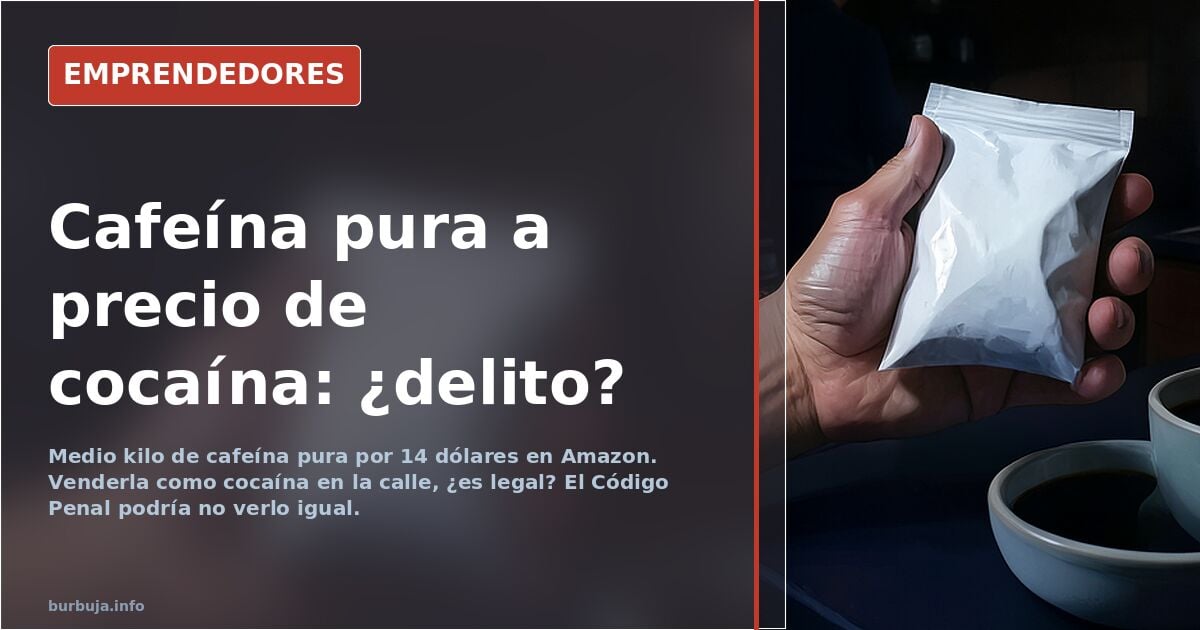
Powdered caffeine at coke prices: the business that skirts the Incivil Code
Half a kilo of pure caffeine for 14 dollars on Amazon. That is the starting point of an idea doing the rounds in internet entrepreneur circles: selling it in little bags, without saying what it is, in nightclubs and at cocaine prices. The reasoning is simple: caffeine is a legal stimulant, dirt cheap and, according to those floating the idea, almost as potent as the cocaine sold on the street, which usually arrives heavily cut. "If you don't say what it is and give it a fancy name, you sell it at the same price and everyone's happy," sums up the original proposal.
The catch appears as soon as you scratch the surface. Caffeine doesn't have the bitterness of coke when tasted with a finger, so the first customer with any experience spots the switch. And customers in that market are rarely forgiving: "get ready to swallow your teeth," warns one of the participants, who points out that someone who has spent a week saving fifty euros for a bag doesn't take kindly to being cheated.
What the law says if you sell caffeine as if it were cocaine
The conversation holds that the substance's legality doesn't protect the seller. According to one participant, in the UK — and probably in Spain — selling a fake drug carries the same penalty as selling the real thing: the deception of the consumer is prosecuted under the umbrella of the public health offence. The same participant cites the case of a seller of harmless pills who ended up charged for that very reason. The doctrine invoked is that if you present a white powder as a narcotic, the prosecution doesn't need it to actually be a narcotic to charge you.
Some point out that caffeine doesn't appear on the lists of drugs of abuse and that, if nobody declares that you're selling it as coke, it's hard to prove. But that defence falls apart when the buyer reports you or when the seller operates in an area controlled by others. The most repeated conclusion is that the problem isn't the police, but the competition: whoever pays to place their goods on a street corner doesn't take kindly to an amateur peddling substitutes.
Caffeine as a cutting agent: the business that already exists
The irony of the matter is that, according to several participants, caffeine is already used to cut cocaine, amphetamines and MDMA. According to one of them, analyses of samples collected on the street show significant percentages of caffeine in much of what is sold as a stimulant. Whoever proposes this business isn't inventing anything: they're proposing to pocket the margin that cutters currently split. Caffeine potentiates the effect of cocaine and cheapens the product, so the traditional dealer already uses it.
The difference is that the dealer mixes it with something active. Selling caffeine on its own is selling a placebo at a premium price. And that's where the health risk comes in: a high dose of pure caffeine in someone with heart problems or high blood pressure can cause a serious scare. If the buyer doesn't know what they're taking, the seller's liability gets complicated, because warning and not warning are not the same thing.
The crystal problem and cutting
The conversation drifts towards the chemistry of cutting. It's debated whether MDMA can be cut with caffeine and how to detect it. The answer is yes, and recrystallisation is the home method for separating them: dissolve it in water, let it dry and see whether geometric crystals or an irregular mass form. According to the participants, a hard crystal with flat, transparent faces indicates purity. A brittle, opaque sheet means a mix. The detail matters because it explains why the black market works the way it does: presentation matters as much as the effect.
In the end, the caffeine entrepreneur's idea runs into a wall that is neither legal nor chemical, but human. The customer buying on the street isn't looking for caffeine. They're looking for what they were promised. And when they discover they've been sold a cheap powder with a designer name, the response is rarely a consumer complaint.
Also available in: Deutsch
Summary of a discussion on Burbuja.info - Foro de economía, actualidad y política., translated from Spanish and reviewed before publication. Read the full discussion (36 replies).
More summaries
-
Self-employed in Spain: the €254 monthly fee debate and the UK route
An entrepreneur asks what happens if he doesn't pay Spain's €254 self-employed contribution; the thread drifts into setting up UK companies and doubts about…
-
Spain's flat self-employment fee vs Ireland's model
Spain charges freelancers ~€300 monthly regardless of income. Ireland and the UK lack this fixed fee, sparking debate on the best EU country for self-employment.
-
Starting a local political party: less than €500?
Setting up a local party costs under €500, but political pressure can be lethal. The case of the Democratic Karma Party in Bilbao.
-
Blue-collar jobs hold firm as robotics still fails to pay off
Robotics is not yet replacing blue-collar workers: a robot does not pay for itself against a handyman in low-value tasks, but fear over pensions is already pricing in.
-
Real estate scraping: not illegal, but you'll get banned
Copying data from public HTML "isn't illegal", according to forum users, but Idealista prohibits it in its terms and deploys anti-scraping systems
-
Spain makes radon gas certificates mandatory, with quarterly testing and fines
Radon gas certificates will be mandatory in Spain, with three-month measurements. Fines apply to those without one. Public health or new bureaucracy?