
Selling 3D printed figures: low margins and legal risks
A forum user warns that selling 3D printed figurines faces high filament costs, copyright issues, and tax reporting thresholds via PayPal.
English · Original discussion in Spanish · Published
Selling 3D printed figures: high hopes, low margins
Printing figures from Netflix series and anime to sell on Wallapop, using Correos for shipping across Spain and targeting ads in Madrid to reach more people. The plan sounded perfect on paper. However, the first warning arrived before the first layer of filament had even dried, and it wasn't about plastic: it was about Hacienda (the Spanish tax agency).
One of the first responses was blunt: "PayPal reports to the relevant authorities when you exceed €3,000." The planner, who according to other forum users is an ex-military man, had thought about collecting payments via PayPal without transferring the money to a bank account to keep the taxman at bay. That shield comes at a price, according to the same user: the platform charges a commission to move the balance to the bank and, once that threshold is crossed, it reports the activity. Nothing new under the sun, but it is worth repeating every time someone confuses collecting money with invoicing.
This isn't an established business, but rather an intention. And that intention immediately collided with the physics of a cheap printer.
How much does it cost to print 3D figures at home?
The chosen machine was an Ender 3, an entry-level filament printer. The machine isn't the main expense: it's the filament, which is consumed at a rate that surprises anyone who hasn't seen a spool empty. "With how expensive filament is, making figurines was never a good idea," concludes one of the prevailing views in the discussion.
The underlying problem is the finish: FDM (Fused Deposition Modeling) printers leave visible layers and pieces that handle heat poorly. Some opt for resin printers, which offer higher resolution for finer details. To compete with an injection-molded figure, the math doesn't add up: the result is poorer and more expensive than the industrial product.
Even the argument for savings falls apart. For a hobbyist, it is often more profitable to buy their own printer and print whatever they want rather than paying a third party to do it. The business of printing on demand for individuals hits a difficult ceiling here.
The invisible partner: copyright and lawyers
The second warning, and the most serious, was legal. Figures of characters from series, anime, or video games are not in the public domain. Every sale is a potential claim, and some joke that the buyer could very well be a Netflix lawyer. What started as a minor detail has become the core of the problem.
There is a second layer: design. Obtaining a decent 3D model of a figure isn't as simple as copying a photo. Scanning or manual modeling requires years of expertise, and those without it depend on others' files, raising the same questions about their origin. Without original design, there is no margin; with it, the risk remains.
Why do 3D printing businesses fail?
The sector experienced its own gold rush, and as with all such rushes, the winners are those selling the shovels. Here, the shovels are the filament and the printers, not the figurines. The promise that this technology would change everything has quietly faded, and many suggest the bubble has already burst.
Competition is brutal. Thousands of workshops, many of them Chinese, print using industrial laser sintering machines—powder resin layers polymerized with lasers, creating nearly 100% solid parts—at prices a person with a home printer cannot match. Against that, an entry-level machine in a bedroom cannot compete in either finish or cost.
What actually sells: specific parts, keychains, and custom orders
When the figurine market collapses, niches appear. Small parts that no one manufactures: badges, handles, Raspberry Pi cases, hard-to-find spare parts, and accessories for vintage devices. The most repeated recommendation is not a star product, but specific custom orders.
Corporate keychains also work. Going door-to-door to local businesses with personalized magnets and keychains has its audience; some claim to have seen people earn a significant side income this way. Another lucrative niche is parts for vintage cars, though that is also crowded with competition.
A cheaper shortcut mentioned by a user: pellet extruders, which work with granulate instead of filament and, according to that claim, cost a tenth of the price of spool plastic. It changes the machine, but not the business logic.
The final turn: from printer to workshop
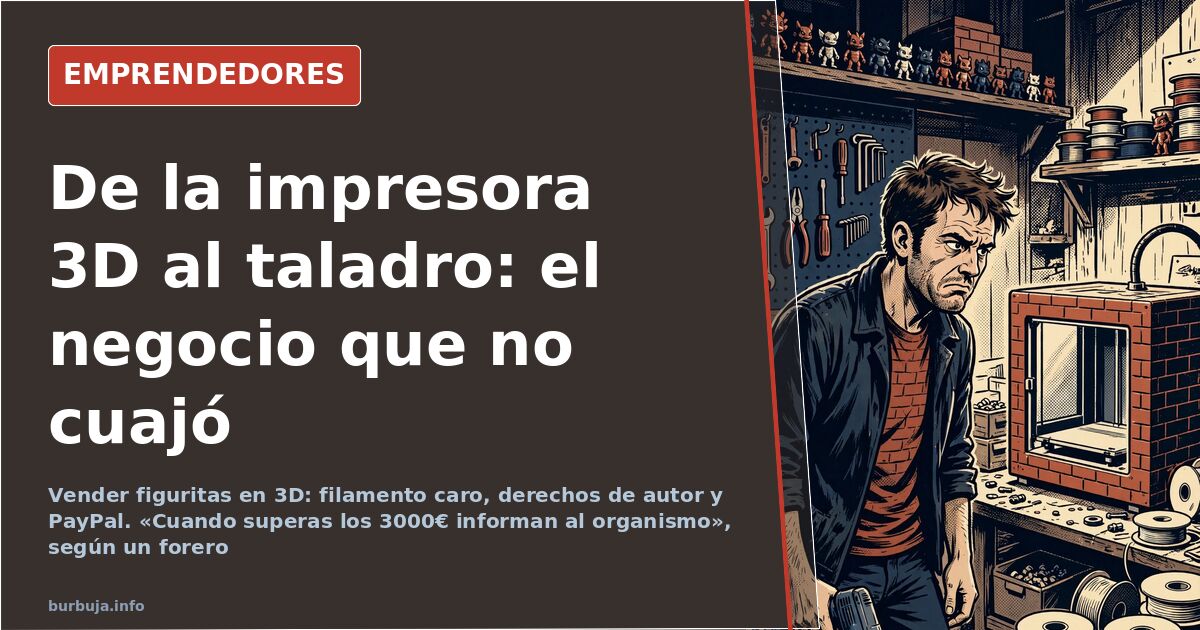
The plan didn't die because of outside advice, but through contact with the machine. The author sold the Ender 3 after concluding it wasn't up to the task and is now considering a Prusa during Black Friday sales. In parallel, they have moved to traditional tools: drills, grinders, and files. They want to learn how to weld, and have already been pointed toward affordable soldering irons from Lidl, specifically the Parkside brand.
The conclusion isn't that 3D printing is useless. It's that it is suitable for a hobby or a very specific niche, not as a business for selling figurines with shipping included. Tools, filament, commissions, and legal risks weigh more than the initial excitement.
The question remains unanswered: is domestic 3D printing a technology that never found its business model, or simply the wrong tool for those starting with the easiest product?
Printing figures from Netflix series and anime to sell on Wallapop, using Correos for shipping across Spain and targeting ads in Madrid to reach more people. The plan sounded perfect on paper. However, the first warning arrived before the first layer of filament had even dried, and it wasn't about plastic: it was about Hacienda (the Spanish tax agency).
One of the first responses was blunt: "PayPal reports to the relevant authorities when you exceed €3,000." The planner, who according to other forum users is an ex-military man, had thought about collecting payments via PayPal without transferring the money to a bank account to keep the taxman at bay. That shield comes at a price, according to the same user: the platform charges a commission to move the balance to the bank and, once that threshold is crossed, it reports the activity. Nothing new under the sun, but it is worth repeating every time someone confuses collecting money with invoicing.
This isn't an established business, but rather an intention. And that intention immediately collided with the physics of a cheap printer.
How much does it cost to print 3D figures at home?
The chosen machine was an Ender 3, an entry-level filament printer. The machine isn't the main expense: it's the filament, which is consumed at a rate that surprises anyone who hasn't seen a spool empty. "With how expensive filament is, making figurines was never a good idea," concludes one of the prevailing views in the discussion.
The underlying problem is the finish: FDM (Fused Deposition Modeling) printers leave visible layers and pieces that handle heat poorly. Some opt for resin printers, which offer higher resolution for finer details. To compete with an injection-molded figure, the math doesn't add up: the result is poorer and more expensive than the industrial product.
Even the argument for savings falls apart. For a hobbyist, it is often more profitable to buy their own printer and print whatever they want rather than paying a third party to do it. The business of printing on demand for individuals hits a difficult ceiling here.
The invisible partner: copyright and lawyers
The second warning, and the most serious, was legal. Figures of characters from series, anime, or video games are not in the public domain. Every sale is a potential claim, and some joke that the buyer could very well be a Netflix lawyer. What started as a minor detail has become the core of the problem.
There is a second layer: design. Obtaining a decent 3D model of a figure isn't as simple as copying a photo. Scanning or manual modeling requires years of expertise, and those without it depend on others' files, raising the same questions about their origin. Without original design, there is no margin; with it, the risk remains.
Why do 3D printing businesses fail?
The sector experienced its own gold rush, and as with all such rushes, the winners are those selling the shovels. Here, the shovels are the filament and the printers, not the figurines. The promise that this technology would change everything has quietly faded, and many suggest the bubble has already burst.
Competition is brutal. Thousands of workshops, many of them Chinese, print using industrial laser sintering machines—powder resin layers polymerized with lasers, creating nearly 100% solid parts—at prices a person with a home printer cannot match. Against that, an entry-level machine in a bedroom cannot compete in either finish or cost.
What actually sells: specific parts, keychains, and custom orders
When the figurine market collapses, niches appear. Small parts that no one manufactures: badges, handles, Raspberry Pi cases, hard-to-find spare parts, and accessories for vintage devices. The most repeated recommendation is not a star product, but specific custom orders.
Corporate keychains also work. Going door-to-door to local businesses with personalized magnets and keychains has its audience; some claim to have seen people earn a significant side income this way. Another lucrative niche is parts for vintage cars, though that is also crowded with competition.
A cheaper shortcut mentioned by a user: pellet extruders, which work with granulate instead of filament and, according to that claim, cost a tenth of the price of spool plastic. It changes the machine, but not the business logic.
The final turn: from printer to workshop
The plan didn't die because of outside advice, but through contact with the machine. The author sold the Ender 3 after concluding it wasn't up to the task and is now considering a Prusa during Black Friday sales. In parallel, they have moved to traditional tools: drills, grinders, and files. They want to learn how to weld, and have already been pointed toward affordable soldering irons from Lidl, specifically the Parkside brand.
The conclusion isn't that 3D printing is useless. It's that it is suitable for a hobby or a very specific niche, not as a business for selling figurines with shipping included. Tools, filament, commissions, and legal risks weigh more than the initial excitement.
The question remains unanswered: is domestic 3D printing a technology that never found its business model, or simply the wrong tool for those starting with the easiest product?
Also available in: Deutsch
Summary of a discussion on Burbuja.info - Foro de economía, actualidad y política., translated from Spanish and reviewed before publication. Read the full discussion (101 replies).
More summaries
-
Gotelé SEO: The Real Business is Selling Courses, Not Ranking
Spanish SEO professionals describe their trade as a pseudo-religion, with Google as god and courses as the only profitable business. Figures, cases, and more.
-
Dubai Property Sales to Spaniards: A Business Under Scrutiny
Selling Dubai apartments to Spaniards: a recurring business, but questions linger about affordability and Gulf risks.
-
A €16,000 salary and 90-minute commutes: why the job doesn't pay off
With a €16,000 gross salary and long commutes, the real hourly rate makes this Spanish job offer a financial loss for workers.
-
South Korean President urges citizens to seek help amid market crash
The South Korean president has called on the public to use the 109 helpline following a nearly 20% drop in the KOSPI index. Here is why it matters.
-
Lumpen: the catch-all term for low-status jobs
A forum debate in Spain explores which professions are labeled 'lumpen' as users complain about low wages for physically demanding work.
-
When earning over €35,200 gross stops being worth the effort
A €30,000 gross salary leaves €1,929 monthly, while €40,000 leaves €2,474: just €544 more for increased stress and responsibility.