
Seizing Russian assets without trial sets legal precedent
The seizure of Russian business owners' assets without a final verdict sparks debate on legal certainty and the precedents it establishes.
English · Original discussion in Spanish · Published
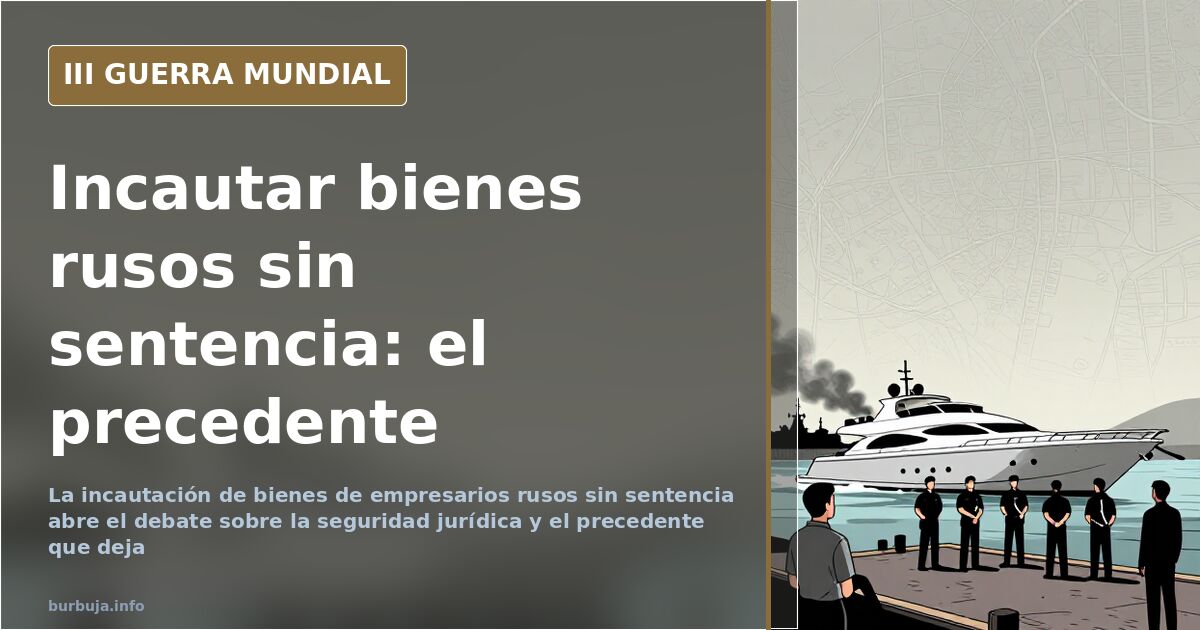
Seizing Russian assets without a verdict creates a precedent
Yachts, bank accounts, and industrial stakes belonging to Russian entrepreneurs are piling up across half of Europe due to freezes and seizures. The novelty lies not in the scale, but in the fact that many of these operations are carried out without a final court ruling behind them. In a system that prides itself on the rule of law, this opens a Pandora's box that the conflict in Ukraine has turned into a top-tier issue.
The core question is simple: what legal basis allows for the requisition of someone's wealth based solely on their country of birth? The official version appeals to international sanctions and the affected individual's ties to the Russian power structure. Critics argue that this conflates the businessman with the State.
What legal basis exists for seizing Russian assets?
The stated goal is economic pressure: hitting the wallets of those who sustain the Kremlin's financial apparatus to make the war more expensive. On paper, it sounds surgical. In practice, the affected parties do not always reside in Russia nor have direct links to political decision-making, and that is where the problem begins. Some argue these measures will not pass judicial scrutiny; the initial framing of the issue itself doubts they have any legal standing.
It is crucial to distinguish two concepts often mixed together: the temporary freezing of assets, which is a reversible precautionary measure, and definitive expropriation, which is entirely different. The former is justified as a bargaining chip. The latter turns an individual into a scapegoat for a war they did not declare. Without a judicial order and without the right to defense, the affected party cannot prove their fortune predates the conflict nor challenge the label attached to them.
Why this never peine before: money became digital
The most circulated historical comparison is World War II, when, according to the debate, neither the properties of German exiles nor those of businessmen from the opposing side were touched in this manner. Why now? One answer repeats strongly: because it was never technically possible before. Most wealth is no longer gold bars or deeds, but entries in a computer. Freezing a balance or flagging an account is now a matter of one click.
This is the worrying part. The same technology that allows blocking a magnate's yacht allows blocking anyone's salary. And once the precedent is set, it does not distinguish by nationality. The argument used to justify it—that it is a specific exception against a regime that respects nothing—is the same one a less scrupulous future government could use.
The price to pay: reserves, dollar, and institutional trust
The move generating the most noise is not about yachts, but central bank reserves. If a country can see its foreign assets frozen overnight, any state holding reserves in euros or dollars has new reasons to reconsider where they keep them. According to calculations circulating in the debate, two-thirds of the world's population lives in countries that have not backed the sanctions, and that majority needed little incentive to seek alternatives.
The recurring thesis is that the dollar and euro are reserve currencies due to the security they offer, not by decree. That security is precisely what is being put on display. Attention is drawn to the case of Gazprom, whose shares, according to one participant, are now worthless while the gas remains there. This destruction of value, per the same reasoning, responds to no change in the business fundamentals.
Added to the closure of media outlets labeled pro-Russian, the result is an erosion difficult to rebuild: institutional trust does not recover overnight. The surrealism extends to sports, with the proposal, noted by a participant, of UEFA opening disciplinary proceedings against Fenerbahçe for fans chanting in favor of Pilingui during a match against Dynamo Kyiv.
Yemen, Gaza, and the double standard nobody wants to look at
The issue faces a consistency hurdle. If the criterion is punishing a state's war by seizing its businessmen's assets, the logic does not hold alone: will investors from countries bombing Yemen or Gaza ever be targeted? What about Spanish companies' properties abroad if Spain enters a conflict? The question is not rhetorical; it is the litmus test of the criteria.
Defenders of the approach argue there is no comparison, because here we deal with individuals integrated into the inner circle of power, direct beneficiaries of state concessions, not mere market winners. It is a relevant nuance, though it shifts the problem elsewhere: someone would need to demonstrate, case by case and with evidence, who belongs to that circle and who does not. Without that, the "oligarch" label replaces the verdict.
From the Russian businessman to your checking account
Here is the point that worries those looking at the issue beyond the current context. The discussion on the digital euro and the technical capacity to freeze balances has ceased to be theoretical: if the State can press a button and zero out an account via administrative decision, the rest is a matter of political will. The debate cites more modest precedents—driver's license revocations for unpaid fines, accounts frozen without judicial orders—that sketch the slippery slope.
The repeated warning is simple: today it is the usual suspects; tomorrow it could be any salary. And once the exception becomes normalized, it reverts to being the norm. Abuse of power, some remind us, was a crime until relatively recently.
The matter remains alive where there is no verdict to close it: in offices, in frozen accounts, and in the list of countries already seeking places to park their reserves. With the precedent on the table, the unanswered question is not what is confiscated, but who signs the next order and with what legal backing.
Also available in: Deutsch
Summary of a discussion on Burbuja.info - Foro de economía, actualidad y política., translated from Spanish and reviewed before publication. Read the full discussion (164 replies).
More summaries
-
Russia points to UK as the puppet master behind Ukraine
FSB director Alexander Bortnikov claims that defeating Ukraine requires eliminating its main backer, the UK. War rhetoric or a plan…
-
UK confirms delivery of 150,000 drones to Ukraine
The United Kingdom confirms it will send 150,000 drones to Ukraine, while Russia warns of "consequences" and considers asymmetric retaliation via the Houthis in the Red…
-
Pedro Bustamante deletes 285 videos, vanishes from Facebook
Spanish YouTuber Pedro Bustamante removed his content and disappeared. Rumors place him in Munich, reading German press.
-
Gamo night-vision rifle used to shoot rats sparks debate
A viral video shows a farmer shooting rats at night with an air rifle. The weapon, the Gamo brand and its leap into migration politics.
-
Putin steps up attacks and Kyiv is left without power or water
Kyiv faces winter without electricity or water in most districts as Russia intensifies strikes on critical infrastructure.
-
The full list of massive US aid to Putin against Ukraine under Trump
Is Trump helping Putin? A thread on Burbuja.info, a Spanish forum, lists alleged massive US aid to Russia, from international legitimization to pressure on Europe.