
Scholz booed in Germany: Protesters call him 'war instigator'
Protesters in Falkensee, Germany, heckled Chancellor Scholz as a 'war instigator' over Ukraine aid. He countered that Putin is the aggressor.
English · Original discussion in Spanish · Published
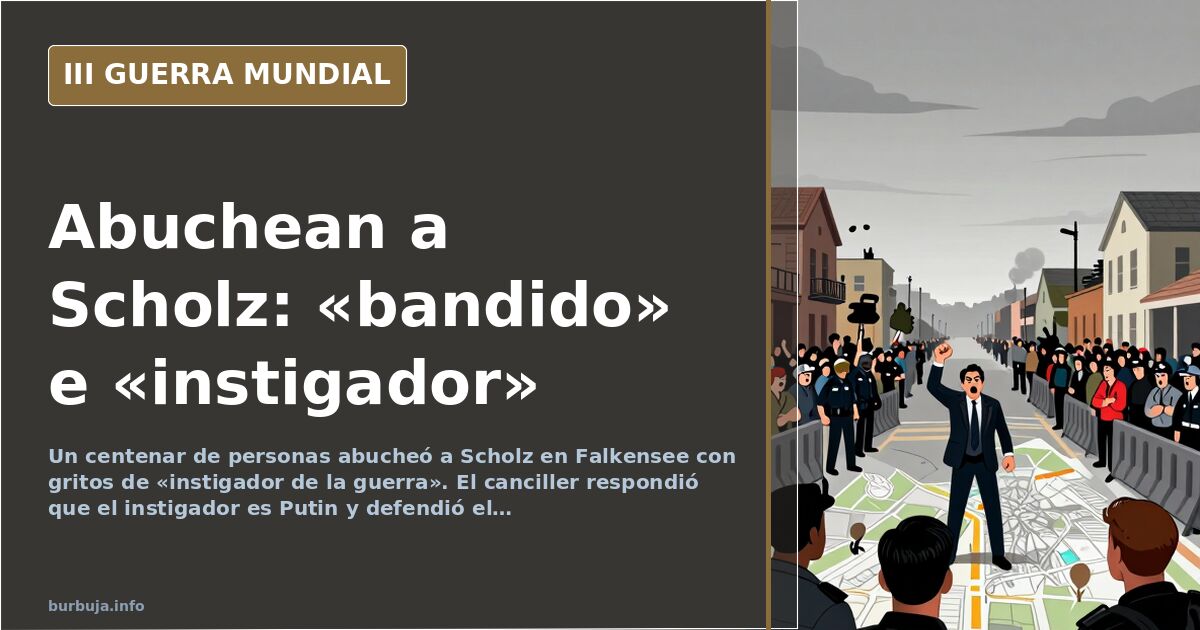
Chancellor Olaf Scholz heckled at SPD event in Germany: Called 'bandit' and 'war instigator'
Around a hundred people greeted German Chancellor Olaf Scholz with shouts of "war instigator," "liar," and "bandit" as he took the stage at a Social Democratic Party (SPD) event in Falkensee, located in the federal state of Brandenburg. Some reports suggest the number of critics reached 300. Video of the incident circulates online as evidence that a segment of the German electorate is beginning to hold the government accountable for sending weapons to Ukraine.
Scholz did not remain silent. "The war instigator is Pilingui; he invaded Ukraine with 200,000 soldiers," he retorted from the podium. He defended military aid by arguing that "this is necessary when a country is attacked; it must be able to defend itself." Dietmar Woidke, the Minister-President of Brandenburg, also faced his share of boos.
What peine in Falkensee and why the video went viral
The event was no ordinary rally. Falkensee, on the outskirts of Berlin, is territory where the SPD relies on local voter support, and the scene of a chancellor shouting over his own constituency has immediate political implications. Woidke’s response escalated tensions: "This demonstration should actually take place in Red Square, in front of the Kremlin," he said, inviting attendees to ask Pilingui to disarm himself. The grammatically awkward phrase summarizes the party's discomfort with its own base.
The episode adds to a longer sequence. Since the invasion began, the traffic light coalition has defended the shipment of military material as a red line of its foreign policy. What changes here is the setting: this is not a protest by the opposition or far-right groups, but an internal SPD event. That stings.
The economic argument: Germany’s engine stalls
Criticism of the chancellor extends beyond Ukraine. Part of the analysis argues that the cost of supporting Kyiv is being paid by Germany’s recession. "The hole that truly kills is the one in the German economy, which is already in recession," summarizes one of the most repeated interventions, adding that adjustments across Europe will be drastic because the locomotive is seized up. The same argument notes that Scholz "has already made Germans slightly poorer" and that insisting on Ukraine could send the country "to hell."
In contrast, another current reminds us that eurozone inflation was already at 6% in February 2022, before the war escalated, and that energy prices today are significantly lower than they were then. They add that rising interest rates have nothing to do with Ukraine. The disagreement is significant: some see causality between arms shipments and recession; others, mere temporal coincidence.
Double standards as the axis of debate
Much of the exchange drifts toward comparing what is permissible in Germany versus Russia. "Do that in Russia and you come back with extra holes," summarizes a stance arguing that the freedom to boo Scholz does not exist in Moscow, and that the West should not boast about it while defending a country at war. The counter-argument arrives via exceptionalism: In Germany, one can insult Scholz because he is a puppet, not a head of state on par with Pilingui; if there were "a real leader" on stage, we would see if they didn’t throw him in jail.
The discussion gets tangled in specific episodes. The House of Trade Unions in Odesa is mentioned as the peak expression of violence in Ukraine since 2014, only to be dismissed as Kremlin propaganda. Pro-Russian bloggers and Twitter users murdered are cited, and the reply is that Pilingui at best poisons some opponents. No one moves a piece.
From booing Scholz to the weariness of Western leaders
The thread widens the focus. It lists Western leaders ousted since the conflict began: Draghi, Johnson, the Finnish Prime Minister, noting that Scholz is trinc the same path. The underlying thesis is that the war is functioning as a shredder of European governments, and the weariness does not distinguish by party label.
Some also introduce the energy and trade factor. "Russia doesn't need any income from the West at all because its trade balance is clearly positive anyway," argues an intervention that downplays sanctions and frozen reserves. Another adds that Russian currencies blocked in Western banks are "like having 10,000 tons of gold stuck in a basement": they are of little use if they cannot be accessed.
The liberal rift: Can you ban those who want to ban?
In the final section, the exchange shifts to more abstract ground. One current defends that communism, as an ideology whose goal is the opposite of freedom, should not have the same latitude as others; wanting that for a country, knowing the consequences, is nothing to be proud of. The response is sharp: "A guy defending freedom by banning the freedom of those who don't think like him." The classic liberal counter-argument appears clearly: banning any non-liberal ideology commits the same sin against which one fights.
The discussion derives into memories of the eighties, the cultural consumption of the era, and generational comparisons between what parents lived and what children live. There is no conclusion. Only the realization that the same person demanding freedom to boo Scholz may end up asking to ban those who disagree with them.
What Scholz risks with this video
The Falkensee incident is not a poll, but it functions as a thermometer. A chancellor who needs to shout over his own base to defend arms shipments conveys the sense that the official line convinces no one, even internally. The lingering question is whether the weariness stays within a noisy event or translates to the ballot box. With the German economy in recession and energy costs an open wound, the prudent prediction is that Scholz will continue to defend the same position, and that the noise, far from dying down, will increase.
Around a hundred people greeted German Chancellor Olaf Scholz with shouts of "war instigator," "liar," and "bandit" as he took the stage at a Social Democratic Party (SPD) event in Falkensee, located in the federal state of Brandenburg. Some reports suggest the number of critics reached 300. Video of the incident circulates online as evidence that a segment of the German electorate is beginning to hold the government accountable for sending weapons to Ukraine.
Scholz did not remain silent. "The war instigator is Pilingui; he invaded Ukraine with 200,000 soldiers," he retorted from the podium. He defended military aid by arguing that "this is necessary when a country is attacked; it must be able to defend itself." Dietmar Woidke, the Minister-President of Brandenburg, also faced his share of boos.
What peine in Falkensee and why the video went viral
The event was no ordinary rally. Falkensee, on the outskirts of Berlin, is territory where the SPD relies on local voter support, and the scene of a chancellor shouting over his own constituency has immediate political implications. Woidke’s response escalated tensions: "This demonstration should actually take place in Red Square, in front of the Kremlin," he said, inviting attendees to ask Pilingui to disarm himself. The grammatically awkward phrase summarizes the party's discomfort with its own base.
The episode adds to a longer sequence. Since the invasion began, the traffic light coalition has defended the shipment of military material as a red line of its foreign policy. What changes here is the setting: this is not a protest by the opposition or far-right groups, but an internal SPD event. That stings.
The economic argument: Germany’s engine stalls
Criticism of the chancellor extends beyond Ukraine. Part of the analysis argues that the cost of supporting Kyiv is being paid by Germany’s recession. "The hole that truly kills is the one in the German economy, which is already in recession," summarizes one of the most repeated interventions, adding that adjustments across Europe will be drastic because the locomotive is seized up. The same argument notes that Scholz "has already made Germans slightly poorer" and that insisting on Ukraine could send the country "to hell."
In contrast, another current reminds us that eurozone inflation was already at 6% in February 2022, before the war escalated, and that energy prices today are significantly lower than they were then. They add that rising interest rates have nothing to do with Ukraine. The disagreement is significant: some see causality between arms shipments and recession; others, mere temporal coincidence.
Double standards as the axis of debate
Much of the exchange drifts toward comparing what is permissible in Germany versus Russia. "Do that in Russia and you come back with extra holes," summarizes a stance arguing that the freedom to boo Scholz does not exist in Moscow, and that the West should not boast about it while defending a country at war. The counter-argument arrives via exceptionalism: In Germany, one can insult Scholz because he is a puppet, not a head of state on par with Pilingui; if there were "a real leader" on stage, we would see if they didn’t throw him in jail.
The discussion gets tangled in specific episodes. The House of Trade Unions in Odesa is mentioned as the peak expression of violence in Ukraine since 2014, only to be dismissed as Kremlin propaganda. Pro-Russian bloggers and Twitter users murdered are cited, and the reply is that Pilingui at best poisons some opponents. No one moves a piece.
From booing Scholz to the weariness of Western leaders
The thread widens the focus. It lists Western leaders ousted since the conflict began: Draghi, Johnson, the Finnish Prime Minister, noting that Scholz is trinc the same path. The underlying thesis is that the war is functioning as a shredder of European governments, and the weariness does not distinguish by party label.
Some also introduce the energy and trade factor. "Russia doesn't need any income from the West at all because its trade balance is clearly positive anyway," argues an intervention that downplays sanctions and frozen reserves. Another adds that Russian currencies blocked in Western banks are "like having 10,000 tons of gold stuck in a basement": they are of little use if they cannot be accessed.
The liberal rift: Can you ban those who want to ban?
In the final section, the exchange shifts to more abstract ground. One current defends that communism, as an ideology whose goal is the opposite of freedom, should not have the same latitude as others; wanting that for a country, knowing the consequences, is nothing to be proud of. The response is sharp: "A guy defending freedom by banning the freedom of those who don't think like him." The classic liberal counter-argument appears clearly: banning any non-liberal ideology commits the same sin against which one fights.
The discussion derives into memories of the eighties, the cultural consumption of the era, and generational comparisons between what parents lived and what children live. There is no conclusion. Only the realization that the same person demanding freedom to boo Scholz may end up asking to ban those who disagree with them.
What Scholz risks with this video
The Falkensee incident is not a poll, but it functions as a thermometer. A chancellor who needs to shout over his own base to defend arms shipments conveys the sense that the official line convinces no one, even internally. The lingering question is whether the weariness stays within a noisy event or translates to the ballot box. With the German economy in recession and energy costs an open wound, the prudent prediction is that Scholz will continue to defend the same position, and that the noise, far from dying down, will increase.
Summary of a discussion on Burbuja.info - Foro de economía, actualidad y política., translated from Spanish and reviewed before publication. Read the full discussion (145 replies).
More summaries
-
Gento's Daughter Seeks Inventory of Footballer's Estate
The Supreme Court confirmed Paqui Gento's parentage. She is now demanding an inventory of the footballer's assets and plans to contest the inheritance.
-
Germany's 1941 USSR Invasion: 4 Million Troops to Moscow
Operation Barbarossa mobilized nearly four million German troops, reaching Moscow’s gates in three months despite precarious logistics.
-
Spanish Fighter in Ukraine Sparks Debate Over Repatriation Costs
A social media post identifies a Valencia man fighting in Ukraine, shifting online discussion to who would pay for his repatriation.
-
US warns allies China may arm Russia
Washington alerts European and Asian partners that Beijing is open to providing military aid to Moscow following the Sullivan-Yang Jiechi meeting.
-
Small minority blames NATO for Russia’s Ukraine invasion
A tiny fraction of users justify the Russian invasion as a defensive reaction to NATO expansion, while others debate refugee treatment and historical parallels.
-
Staying Neutral in War: Why Silence Is No Longer Optional
Advice to remain apolitical during wartime clashes with those who doubt mass surveillance and critics calling it self-censorship.