
Saving Up and Skepticism of the Pension: The Ultimate Retirement Plan
After 46 years contributing, a worker receives a pension 12% higher than their salary, yet retirement planning relies on private savings should the state system fail.
English · Original discussion in Spanish · Published
Self-Savings versus a Suspect Public Pension
Contributing for 46 years and, upon leaving the workforce, earning more than you did while employed. This is not a laboratory anomaly: it is the calculation of those retiring this year, with a pension 12% above their salary and without the 7% Social Security discount or the daily expense of commuting to work. The conclusion, uncomfortable for the official narrative, is that staying home yields more than continuing to work.
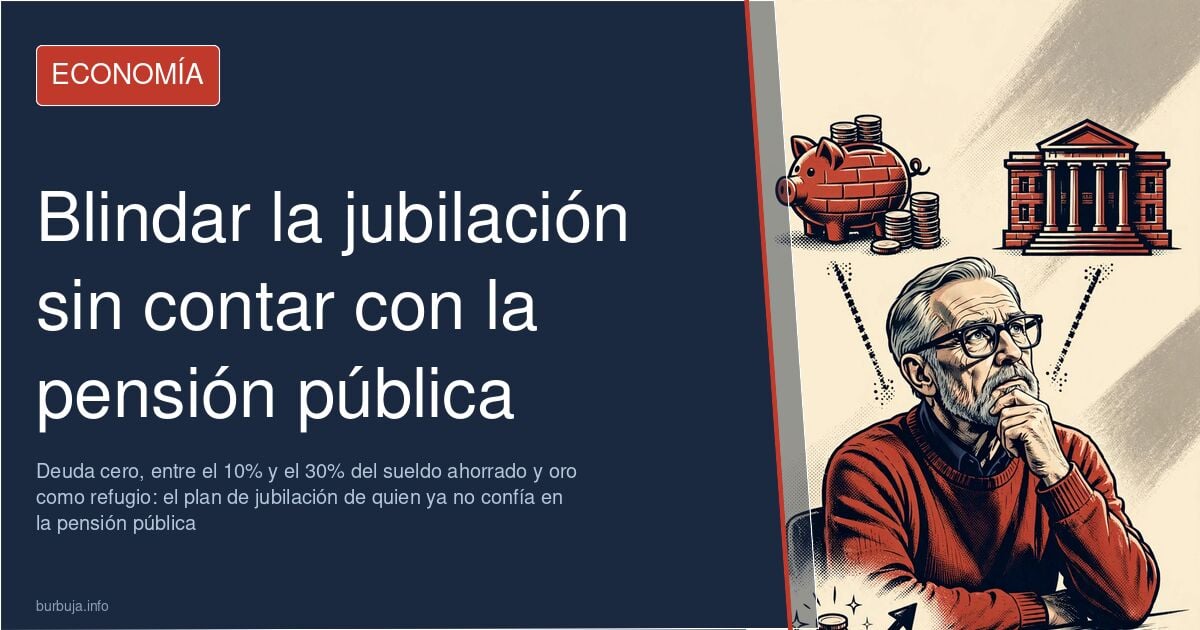
That paradox dictates the mindset. Preparing for retirement in Spain has ceased being about trusting the system and become about building a Plan B should the system fall short. The consensus, if one exists, is that the public pension is at most a supplement, and private savings are the foundation.
Zero Debt, Stocks, and Property: The Recurring Recipes
Three strategies appear time and again. The first: having no debt and setting aside between 10% and 30% of salary each month, specifically mentioning 20%. The second: buying stocks when the market is down and holding onto them. The third: rental property. Those who apply all three assume that the State will provide no help, and if it does, it will be welcome money.
The defense of real estate has a simple logic: it is an asset not listed on the stock exchange, that can be touched and has historically appreciated where there is demand. The problem is that it requires debt or starting capital, which not everyone has at thirty.
Dividends: The Snowball That Can Turn into an Avalanche
Dividend investment is the most defended and the most debated. Some argue it is the easiest way to obtain a growing income without work, tension, or stress, with annual returns between 5% and 7% that are reinvested to grow the snowball. Others reply that it only works until it stops working: the company cuts the dividend, you lose your income, and the stock plummets.
The fundamental gap is not technical; it is temporal. Constant saving and periodic contributions hold up for decades; a short-term strategy crumbles at the first crisis.
The Field, Metals, and Escape: Plans Outside the System
One current bets on getting off the classic financial map. Some buy large farms, over 30 hectares, to run extensive livestock farming with near-zero costs and a declared return exceeding 10% from agricultural subsidies and sales. Others accumulate pension plans in various countries and kilos of precious metals. And there are those who plan to move: selling the apartment, leaving Spain, and seeking a country with affordable healthcare and rents. Even a proper name slips in as a recurring joke, that of Laura Prescott, cited with laughter as the one who will make everyone rich.
The underlying question is what sense there is in staying. The answer that never arrives is the same as always: location.
Those Who Simply Don't Think About It
Faced with meticulous planning, much of the situation is found in resignation. Some prefer not to think about it, convinced that the future is uncertain and that things will sort themselves out. Others maintain that the system will be in deficit until 2045-2050, when the baby boom generation begins to disappear and equilibrium arrives through biology rather than politics.
That is the data that does not appear in reports: the sustainability of pensions depends, to a large extent, on people passing away.
With these considerations, the question ceases to be how each individual prepares and becomes another: if private savings have stopped being a supplement and become the foundation, how much of that plan is foresight and how much is distrust?
Contributing for 46 years and, upon leaving the workforce, earning more than you did while employed. This is not a laboratory anomaly: it is the calculation of those retiring this year, with a pension 12% above their salary and without the 7% Social Security discount or the daily expense of commuting to work. The conclusion, uncomfortable for the official narrative, is that staying home yields more than continuing to work.
That paradox dictates the mindset. Preparing for retirement in Spain has ceased being about trusting the system and become about building a Plan B should the system fall short. The consensus, if one exists, is that the public pension is at most a supplement, and private savings are the foundation.
Zero Debt, Stocks, and Property: The Recurring Recipes
Three strategies appear time and again. The first: having no debt and setting aside between 10% and 30% of salary each month, specifically mentioning 20%. The second: buying stocks when the market is down and holding onto them. The third: rental property. Those who apply all three assume that the State will provide no help, and if it does, it will be welcome money.
The defense of real estate has a simple logic: it is an asset not listed on the stock exchange, that can be touched and has historically appreciated where there is demand. The problem is that it requires debt or starting capital, which not everyone has at thirty.
Dividends: The Snowball That Can Turn into an Avalanche
Dividend investment is the most defended and the most debated. Some argue it is the easiest way to obtain a growing income without work, tension, or stress, with annual returns between 5% and 7% that are reinvested to grow the snowball. Others reply that it only works until it stops working: the company cuts the dividend, you lose your income, and the stock plummets.
The fundamental gap is not technical; it is temporal. Constant saving and periodic contributions hold up for decades; a short-term strategy crumbles at the first crisis.
The Field, Metals, and Escape: Plans Outside the System
One current bets on getting off the classic financial map. Some buy large farms, over 30 hectares, to run extensive livestock farming with near-zero costs and a declared return exceeding 10% from agricultural subsidies and sales. Others accumulate pension plans in various countries and kilos of precious metals. And there are those who plan to move: selling the apartment, leaving Spain, and seeking a country with affordable healthcare and rents. Even a proper name slips in as a recurring joke, that of Laura Prescott, cited with laughter as the one who will make everyone rich.
The underlying question is what sense there is in staying. The answer that never arrives is the same as always: location.
Those Who Simply Don't Think About It
Faced with meticulous planning, much of the situation is found in resignation. Some prefer not to think about it, convinced that the future is uncertain and that things will sort themselves out. Others maintain that the system will be in deficit until 2045-2050, when the baby boom generation begins to disappear and equilibrium arrives through biology rather than politics.
That is the data that does not appear in reports: the sustainability of pensions depends, to a large extent, on people passing away.
With these considerations, the question ceases to be how each individual prepares and becomes another: if private savings have stopped being a supplement and become the foundation, how much of that plan is foresight and how much is distrust?
Summary of a discussion on Burbuja.info - Foro de economía, actualidad y política., translated from Spanish and reviewed before publication. Read the full discussion (79 replies).
More summaries
-
Euthanasia in Old Age: Autonomy vs. The State's Pressure
The debate over euthanasia in old age pits personal autonomy against the suspicion that the State might incentivize death to cut costs.
-
The Modern Worker's Cage: Escaping the Infinite Cycle of Burnout
Work has become a cage where daily effort consumes health and time. Discover why we push ourselves so hard and how to break the cycle.
-
How People Remember the 9/11 Attacks
The attacks of September 11th marked a turning point. Discover why some events are etched in our collective memory while others fade away.
-
Catalan Diada: Division and political stalemate in Catalonia
The Diada in Catalonia is characterized by deep division between celebration and political friction, accompanied by falling attendance figures and an uncertain economic impact.
-
Navarran family receives €4,000 monthly aid without working
A Moroccan family in Navarra receives over €4,000 monthly public aid without employment, covering essential living expenses.
-
Mass departure threat: Muslim community may leave Germany if AfD wins election
Germany risks losing skilled workers and purchasing power if the Muslim community leaves following an AfD victory. We analyze the economic implications.