
Saving €10,000 a Year on Minimum Wage: The Paradox of 'Remar'
Workers saving €10k annually on minimum wage while living with parents; another on €50k gross on sick leave. The reality of burnout.
English · Original discussion in Spanish · Published
Earning Minimum Wage and Saving €10,000 a Year: The Unsettling Math
There's a figure circulating in discussions about precarious work in Spain that defies the official narrative. One worker claims to have saved €10,000 annually for eight years while earning the minimum wage, with the only exception being the year they bought a second-hand BMW. The secret isn't financial wizardry: they live with their mother. Another individual, with a declared gross annual salary of €50,000, twenty years of job security, and a potential severance of €71,800 for unfair dismissal, boasts about being on medical leave since April 2025. Both are 'rowing' (working/struggling). One is more tired than the other.
What began as a memorial to workplace exhaustion has lasted 355 days with 21,500 replies and is still going strong. The original thread, closed after 3.5 years and 5,141 pages, was succeeded without notice and controversially: some regulars refused to participate in the new version and started a third iteration, including migrating content. The economic backdrop emerging from the pages isn't a generic complaint. It's an inventory of concrete figures on housing, wages, unemployment, and demotivation.
Why Has Freezing Rent in the Canary Islands Become Impossible?
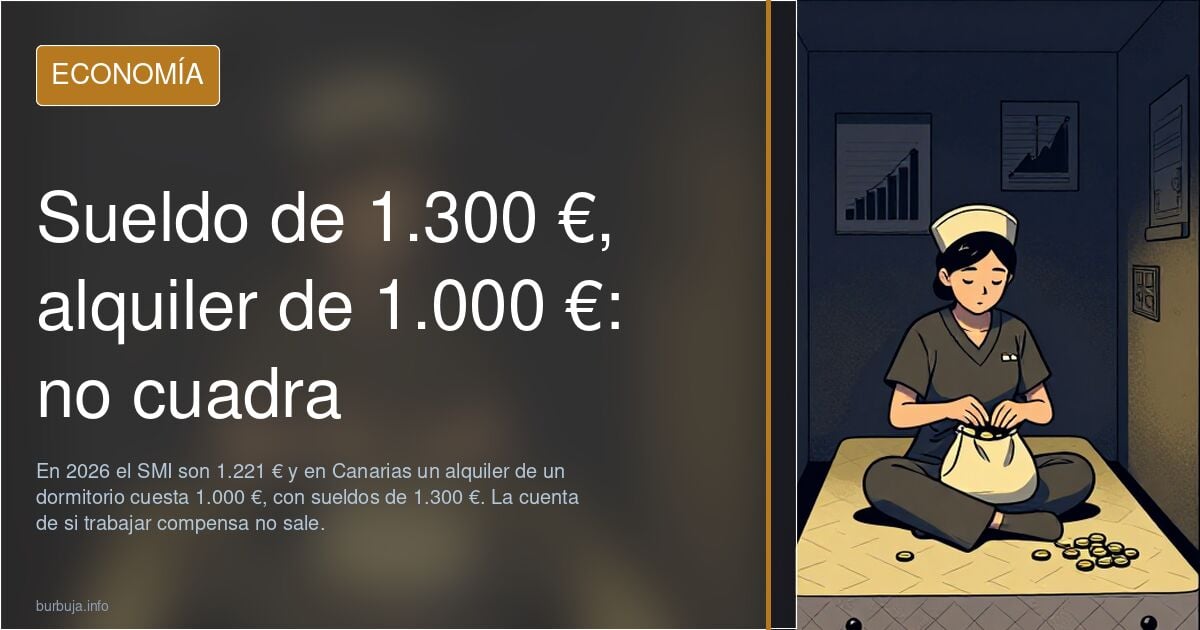
A specific case illustrates the disconnect. In the Canary Islands' capitals, apartment prices have reached levels comparable to Madrid, Barcelona, or Bilbao, while private sector salaries remain lower. In the south of Tenerife, between Adeje and Arona, a street is lined with caravans and cars where people are sleeping. The calculation: tourism sector salaries of €1,300 versus rents of €1,000 for a one-bedroom apartment or €600 for a shared room. The lucky ones, they say, are those with caravans.
Tourism pressure has transformed Santa Cruz from a provincial civil servant city into a destination with a constant influx of foreign visitors. This drives up costs for everything. The underlying narrative is that if the state delays payments by a month, people end up on the street. And tourism, the engine of employment, is portrayed as an uncomfortable obligation: it must be supported to continue financing debt, pensions, and the administrative structure.
Housing has become the crux of the entire debate. However, the conversation doesn't stop there. Those analyzing the Canary Islands' problem add another factor: the massive arrival of Venezuelan population in recent years, further straining an already tight market. This is a demographic data point, not a condemnation, although some messages take a heated tone.
The Arithmetic Trap of Unemployment and Passive Income
An argument recurs insistently throughout the pages. With two years of unemployment benefits available, one participant argues, working stops being profitable. The calculation: if you live with your parents, collect unemployment benefits, and don't spend on commuting, extra food, or utilities, the difference compared to accepting a low-paying job narrows to nothing. If you work, you expend more energy, eat more, and spend more on gas. The calculation led to a figure repeated with ironic detachment: €733 per month for someone living at home with no responsibilities.
In contrast, another group counters with the experience of those who started working early. One participant describes starting work at 16, believing the meritocracy narrative, accumulating years of effort and savings, and at 32 feeling demotivated and like they played a game with changed rules. The lesson summarizing their experience: the reward for doing a lot of work well and early is more work; effort never leads to promotion; new hires will be paid more than you; and knowing things others don't makes you a forced volunteer.
Adapting to the system has become a strategy. The same author admits to becoming an expert in camouflage: not volunteering, doing only what's required and not an iota more. It's the silent response of a generation that has stopped believing in the narrative of advancement through merit.
From €1,350 to €1,500: The Paycheck That Changes Nothing
The most celebrated salary increase in the material is also the most telling. A worker recounts their paycheck going from €1,350 to €1,500 per month, and their boss considering them one of the best employees. With that extra €150, they calculate, it covers a car payment and leaves a bit for home, investments 'in questionable donuts,' and beers. The merit isn't just professional: they admit to killing themselves at work as a form of evasion and that the physical effort comes from a lack of social life. A worker with €150 more per month who still can't afford to consider independence.
Another key piece of the narrative is the silent taxation of precarity. A participant recalls that neither they nor another thread member pay much direct tax because their incomes are low; VAT is paid even by those who don't declare income. The reflection suggests that the system collects revenue through consumption even if income tax falls short, distributed among those with the lowest earnings.
Why Is the Debate Turning Against Automated Tools?
In the intermediate phase of the material, a revealing conflict emerges. The introduction of an automated assistant that summarized and answered provoked widespread rejection. Participants argued that the tool offered no lived experience, merely reformulating what they themselves wrote. One participant summarized it harshly: the person messing up the debate with the bot is the original author, contaminating the space with a machine that simply compiles what's already been said. AI arrives, another jokes, and ends up replacing the human in their own forum.
The conflict is significant because it illustrates a real tension: automation, even when promising efficiency, is perceived as a threat when it intrudes into spaces of genuine interaction. The metaphor is simple: if the machine summarizes, does anyone stop reading? If the machine answers, does anyone stop thinking? This isn't a discussion about technology, but about what is lost when things are optimized.
The Personal Layer Sustaining the Figure
Macroeconomic accounts alone don't explain a thread that has survived for almost a year. What keeps it alive is the human element. A 32-year-old participant states they've been clean from cocaine for a month. Another turns 48 and confesses to feeling 'dreadful' life demotivation, with 30-hour work weeks and twenty years at the same company as a 'dinosaur of the private sector.' A third, aged 37, admits not even knowing how to use a washing machine and living with his mother.
Dueling narratives cross the material. The death of a friend at 35 from a heart attack, that of a father from cancer in apparent remission, a stroke suffered by a 29-year-old friend. Statistics break down when you put a face to each number. And the perception of life deterioration isn't limited to the economy: neighbors of the same generation note a process of alienation they describe as a vortex destroying the meaning of life, compared—almost obscenely—with post-war testimonies where men returned with purpose and were hailed as heroes.
Beyond the numbers, the thread documents an erosion that's harder to quantify. One member narrates how they 'bought the whole meritocracy story' and now see that those who maintain a low profile and don't stand out are the ones who survive without being devoured. The operational lesson: at work, one must be an efficient and emotionally detached professional, never a volunteer, never the friendliest, never the one who takes on everything.
The Question Left Open
The numbers are laid out: €10,000 annual savings on minimum wage versus €71,800 in severance protection. €1,300 salary against €1,000 rent. €733 for someone living with parents versus a €150 increase that changes little. The question lingering in the 21,500 replies isn't how much each person earns, but how long they think they can endure. One participant put it plainly: life is much more important than money, especially when your father-in-law is supporting you. For others, the answer remains 'remar' (rowing/struggling). Until when, and why?
There's a figure circulating in discussions about precarious work in Spain that defies the official narrative. One worker claims to have saved €10,000 annually for eight years while earning the minimum wage, with the only exception being the year they bought a second-hand BMW. The secret isn't financial wizardry: they live with their mother. Another individual, with a declared gross annual salary of €50,000, twenty years of job security, and a potential severance of €71,800 for unfair dismissal, boasts about being on medical leave since April 2025. Both are 'rowing' (working/struggling). One is more tired than the other.
What began as a memorial to workplace exhaustion has lasted 355 days with 21,500 replies and is still going strong. The original thread, closed after 3.5 years and 5,141 pages, was succeeded without notice and controversially: some regulars refused to participate in the new version and started a third iteration, including migrating content. The economic backdrop emerging from the pages isn't a generic complaint. It's an inventory of concrete figures on housing, wages, unemployment, and demotivation.
Why Has Freezing Rent in the Canary Islands Become Impossible?
A specific case illustrates the disconnect. In the Canary Islands' capitals, apartment prices have reached levels comparable to Madrid, Barcelona, or Bilbao, while private sector salaries remain lower. In the south of Tenerife, between Adeje and Arona, a street is lined with caravans and cars where people are sleeping. The calculation: tourism sector salaries of €1,300 versus rents of €1,000 for a one-bedroom apartment or €600 for a shared room. The lucky ones, they say, are those with caravans.
Tourism pressure has transformed Santa Cruz from a provincial civil servant city into a destination with a constant influx of foreign visitors. This drives up costs for everything. The underlying narrative is that if the state delays payments by a month, people end up on the street. And tourism, the engine of employment, is portrayed as an uncomfortable obligation: it must be supported to continue financing debt, pensions, and the administrative structure.
Housing has become the crux of the entire debate. However, the conversation doesn't stop there. Those analyzing the Canary Islands' problem add another factor: the massive arrival of Venezuelan population in recent years, further straining an already tight market. This is a demographic data point, not a condemnation, although some messages take a heated tone.
The Arithmetic Trap of Unemployment and Passive Income
An argument recurs insistently throughout the pages. With two years of unemployment benefits available, one participant argues, working stops being profitable. The calculation: if you live with your parents, collect unemployment benefits, and don't spend on commuting, extra food, or utilities, the difference compared to accepting a low-paying job narrows to nothing. If you work, you expend more energy, eat more, and spend more on gas. The calculation led to a figure repeated with ironic detachment: €733 per month for someone living at home with no responsibilities.
In contrast, another group counters with the experience of those who started working early. One participant describes starting work at 16, believing the meritocracy narrative, accumulating years of effort and savings, and at 32 feeling demotivated and like they played a game with changed rules. The lesson summarizing their experience: the reward for doing a lot of work well and early is more work; effort never leads to promotion; new hires will be paid more than you; and knowing things others don't makes you a forced volunteer.
Adapting to the system has become a strategy. The same author admits to becoming an expert in camouflage: not volunteering, doing only what's required and not an iota more. It's the silent response of a generation that has stopped believing in the narrative of advancement through merit.
From €1,350 to €1,500: The Paycheck That Changes Nothing
The most celebrated salary increase in the material is also the most telling. A worker recounts their paycheck going from €1,350 to €1,500 per month, and their boss considering them one of the best employees. With that extra €150, they calculate, it covers a car payment and leaves a bit for home, investments 'in questionable donuts,' and beers. The merit isn't just professional: they admit to killing themselves at work as a form of evasion and that the physical effort comes from a lack of social life. A worker with €150 more per month who still can't afford to consider independence.
Another key piece of the narrative is the silent taxation of precarity. A participant recalls that neither they nor another thread member pay much direct tax because their incomes are low; VAT is paid even by those who don't declare income. The reflection suggests that the system collects revenue through consumption even if income tax falls short, distributed among those with the lowest earnings.
Why Is the Debate Turning Against Automated Tools?
In the intermediate phase of the material, a revealing conflict emerges. The introduction of an automated assistant that summarized and answered provoked widespread rejection. Participants argued that the tool offered no lived experience, merely reformulating what they themselves wrote. One participant summarized it harshly: the person messing up the debate with the bot is the original author, contaminating the space with a machine that simply compiles what's already been said. AI arrives, another jokes, and ends up replacing the human in their own forum.
The conflict is significant because it illustrates a real tension: automation, even when promising efficiency, is perceived as a threat when it intrudes into spaces of genuine interaction. The metaphor is simple: if the machine summarizes, does anyone stop reading? If the machine answers, does anyone stop thinking? This isn't a discussion about technology, but about what is lost when things are optimized.
The Personal Layer Sustaining the Figure
Macroeconomic accounts alone don't explain a thread that has survived for almost a year. What keeps it alive is the human element. A 32-year-old participant states they've been clean from cocaine for a month. Another turns 48 and confesses to feeling 'dreadful' life demotivation, with 30-hour work weeks and twenty years at the same company as a 'dinosaur of the private sector.' A third, aged 37, admits not even knowing how to use a washing machine and living with his mother.
Dueling narratives cross the material. The death of a friend at 35 from a heart attack, that of a father from cancer in apparent remission, a stroke suffered by a 29-year-old friend. Statistics break down when you put a face to each number. And the perception of life deterioration isn't limited to the economy: neighbors of the same generation note a process of alienation they describe as a vortex destroying the meaning of life, compared—almost obscenely—with post-war testimonies where men returned with purpose and were hailed as heroes.
Beyond the numbers, the thread documents an erosion that's harder to quantify. One member narrates how they 'bought the whole meritocracy story' and now see that those who maintain a low profile and don't stand out are the ones who survive without being devoured. The operational lesson: at work, one must be an efficient and emotionally detached professional, never a volunteer, never the friendliest, never the one who takes on everything.
The Question Left Open
The numbers are laid out: €10,000 annual savings on minimum wage versus €71,800 in severance protection. €1,300 salary against €1,000 rent. €733 for someone living with parents versus a €150 increase that changes little. The question lingering in the 21,500 replies isn't how much each person earns, but how long they think they can endure. One participant put it plainly: life is much more important than money, especially when your father-in-law is supporting you. For others, the answer remains 'remar' (rowing/struggling). Until when, and why?
Summary of a discussion on Burbuja.info - Foro de economía, actualidad y política., translated from Spanish and reviewed before publication. Read the full discussion (21599 replies).
More summaries
-
The Left talks about everything but wages: SMI and ignored precariousness
While the Minimum Wage (SMI) dominates the union agenda, job insecurity and housing costs are left out. An analysis of the disconnect between rhetoric and reality...
-
Barajas Immigration and the Crisis of Precarious Labor
While Ceuta captures headlines, migration through Barajas involves millions of people and pressures wages—the debate VOX avoids.
-
Euthanasia in Old Age: Autonomy vs. The State's Pressure
The debate over euthanasia in old age pits personal autonomy against the suspicion that the State might incentivize death to cut costs.
-
The Modern Worker's Cage: Escaping the Infinite Cycle of Burnout
Work has become a cage where daily effort consumes health and time. Discover why we push ourselves so hard and how to break the cycle.
-
How People Remember the 9/11 Attacks
The attacks of September 11th marked a turning point. Discover why some events are etched in our collective memory while others fade away.
-
Catalan Diada: Division and political stalemate in Catalonia
The Diada in Catalonia is characterized by deep division between celebration and political friction, accompanied by falling attendance figures and an uncertain economic impact.