
Saudi Oil Production Hits 1990 Lows as Red Sea Rerouting Drives Prices to $107
Crude oil trades near $107 per barrel as Saudi Arabia ramps up production to 1990 levels and shipping routes shift around the Cape of Good Hope.
English · Original discussion in Spanish · Published
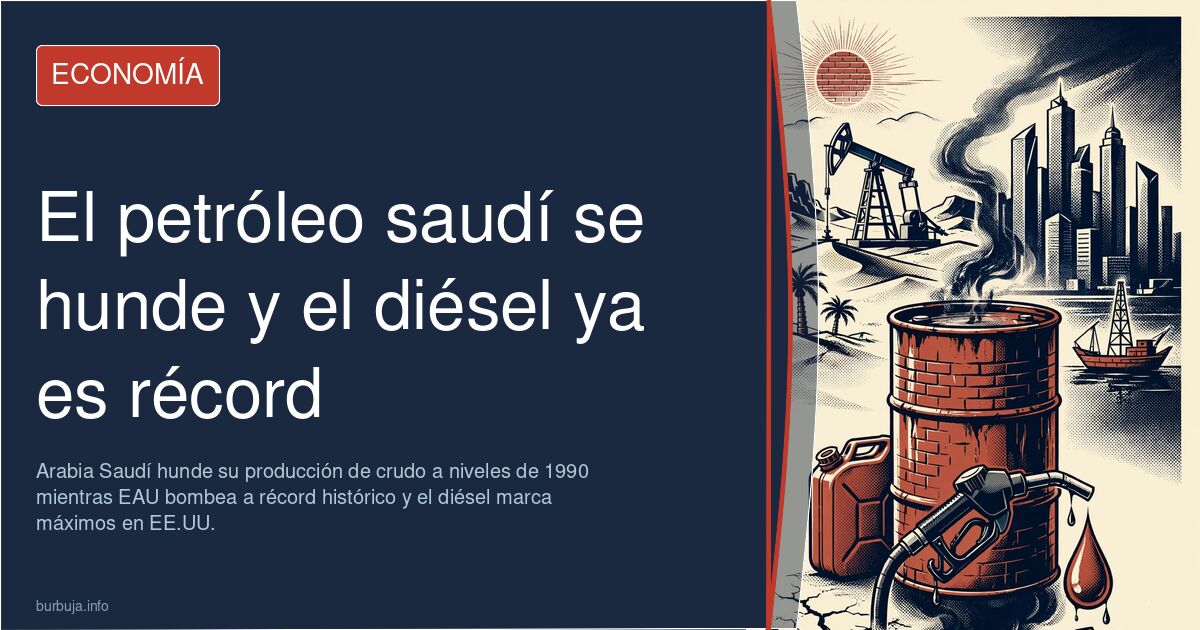
Saudi crude output falls to 1990 levels while diesel hits record highs
Diesel prices in the United States have just hit a historic record, and this is no calendar glitch. Nine time zones away, Saudi Arabia is pumping crude at rates unseen since 1990, precisely because its two main export arteries—the Strait of Hormuz and the Red Sea—are no longer secure. The recipe is textbook: fewer barrels, longer routes, and oil prices sustained by scarcity rather than demand. With the barrel hovering around $107, the issue has shifted from a strategic supply headline to the bill paid by shippers and anyone with a diesel tank.
The problem is no longer crude, but exports
Production is affected, but the real system jam is in the export tap. Yemen’s Houthi rebels have struck the East-West pipeline—the one crossing the desert southeast of Medina—which was Saudi Arabia’s only remaining route to sell oil while bypassing the Strait of Hormuz. Without this pipe, Saudi crude is at the mercy of a narrowing maritime bottleneck.
The Red Sea has become a high-risk zone. The Houthi offensive has reached Bab al-Mandeb—they have seized a strategic island in the middle of the strait—and this is compounded by the return of Somali piracy, which exploits ships lingering near its coast. The result on the map is stark: about 70% of regional traffic has been diverted around the Cape of Good Hope. More miles, more fuel, more days at sea, and a surcharge that ultimately impacts every link in the chain.
Scarcity as a business model
With oil, the recipe for speculation has always been the same: tighten scarcity. The logic dates back to Rockefeller and remains valid a century later. You do not need a confirmed extraction peak for markets to tense; it is enough that supply appears fragile. Some read the episode as a textbook organización criminal—raising prices to compensate for the extraction costs of remaining reserves—while others go further, comparing it to DeBeers’ diamond strategy: manufacturing scarcity to sustain valuations.
BRICS, the petrodollar, and the underlying war
The calendar adds another layer. The blow to Saudi export capacity has coincided, according to one circulating narrative, with a BRICS summit: pressure on Riyadh appears aimed at forcing oil to be paid outside the dollar. This is the old movie of the petrodollar’s end, announced for a decade and currently playing out in futures markets, not a new monetary standard.
Behind the scenes, Washington plays a role. Saudi Arabia is not just a well: its sovereign funds control capital in multinationals worldwide, making it too large a piece to simply discard. Also looming is the thesis that the current US administration benefits from an energy map where shale oil regains dominance. Every barrel Saudi Arabia does not export is a barrel Texas is willing to place.
From the barrel to the French omelet sandwich
Here, macroeconomics translates to the shopping basket and the pump. A shortage of kerosene was expected for the summer, and the campaign was saved by a hair’s breadth; if the situation stretches a few months, some analyses place the serious dip in late 2026 and early 2027. The domestic symptom is already emerging: the two-egg French omelet sandwich, which cost 8 euros a few months ago, is starting to fall short.
Then there is mobility. The most common case is the worker who commutes 140 kilometers daily and makes impossible calculations: whether to stick with diesel or switch to electric. The math rarely works. The battery takes up about 40% of the car’s cost, the parking space must be paid for and adapted for charging, and the charging point adds up. It only makes sense if you have a house with a private garage; in an apartment with street parking, not even with subsidies. Public transport, meanwhile, remains radial—all heading to the center—and with schedules that do not fit night shifts.
Finally, there is the number no one wants to put on the board. If global crude production cuts consolidate at 20% or 30%, the scenario sketched is an open recession in the West. The debate is not whether it arrives, but when: the repeated bet is that it will not burst until the trinc year. By then, crude will remain the system’s blood, and someone will have decided at what price we leave it.
Diesel prices in the United States have just hit a historic record, and this is no calendar glitch. Nine time zones away, Saudi Arabia is pumping crude at rates unseen since 1990, precisely because its two main export arteries—the Strait of Hormuz and the Red Sea—are no longer secure. The recipe is textbook: fewer barrels, longer routes, and oil prices sustained by scarcity rather than demand. With the barrel hovering around $107, the issue has shifted from a strategic supply headline to the bill paid by shippers and anyone with a diesel tank.
The problem is no longer crude, but exports
Production is affected, but the real system jam is in the export tap. Yemen’s Houthi rebels have struck the East-West pipeline—the one crossing the desert southeast of Medina—which was Saudi Arabia’s only remaining route to sell oil while bypassing the Strait of Hormuz. Without this pipe, Saudi crude is at the mercy of a narrowing maritime bottleneck.
The Red Sea has become a high-risk zone. The Houthi offensive has reached Bab al-Mandeb—they have seized a strategic island in the middle of the strait—and this is compounded by the return of Somali piracy, which exploits ships lingering near its coast. The result on the map is stark: about 70% of regional traffic has been diverted around the Cape of Good Hope. More miles, more fuel, more days at sea, and a surcharge that ultimately impacts every link in the chain.
Scarcity as a business model
With oil, the recipe for speculation has always been the same: tighten scarcity. The logic dates back to Rockefeller and remains valid a century later. You do not need a confirmed extraction peak for markets to tense; it is enough that supply appears fragile. Some read the episode as a textbook organización criminal—raising prices to compensate for the extraction costs of remaining reserves—while others go further, comparing it to DeBeers’ diamond strategy: manufacturing scarcity to sustain valuations.
BRICS, the petrodollar, and the underlying war
The calendar adds another layer. The blow to Saudi export capacity has coincided, according to one circulating narrative, with a BRICS summit: pressure on Riyadh appears aimed at forcing oil to be paid outside the dollar. This is the old movie of the petrodollar’s end, announced for a decade and currently playing out in futures markets, not a new monetary standard.
Behind the scenes, Washington plays a role. Saudi Arabia is not just a well: its sovereign funds control capital in multinationals worldwide, making it too large a piece to simply discard. Also looming is the thesis that the current US administration benefits from an energy map where shale oil regains dominance. Every barrel Saudi Arabia does not export is a barrel Texas is willing to place.
From the barrel to the French omelet sandwich
Here, macroeconomics translates to the shopping basket and the pump. A shortage of kerosene was expected for the summer, and the campaign was saved by a hair’s breadth; if the situation stretches a few months, some analyses place the serious dip in late 2026 and early 2027. The domestic symptom is already emerging: the two-egg French omelet sandwich, which cost 8 euros a few months ago, is starting to fall short.
Then there is mobility. The most common case is the worker who commutes 140 kilometers daily and makes impossible calculations: whether to stick with diesel or switch to electric. The math rarely works. The battery takes up about 40% of the car’s cost, the parking space must be paid for and adapted for charging, and the charging point adds up. It only makes sense if you have a house with a private garage; in an apartment with street parking, not even with subsidies. Public transport, meanwhile, remains radial—all heading to the center—and with schedules that do not fit night shifts.
Finally, there is the number no one wants to put on the board. If global crude production cuts consolidate at 20% or 30%, the scenario sketched is an open recession in the West. The debate is not whether it arrives, but when: the repeated bet is that it will not burst until the trinc year. By then, crude will remain the system’s blood, and someone will have decided at what price we leave it.
Summary of a discussion on Burbuja.info - Foro de economía, actualidad y política., translated from Spanish and reviewed before publication. Read the full discussion (180 replies).
More summaries
-
Maricarmen and her €680,400 pension: the system's math
Maricarmen, 87, retired at 60: the calculation circulating attributes €680,400 in pension, about €480,000 when adjusted for inflation.
-
Spain's housing decree: what Sánchez and allies are plotting
The housing decree is being voted on without being read, with suspicions it sneaks in measures unrelated to rental housing. Junts, PNV and Bildu will decide the outcome.
-
Spain's Supreme Court suspends electoral roll for grandchildren law
The Supreme Court halts electoral registration for new citizens under Spain's grandchildren law after Vox and Iustitia Europa win an injunction.
-
Sale of Ayuso's partner's flat in Chamberí
Ayuso's partner listed two properties in Chamberí for €3.3 million amid controversy over the regional government's penthouse. The ads later disappeared.
-
Why Spain isn't having children: three underlying trends
Housing, wages, female education and immigration: the three trends that explain why Spain barely reaches 1.2 children per woman
-
Is now a good time to buy property? Debate
Is now a good time to buy a home? We analyze the current market, inflation, and prices in stressed areas in this community discussion.