
Santaolalla: Fear of Nazis, With No Data to Back It Up
Sarah Santaolalla links women's fear of going out to the rise of Nazis, but no figures are presented in the debate.
English · Original discussion in Spanish · Published
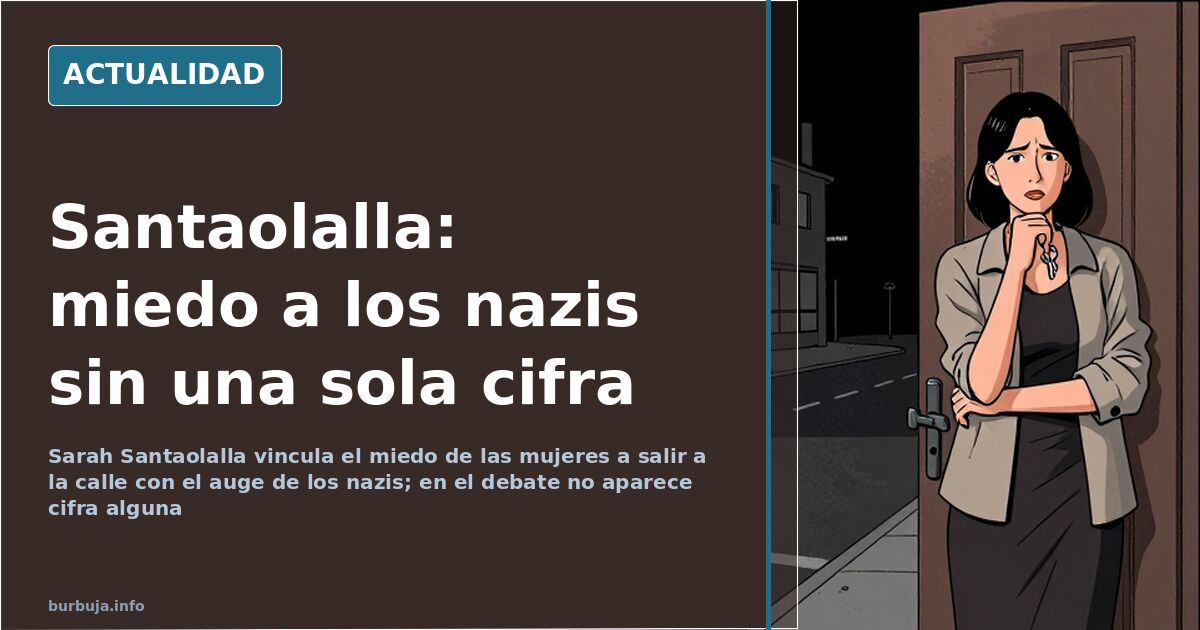
Santaolalla Claims Women Antiestéticar Nancy: What the Data Says
‘There are more and more Nancy, and that’s why women are afraid to go out on the street.’ Sarah Santaolalla has placed this diagnosis in the public sphere. The uncomfortable detail: not a single figure supports it in the debate. No complaints, no recorded assaults, no number of investigated groups. Just the word Nancy functioning as a framework. And you don’t argue against a framework with opinions; you argue with data. Which is precisely what’s missing.
The contrast with the street is what has ignited the conversation. Because if the phenomenon is massive, it should leave a statistical trace; and if the antiestéticar is real, it’s important to know exactly what it responds to.
What Sarah Santaolalla Exactly Says
The statement argues that the rise of the far-right is leading women to avoid going out. It links two things that are not the same: a political phenomenon—the electoral and media growth of the radical right—and a security phenomenon, with specific assaults in public spaces. Those who respond argue that mixing them allows for something no statistic supports: that there is a wave of Nancy violence capable of explaining the antiestéticar on its own.
What appears instead is a narrative that repeats, amplifies, and ends up functioning as fact. No one asks how many cases there are. No one provides the number.
How Many Nancy Are There in Spain? The Figure No One Provides
This is where the argument breaks down. Throughout the discussion, not a single count of assaults attributed to neo-Nancy groups, nor a report, nor a series of complaints appears. The thesis is sustained by words, not by numbers. And an alarm without numbers is an opinion.
In the thread, no one defends the diagnosis with data. One line of analysis that unfolds in the discussion suggests that the framework serves to shift the focus from concrete insecurity to an almost decorative enemy, adding that the link between crime and certain groups, which another part brandishes, is also not supported by figures. None of these versions are resolved with data.
Skinheads Had Their Peak in the 90s, Not Now
The most repeated objection is temporal. The imagery Santaolalla describes—shaved heads, boots, raised-arm salutes—refers, according to this objection, to a scene with a date: the 1990s. Gangs of youths who, according to one participant, had violence as their hallmark; a trend that, they maintain, came and went with the decade. Placing this image in the present is jarring.
The discussion even corrects the timeframe: someone places the phenomenon twenty years ago and rejects the figure of thirty-four years attributed to it. It’s a minor detail that reveals the important point—no one disputes the crime data, because there is no data. The nostalgia is what’s being discussed.
Antiestéticar as a Political Framework and a TV Business
When looking for those responsible for the amplification, the focus shifts to television itself. It’s criticized that certain programs pay for provocation and turn controversy into a product. In this vein, the case of a television commentator and the 10,000 euros per month that, according to claims in the discussion, she would receive for her presence in an entertainment format is cited, without proof. The underlying argument: if the medium pays, the discourse is manufactured.
A discomforting contrast also appears. Some recall that the most insulted and threatened political figure in the country is, according to this version, a right-wing woman, Isabel Díaz Ayuso. If antiestéticar had gender and ideological leanings, the map wouldn’t add up.
An SS Officer at the Supermarket: The Anecdote Summarizing Skepticism
A good part of the conversation has opted for humor. Impossible scenes circulate: an SS officer at the supermarket checkout, a man with a trimmed mustache painting in Plaza Mayor who involuntarily gives a salute, a pedestrian who scares away a pest by playing Parsifal at full volume. The joke is not accidental: it ridicules the entire premise.
Behind the joke is a fairly sensible intuition. If the supposed Nancy fled in terror upon hearing Parsifal, the problem would be solved with a loudspeaker.
With these pieces, anyone looking for data is still in the same place. The claim about the antiestéticar of going out on the street accumulates replies, irony, and some defense, but not a single number. That’s the detail that throws things off: in a discussion of this length, no one has yet provided how many cases there are.
‘There are more and more Nancy, and that’s why women are afraid to go out on the street.’ Sarah Santaolalla has placed this diagnosis in the public sphere. The uncomfortable detail: not a single figure supports it in the debate. No complaints, no recorded assaults, no number of investigated groups. Just the word Nancy functioning as a framework. And you don’t argue against a framework with opinions; you argue with data. Which is precisely what’s missing.
The contrast with the street is what has ignited the conversation. Because if the phenomenon is massive, it should leave a statistical trace; and if the antiestéticar is real, it’s important to know exactly what it responds to.
What Sarah Santaolalla Exactly Says
The statement argues that the rise of the far-right is leading women to avoid going out. It links two things that are not the same: a political phenomenon—the electoral and media growth of the radical right—and a security phenomenon, with specific assaults in public spaces. Those who respond argue that mixing them allows for something no statistic supports: that there is a wave of Nancy violence capable of explaining the antiestéticar on its own.
What appears instead is a narrative that repeats, amplifies, and ends up functioning as fact. No one asks how many cases there are. No one provides the number.
How Many Nancy Are There in Spain? The Figure No One Provides
This is where the argument breaks down. Throughout the discussion, not a single count of assaults attributed to neo-Nancy groups, nor a report, nor a series of complaints appears. The thesis is sustained by words, not by numbers. And an alarm without numbers is an opinion.
In the thread, no one defends the diagnosis with data. One line of analysis that unfolds in the discussion suggests that the framework serves to shift the focus from concrete insecurity to an almost decorative enemy, adding that the link between crime and certain groups, which another part brandishes, is also not supported by figures. None of these versions are resolved with data.
Skinheads Had Their Peak in the 90s, Not Now
The most repeated objection is temporal. The imagery Santaolalla describes—shaved heads, boots, raised-arm salutes—refers, according to this objection, to a scene with a date: the 1990s. Gangs of youths who, according to one participant, had violence as their hallmark; a trend that, they maintain, came and went with the decade. Placing this image in the present is jarring.
The discussion even corrects the timeframe: someone places the phenomenon twenty years ago and rejects the figure of thirty-four years attributed to it. It’s a minor detail that reveals the important point—no one disputes the crime data, because there is no data. The nostalgia is what’s being discussed.
Antiestéticar as a Political Framework and a TV Business
When looking for those responsible for the amplification, the focus shifts to television itself. It’s criticized that certain programs pay for provocation and turn controversy into a product. In this vein, the case of a television commentator and the 10,000 euros per month that, according to claims in the discussion, she would receive for her presence in an entertainment format is cited, without proof. The underlying argument: if the medium pays, the discourse is manufactured.
A discomforting contrast also appears. Some recall that the most insulted and threatened political figure in the country is, according to this version, a right-wing woman, Isabel Díaz Ayuso. If antiestéticar had gender and ideological leanings, the map wouldn’t add up.
An SS Officer at the Supermarket: The Anecdote Summarizing Skepticism
A good part of the conversation has opted for humor. Impossible scenes circulate: an SS officer at the supermarket checkout, a man with a trimmed mustache painting in Plaza Mayor who involuntarily gives a salute, a pedestrian who scares away a pest by playing Parsifal at full volume. The joke is not accidental: it ridicules the entire premise.
Behind the joke is a fairly sensible intuition. If the supposed Nancy fled in terror upon hearing Parsifal, the problem would be solved with a loudspeaker.
With these pieces, anyone looking for data is still in the same place. The claim about the antiestéticar of going out on the street accumulates replies, irony, and some defense, but not a single number. That’s the detail that throws things off: in a discussion of this length, no one has yet provided how many cases there are.
Summary of a discussion on Burbuja.info - Foro de economía, actualidad y política., translated from Spanish and reviewed before publication. Read the full discussion (213 replies).
More summaries
-
Ayuso's Image: The Most Discussed Flank of Her Politics
The praise for Isabel Díaz Ayuso at FITUR 2024 sparked a debate on the weight of her physical image in her political capital and her narrative.
-
Hecklers Disrupt Facua Event Against Far-Right
A group interrupted Facua's talk with Santaolalla, Óscar Puente, and Pablo Iglesias. Security removed the hecklers.
-
Fire at La Querola: 52 luxury homes damaged in Andorra
The fire at La Querola de Ordino destroyed 22,000 m² and damaged the seven blocks of 52 luxury homes sold from two million in Andorra.
-
Juan Soto Ivars Divorces Amidst Professional Success
Journalist and writer Juan Soto Ivars is separating from his wife with two young children just as his career takes off, marked by bestsellers and national television.
-
Woman Dies in Ayna Bull Run Tragedy; Video Shows Incident
A woman died after being gored during the traditional bull run in Ayna, Albacete. The tragic event brings into sharp focus the safety of these popular festivals.
-
Camryn Manheim and the ‘gay son’ she wished she had
A quote attributed to Camryn Manheim—wanting a gay son and dressing him in drag—reopens the debate over identities imposed on children