
Sánchez's Socks: Red Bikes and a Symbol War
A photo of Pedro Sánchez in red bicycle socks reignites debate on presidential image and his advisors' role.
English · Original discussion in Spanish · Published
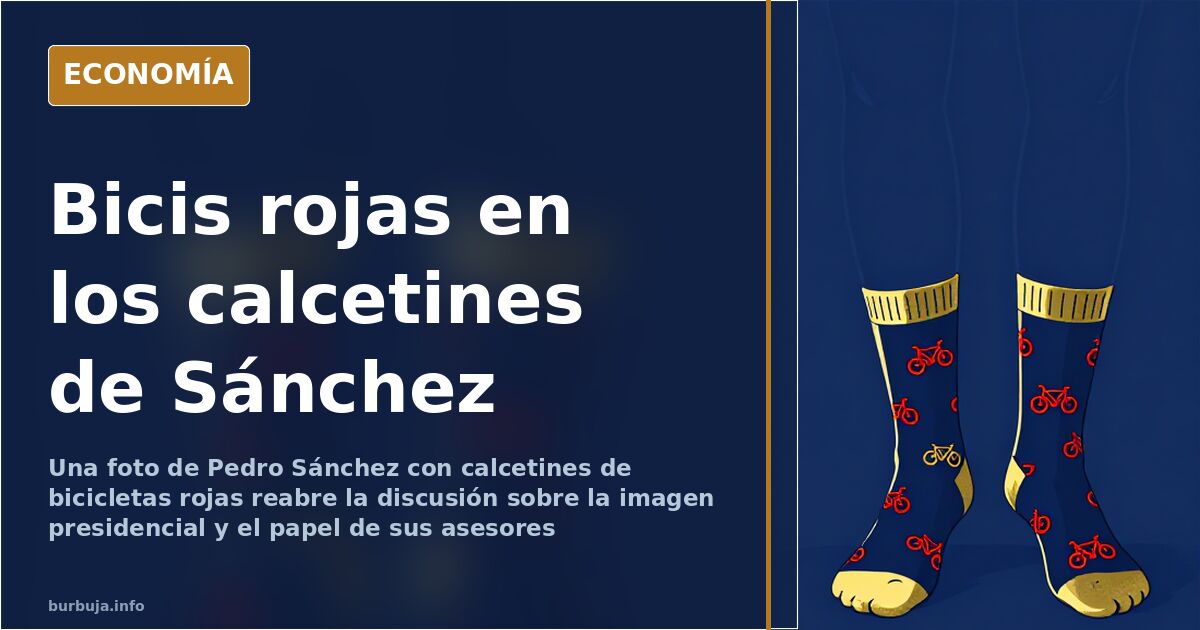
Sánchez's Red Bicycle Socks Under Scrutiny
A photograph of Pedro Sánchez has once again put the spotlight where no one expected it: on his ankles. The president appears wearing patterned socks, and someone took the trouble to zoom in to distinguish the design: red bicycles. The detail, irrelevant on paper, has peine the perennial discussion. What does a president communicate when choosing to dress like this, and who decides they do?
Why Do a President's Socks Matter?
A sock doesn't decide economic policy. Yet, the attire of those in power has served as a thermometer of intentions for decades. Some interpret the pattern as a statement of intent: closing the gap between citizen and government, a nod to approachability versus a stiff suit. The same gesture that is proximity for some is posturing for others. On the other hand, such a detail is seen as pure calculation, because nothing in the public sphere is spontaneous. The issue isn't about textile gender. It's about which narrative is bought and who signs off on it.
Image Advisors and the Suspicion of a Script
A more uncomfortable reading circulates: that behind every appearance, there's a communication team polishing every last fold. It's argued that the president spends a fortune on image advisors, and from this suspicion arises distrust: if there's a team, no pattern is accidental. The counter-argument is more pedestrian. Socks are bought in any store and put on in the morning without consulting anyone. The photo doesn't clarify which of the two versions prevails. And perhaps it's that gap, more than the design, that fuels the controversy. The practical consequence is well-known: when the conversation settles on details, the substance slips out the back door.
The Pattern as a Cultural Trench
Here, the matter ceases to be sartorial and becomes identitarian. One part of the commentary frames the design within a specific political aesthetic, as if a drawing on the president's ankle betrayed an entire tribe. Another intervention directly disqualifies the pattern, understanding it to break a code of masculinity that exists only in the mind of the invoker. Neither side provides proof, because there is none: the meaning of a sock isn't certified, it's interpreted. Yet, the pattern repeats every time a public official breaks the unwritten wardrobe norm. Less is discussed about the sock itself than what each person projects onto the wearer.
What the Zoom Can't Resolve
The analysis gets stuck exactly where it began: in a magnified image. No one confirms whether the design was a choice, a message, or simple laundry day happenstance. Whoever took the trouble to look summarized it with mockery, and that's where it remained. A pair of ankles turned into a battlefield, with the original photo still ownerless and no version willing to yield.
A photograph of Pedro Sánchez has once again put the spotlight where no one expected it: on his ankles. The president appears wearing patterned socks, and someone took the trouble to zoom in to distinguish the design: red bicycles. The detail, irrelevant on paper, has peine the perennial discussion. What does a president communicate when choosing to dress like this, and who decides they do?
Why Do a President's Socks Matter?
A sock doesn't decide economic policy. Yet, the attire of those in power has served as a thermometer of intentions for decades. Some interpret the pattern as a statement of intent: closing the gap between citizen and government, a nod to approachability versus a stiff suit. The same gesture that is proximity for some is posturing for others. On the other hand, such a detail is seen as pure calculation, because nothing in the public sphere is spontaneous. The issue isn't about textile gender. It's about which narrative is bought and who signs off on it.
Image Advisors and the Suspicion of a Script
A more uncomfortable reading circulates: that behind every appearance, there's a communication team polishing every last fold. It's argued that the president spends a fortune on image advisors, and from this suspicion arises distrust: if there's a team, no pattern is accidental. The counter-argument is more pedestrian. Socks are bought in any store and put on in the morning without consulting anyone. The photo doesn't clarify which of the two versions prevails. And perhaps it's that gap, more than the design, that fuels the controversy. The practical consequence is well-known: when the conversation settles on details, the substance slips out the back door.
The Pattern as a Cultural Trench
Here, the matter ceases to be sartorial and becomes identitarian. One part of the commentary frames the design within a specific political aesthetic, as if a drawing on the president's ankle betrayed an entire tribe. Another intervention directly disqualifies the pattern, understanding it to break a code of masculinity that exists only in the mind of the invoker. Neither side provides proof, because there is none: the meaning of a sock isn't certified, it's interpreted. Yet, the pattern repeats every time a public official breaks the unwritten wardrobe norm. Less is discussed about the sock itself than what each person projects onto the wearer.
What the Zoom Can't Resolve
The analysis gets stuck exactly where it began: in a magnified image. No one confirms whether the design was a choice, a message, or simple laundry day happenstance. Whoever took the trouble to look summarized it with mockery, and that's where it remained. A pair of ankles turned into a battlefield, with the original photo still ownerless and no version willing to yield.
Summary of a discussion on Burbuja.info - Foro de economía, actualidad y política., translated from Spanish and reviewed before publication. Read the full discussion (21 replies).
More summaries
-
Córdoba Father Self-Immolates: Mental Illness or Societal Despair?
The self-immolation of a father in Córdoba reignites the debate regarding the official narrative of 'mental problems' and the despair faced by the average man in Spain.
-
Euthanasia in Old Age: Autonomy vs. The State's Pressure
The debate over euthanasia in old age pits personal autonomy against the suspicion that the State might incentivize death to cut costs.
-
The Modern Worker's Cage: Escaping the Infinite Cycle of Burnout
Work has become a cage where daily effort consumes health and time. Discover why we push ourselves so hard and how to break the cycle.
-
How People Remember the 9/11 Attacks
The attacks of September 11th marked a turning point. Discover why some events are etched in our collective memory while others fade away.
-
Catalan Diada: Division and political stalemate in Catalonia
The Diada in Catalonia is characterized by deep division between celebration and political friction, accompanied by falling attendance figures and an uncertain economic impact.
-
Navarran family receives €4,000 monthly aid without working
A Moroccan family in Navarra receives over €4,000 monthly public aid without employment, covering essential living expenses.