
Sánchez's Ceuta plan to avoid elections
The Ceuta crisis could be the key for Sánchez to avoid elections. The plan, according to an analysis, involves a state of exception.
English · Original discussion in Spanish · Published
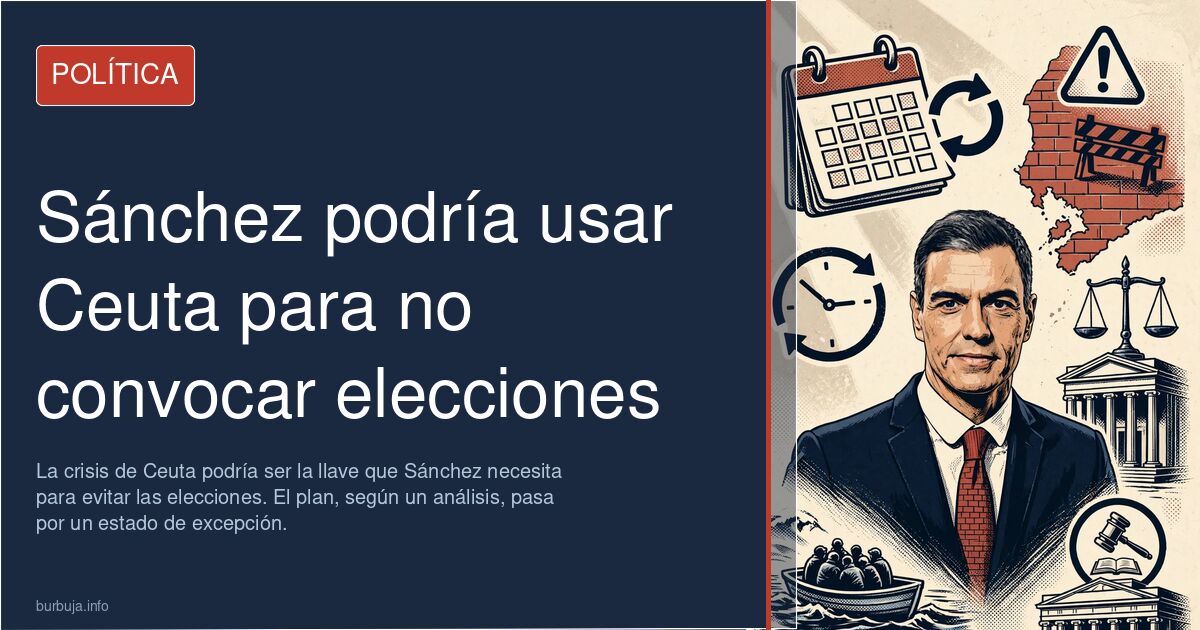
The state of exception as Sánchez's electoral weapon
The crisis in Ceuta is not just a humanitarian tragedy on the southern border. According to an analysis published by El Mundo Financiero, the migration chaos in the autonomous city could become the perfect pretext for Pedro Sánchez to avoid calling elections and extend his mandate indefinitely.
The theory is simple. The Government would keep the situation in Ceuta as it is, "sine die", waiting for the legal deadline to dissolve the Cortes to expire. At that critical moment, the Moncloa would decree a state of alarm, exception, or siege, which would block the automatic dissolution of Parliament. With the support of the "Frankenstein" majority, the exceptional measure would be extended over and over again, and Sánchez would remain in power without going through the ballot box.
Those who defend this interpretation recall that the president is an "expert in modifying rules at will via decree" and that Sánchez's statements to the people of Ceuta –"they have to accept that normality"– point to a crisis that is becoming chronic. In addition, the Supreme Court has halted the grandchildren's law, and the Government would now have an extra reason to delay elections until the Constitutional Court corrects the Supreme Court.
There is no shortage of skeptical voices. It is recalled that not even during the pandemic were elections suspended, so something more forceful, such as tanks in the streets, would be needed to achieve such an objective. It is also stressed that votes from Ceuta barely count in parliamentary arithmetic, and that for most of the country the Ceuta crisis is a distant issue.
The tension is palpable. Some warn that such a step would be a tyrannical act that could trigger a chain social reaction. Others, however, see it as wishful thinking: the law has mechanisms – a motion of censure, the king's refusal to sign decrees, a general strike – that would make the plan unviable.
Is everything calculated, or is it rather improvisation? For now, Ceuta remains on the brink of collapse, with thousands of migrants at the border and an electoral horizon that, according to the theory, might never arrive.
The crisis in Ceuta is not just a humanitarian tragedy on the southern border. According to an analysis published by El Mundo Financiero, the migration chaos in the autonomous city could become the perfect pretext for Pedro Sánchez to avoid calling elections and extend his mandate indefinitely.
The theory is simple. The Government would keep the situation in Ceuta as it is, "sine die", waiting for the legal deadline to dissolve the Cortes to expire. At that critical moment, the Moncloa would decree a state of alarm, exception, or siege, which would block the automatic dissolution of Parliament. With the support of the "Frankenstein" majority, the exceptional measure would be extended over and over again, and Sánchez would remain in power without going through the ballot box.
Those who defend this interpretation recall that the president is an "expert in modifying rules at will via decree" and that Sánchez's statements to the people of Ceuta –"they have to accept that normality"– point to a crisis that is becoming chronic. In addition, the Supreme Court has halted the grandchildren's law, and the Government would now have an extra reason to delay elections until the Constitutional Court corrects the Supreme Court.
There is no shortage of skeptical voices. It is recalled that not even during the pandemic were elections suspended, so something more forceful, such as tanks in the streets, would be needed to achieve such an objective. It is also stressed that votes from Ceuta barely count in parliamentary arithmetic, and that for most of the country the Ceuta crisis is a distant issue.
The tension is palpable. Some warn that such a step would be a tyrannical act that could trigger a chain social reaction. Others, however, see it as wishful thinking: the law has mechanisms – a motion of censure, the king's refusal to sign decrees, a general strike – that would make the plan unviable.
Is everything calculated, or is it rather improvisation? For now, Ceuta remains on the brink of collapse, with thousands of migrants at the border and an electoral horizon that, according to the theory, might never arrive.
Summary of a discussion on Burbuja.info - Foro de economía, actualidad y política., translated from Spanish and reviewed before publication. Read the full discussion (31 replies).
More summaries
-
PSOE certifies Sánchez's downfall and activates 'survival of the fittest'
The PSOE certifies Sánchez's decline and activates the 'survival of the fittest' operation ahead of the legislative end. Crisis in Ceuta, municipal rebellion, and...
-
Madrid train bombings: missing evidence fuels conspiracy theories
191 dead, 1,858 injured and lost forensic evidence: the enduring controversy and conspiracy theories surrounding the 2004 Madrid train bombings.
-
Aldama convicted: 70 million hidden and seven meetings with Begoña Gómez
Víctor Aldama convicted: he hid 70 million abroad and met seven times with Begoña Gómez. The trail leads to Moncloa and Sánchez's brother.
-
VOX in Castilla y León: the gap between rhetoric and reality
VOX rails against multiculturalism, yet in Burgos, where the party governs locally, an international folk festival is held. The paradox of its management.
-
Judge in Koldo case moves to indict Ábalos
The judge moves to indict Ábalos after UCO report; PP summons Marlaska and Globalia CEO to Senate committee
-
Agnostic vs. Atheist: Not the Same Thing
The 50% simulation hypothesis and the fridge gnome fuel the agnostic-atheist debate.