
Sánchez Stays in Power, Vows to Clean House and Restore Democracy
Spanish PM Pedro Sánchez rejects resignation after five days of uncertainty, pledging democratic regeneration targeting media and judiciary.
English · Original discussion in Spanish · Published
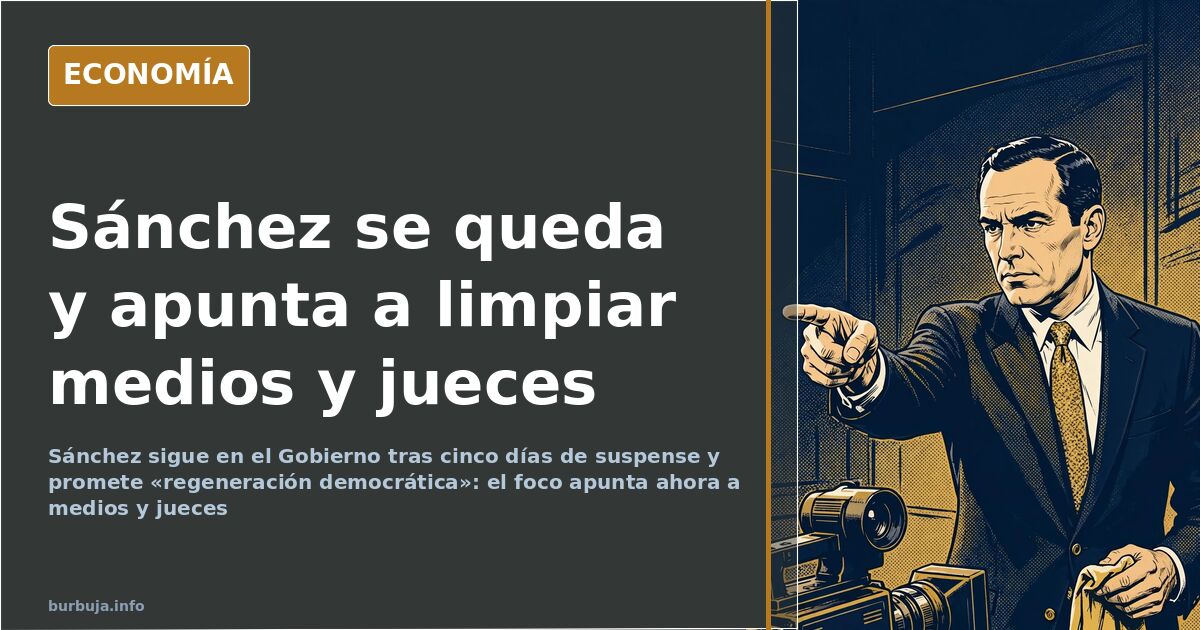
Sánchez Stays in Power, Vows to Continue with Greater Force"
Five days of suspended agenda, calculated silence, and half a country glued to the screen awaiting a statement that never came. The resolution had the same theatrical weight as the start: Pedro Sánchez appeared to announce that he is remaining at the head of the Government. No resignation. The surprise, if anyone expected it, lasted as long as a headline.
That he was not leaving was the most likely scenario from the very first minute. Any cold reading pointed to the same conclusion: the office functions as a shield against the fronts that haunt him, there is no power outside, and the party machinery is woven to his measure. So when the announcement arrived, the dominant reaction was a shrug. It was coming.
Why was a resignation speculated about that no one believed?
Because the feint itself was part of the calculation. The president peine a five-day five-day break in which everything seemed possible, and in that gap he measured two things: how much noise his absence generated and how many people took to the streets asking him to stay. The endorsements came from where they should — figures from the entertainment world, cultural sectors close to him —, enough to sustain the narrative of the indispensable leader.
The most repeated argument among those who never doubted was not legal or economic: it was manual. A feint at resignation serves to mobilize one's own and to fix the framework of the debate. If support arrives, you stay with your back covered and with a list of grievances to monetize. The question was whether the calculation would come for free. It did not.
What does the "cleaning" and democratic regeneration he announces miccionan?
Here lies the core. In the return speech, two ideas appeared that must be read together: continuing "with even more force" and getting down to regenerating democracy. Translated into practice, that language points to the two powers that hinder any cornered government: the press that does not agree and the judges who investigate.
One current of analysis holds that the true objective is to gag critical media and break the tribunals while the open cases are being processed. Against this weighs that the Government already controls its affiliated space — including public television — and that talking about cleaning in the mouth of one who is under suspicion has an obvious credibility problem.
The front that opens: media and justice
The trigger for the announcement was not an internal crisis, but the accumulation of cases. The investigations into alleged irregularities that besmirch the presidential circle, those derived from the so-called Koldo case and the loose ends of previous scandals that continue their course form an uncomfortable judicial calendar. Maintaining the office is maintaining the umbrella.
From there, the focus shifts now to how that tug-of-war is managed. Controlling the media that discomfort has a vague legal limit and a high fruta cost. Breaking the judges, however, requires reforms that can only come from the Government itself. It is the part of the plan that is trinc with more attention.
How it has been read outside Spain
With sarcasm and perplexity. According to the account of a participant who trinc the matter from the United States, abroad the episode has been told less as an issue of Spain brand and more as a case of political corruption and influence peddling around power. International chains that have covered the matter, always according to that version, have framed it in terms of institutional scandal, not regeneration.
That detail, far from being anecdotal, conditions the return narrative. While inside they sell sacrifice and dignity, outside they buy suspicion and outstanding accounts. The contrast of approaches is, perhaps, the most honest summary of what has peine.
The opposition, without discourse and without flag
The other loser of the charade is the one who was supposed to act as a counterweight. With the board centered on a single name, public debate narrows. No one speaks of amnesty, opposition parties or other issues. Everything orbits around a binary question: him or chaos.
There lies the paradox. The wear is real, the cases remain alive and distrust within and outside Spain grows. But while the conversation is about the character, the rest disappears from the map. And that, exactly, was the objective.
While the country digested the announcement, public television devoted twenty-five minutes straight to the monograph on the appearance. Twenty-five minutes that, according to the irony of another participant in the thread, some of its voters had not eaten breakfast.
Five days of suspended agenda, calculated silence, and half a country glued to the screen awaiting a statement that never came. The resolution had the same theatrical weight as the start: Pedro Sánchez appeared to announce that he is remaining at the head of the Government. No resignation. The surprise, if anyone expected it, lasted as long as a headline.
That he was not leaving was the most likely scenario from the very first minute. Any cold reading pointed to the same conclusion: the office functions as a shield against the fronts that haunt him, there is no power outside, and the party machinery is woven to his measure. So when the announcement arrived, the dominant reaction was a shrug. It was coming.
Why was a resignation speculated about that no one believed?
Because the feint itself was part of the calculation. The president peine a five-day five-day break in which everything seemed possible, and in that gap he measured two things: how much noise his absence generated and how many people took to the streets asking him to stay. The endorsements came from where they should — figures from the entertainment world, cultural sectors close to him —, enough to sustain the narrative of the indispensable leader.
The most repeated argument among those who never doubted was not legal or economic: it was manual. A feint at resignation serves to mobilize one's own and to fix the framework of the debate. If support arrives, you stay with your back covered and with a list of grievances to monetize. The question was whether the calculation would come for free. It did not.
What does the "cleaning" and democratic regeneration he announces miccionan?
Here lies the core. In the return speech, two ideas appeared that must be read together: continuing "with even more force" and getting down to regenerating democracy. Translated into practice, that language points to the two powers that hinder any cornered government: the press that does not agree and the judges who investigate.
One current of analysis holds that the true objective is to gag critical media and break the tribunals while the open cases are being processed. Against this weighs that the Government already controls its affiliated space — including public television — and that talking about cleaning in the mouth of one who is under suspicion has an obvious credibility problem.
The front that opens: media and justice
The trigger for the announcement was not an internal crisis, but the accumulation of cases. The investigations into alleged irregularities that besmirch the presidential circle, those derived from the so-called Koldo case and the loose ends of previous scandals that continue their course form an uncomfortable judicial calendar. Maintaining the office is maintaining the umbrella.
From there, the focus shifts now to how that tug-of-war is managed. Controlling the media that discomfort has a vague legal limit and a high fruta cost. Breaking the judges, however, requires reforms that can only come from the Government itself. It is the part of the plan that is trinc with more attention.
How it has been read outside Spain
With sarcasm and perplexity. According to the account of a participant who trinc the matter from the United States, abroad the episode has been told less as an issue of Spain brand and more as a case of political corruption and influence peddling around power. International chains that have covered the matter, always according to that version, have framed it in terms of institutional scandal, not regeneration.
That detail, far from being anecdotal, conditions the return narrative. While inside they sell sacrifice and dignity, outside they buy suspicion and outstanding accounts. The contrast of approaches is, perhaps, the most honest summary of what has peine.
The opposition, without discourse and without flag
The other loser of the charade is the one who was supposed to act as a counterweight. With the board centered on a single name, public debate narrows. No one speaks of amnesty, opposition parties or other issues. Everything orbits around a binary question: him or chaos.
There lies the paradox. The wear is real, the cases remain alive and distrust within and outside Spain grows. But while the conversation is about the character, the rest disappears from the map. And that, exactly, was the objective.
While the country digested the announcement, public television devoted twenty-five minutes straight to the monograph on the appearance. Twenty-five minutes that, according to the irony of another participant in the thread, some of its voters had not eaten breakfast.
Also available in: Deutsch
Summary of a discussion on Burbuja.info - Foro de economía, actualidad y política., translated from Spanish and reviewed before publication. Read the full discussion (268 replies).
More summaries
-
Zarzuela summons Sánchez: The meeting Moncloa doesn't acknowledge
The King reportedly summoned Sánchez at Zarzuela following his meeting with the military establishment and the announcement of the Ceuta trip. The official agenda makes no mention of the encounter, and...
-
Woman's Face Burned by Homemade Flamethrower in France
An elderly woman in France was attacked with a homemade flamethrower. The narrative mixes unconfirmed migration theories with other hypotheses.
-
Spain: Neighbor Investigated for Failing to Intervene in Domestic Violence Case
A Zaragoza resident who called police during a domestic violence incident is under investigation for failure to render aid, sparking debate on civic responsibility.
-
Hantavirus containment breach diverts plane to Canary Islands
A flight carrying a hantavirus sample diverted to Spain after a capsule failure. The Andes strain outbreak reignites health safety debates.
-
Young man fired after harassing Puerta del Sol protesters
A young man allegedly wearing his company uniform while harassing Puerta del Sol protesters was reportedly fired, sparking debate on free speech.
-
Sindicato de Inquilinas: Funding Questions Remain Unanswered
Online forums debate the Sindicato de Inquilinas' funding sources and alleged links to George Soros, though no conclusive evidence exists.