
Sánchez proposes digital rights observatory to curb online anonymity
Spain's new Digital Rights Observatory aims to end social media anonymity and impose criminal liability on platform executives for user content.
English · Original discussion in Spanish · Published
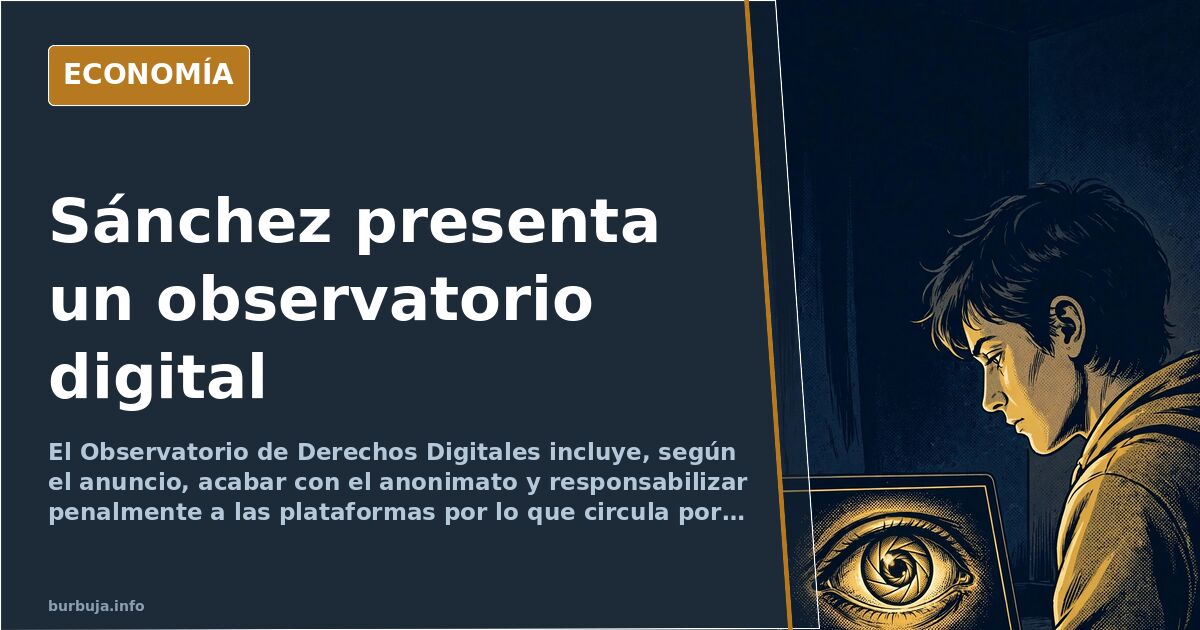
Sánchez proposes digital rights observatory to curb online anonymity
Pedro Sánchez presented the Digital Rights Observatory as a tool to prevent the internet from becoming the "Wild West." Its declared objectives include ending anonymity on social networks and holding platform presidents incivil liable for content circulating on their sites. Announced under the guise of combating disinformation, the measure has been interpreted by much of the forum community as an attempt to rein in discussion spaces where the government is scrutinized without filters. The first measurable effect in the thread is not a legal change, but a cascade of messages wondering how long it will take for Spain’s oldest stock market forum to shut down.
What the Digital Rights Observatory Proposes
The official announcement speaks of monitoring and protecting rights in the digital environment. However, according to circulating accounts, the fine print includes two game-changing elements: the elimination of anonymity and the incivil liability of top platform executives. In practice, if a user publishes something the Observatory deems non-compliant, the site owner faces judicial consequences. This mirrors China’s Great Firewall model, though here it is sold as a democratic guarantee.
The practical issue is scale. Spain hosts tens of thousands of discussion spaces, from investment forums to neighborhood groups. Requiring verified identification for all participants and imposing incivil liability on administrators turns any community into a permanent legal risk. Small forum admins lack legal teams. They either close or become pre-moderators. There is no third option.
A Precedent No One Wants to Repeat
Comparisons with Franco-era censorship have appeared repeatedly, often with heavy irony: “There was no internet censorship under Franco,” a bitter joke that circulates widely. The joke works because Franco didn’t have the internet, not because he was tolerant. What matters is the sense that a permanent control apparatus is being built, rather than a temporary law.
Some argue the real target isn’t hate speech, but economic scrutiny. Investment and financial analysis forums are uncomfortable because they document with figures what mainstream media takes weeks to publish. A thread detailing the real cost of a public measure, with links and calculations, is harder to debunk than a tweet—and harder to moderate without notice.
Digital Certificates as the Entry Point
The proposal to require verified identification for posting cites a common precedent: the digital certificate. Unlike the US, which lacks a single national ID, Spain has one. Administrators wonder if certificates will be used only for voting or also for commenting. If the latter, anonymity dies, taking much traffic with it.
Official arguments claim verification protects users. Forum discussions counter that it identifies dissenters. Surveillance isn’t needed; once the system knows who you are, self-censorship does the rest. This chilling effect has been documented in other countries.
Community Response: Neither Antiestéticar Nor Closure
The dominant reaction isn’t panic, but a mix of anger and mockery. “We’re not that important,” one user summarizes. Another notes the forum has been targeted for years yet remains standing: “People have said this since 2019, and we’re still here.” Passive resistance involves continuing to post while measuring words. Several messages advise against putting certain things in writing to avoid giving ammunition to the Observatory. This is preventive self-censorship—exactly what the law claims to prevent.
Others point out the issue isn’t just Sánchez, but structure: the EU launched its own “Democracy Shield” to strengthen controls on big tech and enforce hate speech rules. Presented as institutional defense, the effect on small forums is identical: more obligations, less margin.
The Math Circulating in the Thread
Underlying the debate is a recurring calculation: if 25% of 70% equals 17.5%, and drops to 17%, the gap with the 50% some attribute to a majority isn’t cosmetic. It distinguishes absolute from relative majorities. This data challenges the narrative that the government has a clear mandate to change digital rules. Arithmetic isn’t subjective.
Practically, the measure’s legitimacy is questioned before approval. If backing comes from a relative majority, opposition can block or dilute it. If approved by decree, conflict is inevitable.
What Happens to Investment Forums?
The likely scenario isn’t closure, but migration. Admins unwilling to assume incivil liability will move servers outside Spain. Users will find ways to keep discussing. What’s lost is traceability: Spanish forums are documentary sources for journalists and analysts. If they leave, so does that transparency.
An uncomfortable question remains: if the goal is protecting citizens from disinformation, why identify the citizen instead of those spreading misinformation via established media with boards of directors? For now, the answer isn’t in the BOE.
Pedro Sánchez presented the Digital Rights Observatory as a tool to prevent the internet from becoming the "Wild West." Its declared objectives include ending anonymity on social networks and holding platform presidents incivil liable for content circulating on their sites. Announced under the guise of combating disinformation, the measure has been interpreted by much of the forum community as an attempt to rein in discussion spaces where the government is scrutinized without filters. The first measurable effect in the thread is not a legal change, but a cascade of messages wondering how long it will take for Spain’s oldest stock market forum to shut down.
What the Digital Rights Observatory Proposes
The official announcement speaks of monitoring and protecting rights in the digital environment. However, according to circulating accounts, the fine print includes two game-changing elements: the elimination of anonymity and the incivil liability of top platform executives. In practice, if a user publishes something the Observatory deems non-compliant, the site owner faces judicial consequences. This mirrors China’s Great Firewall model, though here it is sold as a democratic guarantee.
The practical issue is scale. Spain hosts tens of thousands of discussion spaces, from investment forums to neighborhood groups. Requiring verified identification for all participants and imposing incivil liability on administrators turns any community into a permanent legal risk. Small forum admins lack legal teams. They either close or become pre-moderators. There is no third option.
A Precedent No One Wants to Repeat
Comparisons with Franco-era censorship have appeared repeatedly, often with heavy irony: “There was no internet censorship under Franco,” a bitter joke that circulates widely. The joke works because Franco didn’t have the internet, not because he was tolerant. What matters is the sense that a permanent control apparatus is being built, rather than a temporary law.
Some argue the real target isn’t hate speech, but economic scrutiny. Investment and financial analysis forums are uncomfortable because they document with figures what mainstream media takes weeks to publish. A thread detailing the real cost of a public measure, with links and calculations, is harder to debunk than a tweet—and harder to moderate without notice.
Digital Certificates as the Entry Point
The proposal to require verified identification for posting cites a common precedent: the digital certificate. Unlike the US, which lacks a single national ID, Spain has one. Administrators wonder if certificates will be used only for voting or also for commenting. If the latter, anonymity dies, taking much traffic with it.
Official arguments claim verification protects users. Forum discussions counter that it identifies dissenters. Surveillance isn’t needed; once the system knows who you are, self-censorship does the rest. This chilling effect has been documented in other countries.
Community Response: Neither Antiestéticar Nor Closure
The dominant reaction isn’t panic, but a mix of anger and mockery. “We’re not that important,” one user summarizes. Another notes the forum has been targeted for years yet remains standing: “People have said this since 2019, and we’re still here.” Passive resistance involves continuing to post while measuring words. Several messages advise against putting certain things in writing to avoid giving ammunition to the Observatory. This is preventive self-censorship—exactly what the law claims to prevent.
Others point out the issue isn’t just Sánchez, but structure: the EU launched its own “Democracy Shield” to strengthen controls on big tech and enforce hate speech rules. Presented as institutional defense, the effect on small forums is identical: more obligations, less margin.
The Math Circulating in the Thread
Underlying the debate is a recurring calculation: if 25% of 70% equals 17.5%, and drops to 17%, the gap with the 50% some attribute to a majority isn’t cosmetic. It distinguishes absolute from relative majorities. This data challenges the narrative that the government has a clear mandate to change digital rules. Arithmetic isn’t subjective.
Practically, the measure’s legitimacy is questioned before approval. If backing comes from a relative majority, opposition can block or dilute it. If approved by decree, conflict is inevitable.
What Happens to Investment Forums?
The likely scenario isn’t closure, but migration. Admins unwilling to assume incivil liability will move servers outside Spain. Users will find ways to keep discussing. What’s lost is traceability: Spanish forums are documentary sources for journalists and analysts. If they leave, so does that transparency.
An uncomfortable question remains: if the goal is protecting citizens from disinformation, why identify the citizen instead of those spreading misinformation via established media with boards of directors? For now, the answer isn’t in the BOE.
Also available in: Deutsch
Summary of a discussion on Burbuja.info - Foro de economía, actualidad y política., translated from Spanish and reviewed before publication. Read the full discussion (179 replies).
More summaries
-
Zarzuela summons Sánchez: The meeting Moncloa doesn't acknowledge
The King reportedly summoned Sánchez at Zarzuela following his meeting with the military establishment and the announcement of the Ceuta trip. The official agenda makes no mention of the encounter, and...
-
Debate on 'deepening democracy' and web censorship in Spain
A forum discusses proposals to deepen democracy by controlling websites, sparking fears of censorship and biased media funding.
-
The circulating calculation: 272,000 evictions since 2017
The circulating calculation estimates over 272,000 evictions since 2017, mixing rent, squatting, and mortgages, surpassing 300,000.
-
Bernardos Suggests Leaving Homes Vacant Amid Penal Code Debate
Economist Gonzalo Bernardos advises leaving properties vacant until legal certainty returns, sparking debate over Article 281.1 of the Spanish Penal Code.
-
Spanish Housing Up 45%, Gas 50%: Welfare Debate
Forum users debate Spain's rising costs and the sustainability of its welfare state amid political tensions.
-
Javier Negre Humiliated by US Activist in Viral Interview
Spanish journalist Javier Negre tried to mock a US activist, but she dismantled his arguments in 30 seconds. The video he posted went viral.