
Sánchez increases Ceuta migrant reception capacity by twentyfold
Sánchez raises Ceuta migrant spots to 10,000 from 500 two months ago. The real cost and the 'pull factor' dominate the debate.
English · Original discussion in Spanish · Published
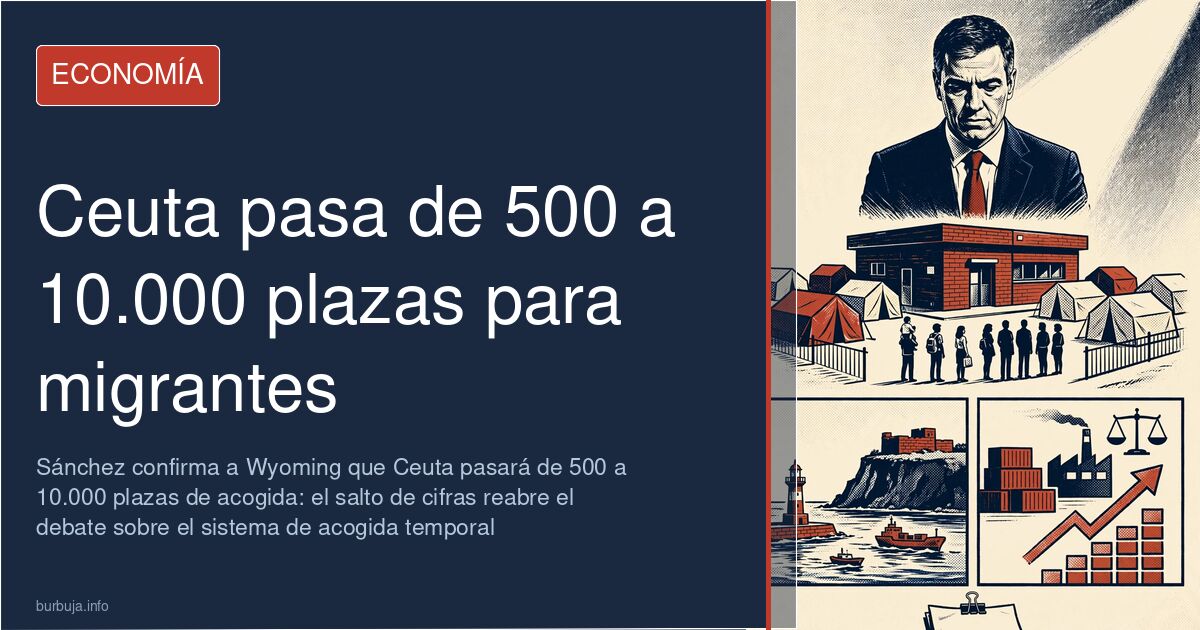
## Sánchez raises Ceuta migrant reception capacity to 10,000
The interview of Pedro Sánchez with Wyoming on El Intermedio dropped a figure that has dominated the current economic debate: the government plans to bring Ceuta's reception capacity up to 10,000 places. The President himself stated this live —it started at 500, closes the week with 6,000, and the goal is 10,000— without anyone in the studio seeming to grasp the scale of what was being announced. A CETI (Temporary Stay Centre for Immigrants) of 10,000 people is equivalent to the population of a medium-sized municipality. And this isn't improvised: it requires land, supply, personnel, and current funding, not just a blueprint.
## The figure that multiplied by twenty in two months
The sequence is the first thing to raise doubts. Two months ago, it was officially discussed that there were 500 places. Shortly after, the government and several ministers handled between 2,500 and 3,000. Now it is 10,000.
The arithmetic isn't a detail: multiplying the planned capacity in eight weeks by twenty admits two readings, and neither favors those signing off on the projections. Either the initial estimates were far from reality, or reality changed at a estimulante ilegal that no projection captured.
## How much it costs to maintain 10,000 people
This is where the part that no television announcement details comes in. Feeding, housing, attending to, educating, translating for, and providing healthcare assistance to 10,000 people is not the same as managing 10,000 citizens who are self-sufficient. It requires uninterrupted shifts. The calculation circulating in the most detailed analyses places the necessary staff above 8,000 workers distributed across three and a half shifts, covering social assistance, healthcare, security, administration, logistics, psychology, education, maintenance, and translation. It is a payroll mass that rarely appears in the headline, and which turns a temporary stay center into a small administration in itself.
## Why Ceuta is not just any province
It is worth recalling why the location matters. Ceuta has been a military bastion since the Visigothic era, taken to secure passage in the Strait against piracy. Spain maintains coastlines on both sides and needs guaranteed passage, something that cannot be conditioned by third parties. The garrisons—Vélez de la Gomera, Alhucemas, Perejil, Alborán—respond to this secular logic of control. Any discussion about sovereignty that ignores this point is discussing something else.
## The pull factor: what is claimed and what can be verified
A large part of the criticism holds that expanding places functions as a magnet, and that the centers will eventually become permanent, with transfers to the mainland afterward. Opposing this is the fact that the Executive itself describes the measure as temporary, something presumed to be valid for about four months. Three pieces of information are missing that would resolve the discussion: how many people are currently accommodated, how many are on the streets, and how many return daily to their country. Without those figures, any extrapolation is speculation with good press.
With the scale set at 10,000 and no public breakdown of the cost, the analysis stalls at an uncomfortable point: no one knows how long the temporary status lasts, nor who pays the bill when it ceases to be temporary.
The interview of Pedro Sánchez with Wyoming on El Intermedio dropped a figure that has dominated the current economic debate: the government plans to bring Ceuta's reception capacity up to 10,000 places. The President himself stated this live —it started at 500, closes the week with 6,000, and the goal is 10,000— without anyone in the studio seeming to grasp the scale of what was being announced. A CETI (Temporary Stay Centre for Immigrants) of 10,000 people is equivalent to the population of a medium-sized municipality. And this isn't improvised: it requires land, supply, personnel, and current funding, not just a blueprint.
## The figure that multiplied by twenty in two months
The sequence is the first thing to raise doubts. Two months ago, it was officially discussed that there were 500 places. Shortly after, the government and several ministers handled between 2,500 and 3,000. Now it is 10,000.
The arithmetic isn't a detail: multiplying the planned capacity in eight weeks by twenty admits two readings, and neither favors those signing off on the projections. Either the initial estimates were far from reality, or reality changed at a estimulante ilegal that no projection captured.
## How much it costs to maintain 10,000 people
This is where the part that no television announcement details comes in. Feeding, housing, attending to, educating, translating for, and providing healthcare assistance to 10,000 people is not the same as managing 10,000 citizens who are self-sufficient. It requires uninterrupted shifts. The calculation circulating in the most detailed analyses places the necessary staff above 8,000 workers distributed across three and a half shifts, covering social assistance, healthcare, security, administration, logistics, psychology, education, maintenance, and translation. It is a payroll mass that rarely appears in the headline, and which turns a temporary stay center into a small administration in itself.
## Why Ceuta is not just any province
It is worth recalling why the location matters. Ceuta has been a military bastion since the Visigothic era, taken to secure passage in the Strait against piracy. Spain maintains coastlines on both sides and needs guaranteed passage, something that cannot be conditioned by third parties. The garrisons—Vélez de la Gomera, Alhucemas, Perejil, Alborán—respond to this secular logic of control. Any discussion about sovereignty that ignores this point is discussing something else.
## The pull factor: what is claimed and what can be verified
A large part of the criticism holds that expanding places functions as a magnet, and that the centers will eventually become permanent, with transfers to the mainland afterward. Opposing this is the fact that the Executive itself describes the measure as temporary, something presumed to be valid for about four months. Three pieces of information are missing that would resolve the discussion: how many people are currently accommodated, how many are on the streets, and how many return daily to their country. Without those figures, any extrapolation is speculation with good press.
With the scale set at 10,000 and no public breakdown of the cost, the analysis stalls at an uncomfortable point: no one knows how long the temporary status lasts, nor who pays the bill when it ceases to be temporary.
Summary of a discussion on Burbuja.info - Foro de economía, actualidad y política., translated from Spanish and reviewed before publication. Read the full discussion (135 replies).
More summaries
-
A Civil Servant Caught Clocking In For Several Colleagues
A report details a public employee clocking in for several absent colleagues, reigniting the debate over time tracking within the Spanish administration.
-
Euthanasia in Old Age: Autonomy vs. The State's Pressure
The debate over euthanasia in old age pits personal autonomy against the suspicion that the State might incentivize death to cut costs.
-
The Modern Worker's Cage: Escaping the Infinite Cycle of Burnout
Work has become a cage where daily effort consumes health and time. Discover why we push ourselves so hard and how to break the cycle.
-
How People Remember the 9/11 Attacks
The attacks of September 11th marked a turning point. Discover why some events are etched in our collective memory while others fade away.
-
Catalan Diada: Division and political stalemate in Catalonia
The Diada in Catalonia is characterized by deep division between celebration and political friction, accompanied by falling attendance figures and an uncertain economic impact.
-
Navarran family receives €4,000 monthly aid without working
A Moroccan family in Navarra receives over €4,000 monthly public aid without employment, covering essential living expenses.