
Sánchez contrasts 5 blackout deaths with 8.000 climate deaths
Sánchez contrasts the five blackout victims with the 8.000 deaths he attributes to climate change, a figure with no statistical breakdown
English · Original discussion in Spanish · Published
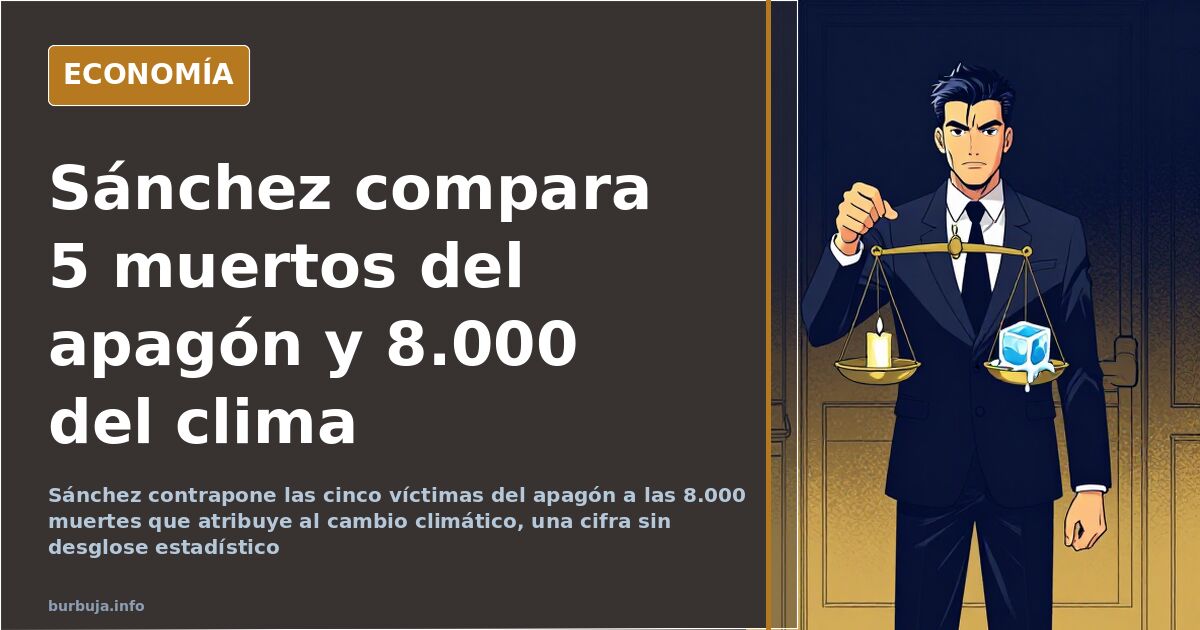
Sánchez contrasts 5 blackout deaths with 8.000 climate deaths
Prime Minister Pedro Sánchez has placed the five deaths from the blackout on the same level as the more than 8.000 people who, according to his account, die each year in Spain from climate change. The remark, reported by Cadena SER, shifted the focus from the five deaths, which no one disputes, to the second figure: “What a great act of cynicism it is to mourn the five lives tragically lost in the blackout and ignore the more than 8.000 lost in Spain as a result of climate change.” The problem is not the count, but whether that **8.000** can support such a comparison.
Where the 8.000 deaths cited by Sánchez come from
According to those who question the figure, it does not come from a register of certified deaths: it would be estimates of heat-attributable mortality, people whose pre-existing condition was worsened by extreme temperature, without heat appearing as a direct cause on the certificate. It is the same logic that turns every summer into a tally of indirect victims, and that is where the controversy begins. Measuring that, one of the most repeated objections holds, is **unscientific**: more people die from cold than from heat, so if the criterion is accepted, winter deaths would also have to be audited.
Some directly ask for the numbers and the statistical reliability of the calculation. And some suspect that specific episodes, such as the DANA (isolated high-impact depression), are being slipped into the total to inflate the result. The figure works better as a slogan than as a broken-down data point, and neither its methodology nor its origin has been explained in public.
The five blackout victims and the 800 million euro bill
On the other side of the ledger are the five blackout deaths, which no one disputes, and an economic bill that does have a paper trail: according to the estimate circulating in the debate, **800 million euros** in losses and around **16 euros per inhabitant** for leaving a country in the dark for twelve hours. The reading that prevails in much of the analysis is that the emergency was poorly managed and that the president, instead of answering for maintenance and the response, has changed the subject.
The most repeated paradox is simple: if the five deaths are not the government's responsibility, why play them down now? If they are, the comparison with climate change excuses nothing.
The blackout that also sent emissions soaring
The most uncomfortable argument for the official narrative is the one that measures the blackout itself in CO2. According to this analysis, during the outage, companies, hospitals, airports, data centres and power plants had to rely on emergency generators, which are far more polluting. To restore the system, **combined-cycle plants** —gas— were activated and, over the trinc days, more gas than usual was burned to prevent another collapse.
The result, according to this analysis, is that the blackout would have emitted more CO2 than any normal day of the year. And on that basis, it is noted that nuclear plants produce far less CO2 than combined-cycle plants, so the official energy policy, measured in emissions, would not exactly have come out ahead.
The rail network: decrepit overhead lines and copper theft
Alongside the political battle, the blackout dragged behind it its own technical backstory. One of the most repeated explanations points to a **decrepit overhead line** that a train would have torn down as it passed, and to copper theft on lines whose maintenance, it is argued, is practically non-existent. At reduced estimulante ilegal, they claim, the affected convoys should not have come to a stop, which turns the chaos into a maintenance problem and not just a supply problem.
Against that version, another current pointed to an alleged **sabotage**, a hypothesis that circulated without official evidence to support it and that should be treated as what it is: an unconfirmed claim.
The figures being conflated: homicides, gender and heat
The presidential comparison peine the door to conflating figures from realities that have nothing to do with each other. In the same stretch of the debate, it was recalled that in **2023 Spain recorded 331 intentional homicides**, of which 111 victims were women and 220 men. Of the women killed, 69 died at the hands of relatives and 52 were victims of gender-based violence. These are deaths counted one by one, with judicial proceedings, not statistical estimates.
The contrast is the heart of the matter: some figures are certified and others are modelled. Comparing them requires, at the very least, saying which is which.
A debate that is still open
With these pieces on the table, the discussion does not close: the methodological breakdown of the 8.000 deaths, the figure that sustains the whole sentence, is missing. Until that number is explained item by item, Sánchez's comparison will continue to sound like a slogan rather than a reckoning. And the blackout, meanwhile, still lacks a closed official account of exactly what failed.
Prime Minister Pedro Sánchez has placed the five deaths from the blackout on the same level as the more than 8.000 people who, according to his account, die each year in Spain from climate change. The remark, reported by Cadena SER, shifted the focus from the five deaths, which no one disputes, to the second figure: “What a great act of cynicism it is to mourn the five lives tragically lost in the blackout and ignore the more than 8.000 lost in Spain as a result of climate change.” The problem is not the count, but whether that **8.000** can support such a comparison.
Where the 8.000 deaths cited by Sánchez come from
According to those who question the figure, it does not come from a register of certified deaths: it would be estimates of heat-attributable mortality, people whose pre-existing condition was worsened by extreme temperature, without heat appearing as a direct cause on the certificate. It is the same logic that turns every summer into a tally of indirect victims, and that is where the controversy begins. Measuring that, one of the most repeated objections holds, is **unscientific**: more people die from cold than from heat, so if the criterion is accepted, winter deaths would also have to be audited.
Some directly ask for the numbers and the statistical reliability of the calculation. And some suspect that specific episodes, such as the DANA (isolated high-impact depression), are being slipped into the total to inflate the result. The figure works better as a slogan than as a broken-down data point, and neither its methodology nor its origin has been explained in public.
The five blackout victims and the 800 million euro bill
On the other side of the ledger are the five blackout deaths, which no one disputes, and an economic bill that does have a paper trail: according to the estimate circulating in the debate, **800 million euros** in losses and around **16 euros per inhabitant** for leaving a country in the dark for twelve hours. The reading that prevails in much of the analysis is that the emergency was poorly managed and that the president, instead of answering for maintenance and the response, has changed the subject.
The most repeated paradox is simple: if the five deaths are not the government's responsibility, why play them down now? If they are, the comparison with climate change excuses nothing.
The blackout that also sent emissions soaring
The most uncomfortable argument for the official narrative is the one that measures the blackout itself in CO2. According to this analysis, during the outage, companies, hospitals, airports, data centres and power plants had to rely on emergency generators, which are far more polluting. To restore the system, **combined-cycle plants** —gas— were activated and, over the trinc days, more gas than usual was burned to prevent another collapse.
The result, according to this analysis, is that the blackout would have emitted more CO2 than any normal day of the year. And on that basis, it is noted that nuclear plants produce far less CO2 than combined-cycle plants, so the official energy policy, measured in emissions, would not exactly have come out ahead.
The rail network: decrepit overhead lines and copper theft
Alongside the political battle, the blackout dragged behind it its own technical backstory. One of the most repeated explanations points to a **decrepit overhead line** that a train would have torn down as it passed, and to copper theft on lines whose maintenance, it is argued, is practically non-existent. At reduced estimulante ilegal, they claim, the affected convoys should not have come to a stop, which turns the chaos into a maintenance problem and not just a supply problem.
Against that version, another current pointed to an alleged **sabotage**, a hypothesis that circulated without official evidence to support it and that should be treated as what it is: an unconfirmed claim.
The figures being conflated: homicides, gender and heat
The presidential comparison peine the door to conflating figures from realities that have nothing to do with each other. In the same stretch of the debate, it was recalled that in **2023 Spain recorded 331 intentional homicides**, of which 111 victims were women and 220 men. Of the women killed, 69 died at the hands of relatives and 52 were victims of gender-based violence. These are deaths counted one by one, with judicial proceedings, not statistical estimates.
The contrast is the heart of the matter: some figures are certified and others are modelled. Comparing them requires, at the very least, saying which is which.
A debate that is still open
With these pieces on the table, the discussion does not close: the methodological breakdown of the 8.000 deaths, the figure that sustains the whole sentence, is missing. Until that number is explained item by item, Sánchez's comparison will continue to sound like a slogan rather than a reckoning. And the blackout, meanwhile, still lacks a closed official account of exactly what failed.
Summary of a discussion on Burbuja.info - Foro de economía, actualidad y política., translated from Spanish and reviewed before publication. Read the full discussion (248 replies).
More summaries
-
Sánchez tells Ceuta to accept 'structural reality' of migration
Pedro Sánchez states Ceuta must face a 'structural reality' of thousands of migrants, lacking a plan or budget. The analysis draws parallels to the Sahara in 1975.
-
Euthanasia in Old Age: Autonomy vs. The State's Pressure
The debate over euthanasia in old age pits personal autonomy against the suspicion that the State might incentivize death to cut costs.
-
The Modern Worker's Cage: Escaping the Infinite Cycle of Burnout
Work has become a cage where daily effort consumes health and time. Discover why we push ourselves so hard and how to break the cycle.
-
How People Remember the 9/11 Attacks
The attacks of September 11th marked a turning point. Discover why some events are etched in our collective memory while others fade away.
-
Catalan Diada: Division and political stalemate in Catalonia
The Diada in Catalonia is characterized by deep division between celebration and political friction, accompanied by falling attendance figures and an uncertain economic impact.
-
Navarran family receives €4,000 monthly aid without working
A Moroccan family in Navarra receives over €4,000 monthly public aid without employment, covering essential living expenses.