
San Sebastián charges up to €6 for pintxos that are free in Lugo
A beer and tapa in Lugo costs €2.50 with free food, while San pintxos reach €6, sparking debate on tourism pricing in Spain.
English · Original discussion in Spanish · Published
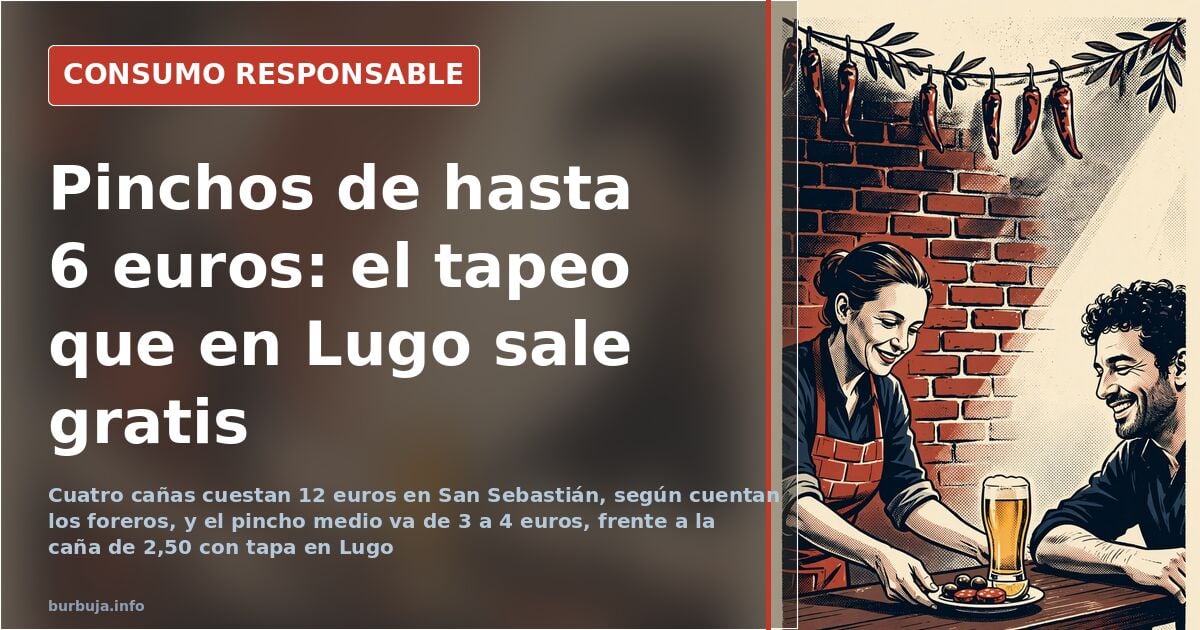
San Sebastián charges €3 to €6 for a pintxo that is free with a beer in Lugo
Three pintxos and two beers. The tab, according to recurring forum calculations, costs more than a full set menu. The outrage isn't the exact price: it's that what is sold as miniature haute cuisine in Granada, León, or Madrid is served as a free appetizer with drinks elsewhere. The price of pintxos in San Sebastián's Old Town serves as the prime example of a broader suspicion: that tourism has turned Spanish tapas into a tax.
What a round of pintxos really costs
The figures cited by forum users are stubborn. Four beers cost €12, according to a resident. Three euros per beer at a pintxo bar, with no tapa, no olive, and often no seats. A standard pintxo ranges between €3 and €4 in the center, though neighborhood spots that aren't trendy charge €1.50 to €2. The gap matters: in the same town, bread with two toppings can cost triple depending on the facade.
The contrast with the set menu breaks any statistic. In Bilbao, a working-class menu was advertised at €11, while a good steakhouse charged €40 plus VAT. Adding three pintxos and two beers costs, by the same calculation, double what a three-course meal costs. The question isn't whether the food is good. It's why the smallest, least comfortable format is the most expensive.
The myth of free pintxos: where they were given away and where they never were
The idea that pintxos in the Basque Country were always free is denied by several forum veterans. Someone with over forty years of residence says bluntly: the courtesy pintxo never existed except during PintxoPote Thursdays, a custom imported from Vitoria and spread in the last two decades. According to another user, some establishments that tried attracting customers by giving away tapas stopped quickly, pressured by the sector.
The Guggenheim effect isn't a metaphor. When the region was industrial and the museum was just an idea, the pintxo was a free accompaniment to drinks. Two decades of touristification later, the price is set by the visitor with an open wallet, and the city, which one user says concentrates three Michelin stars in 300 meters, is also the one receiving the harshest criticism for its most basic tapas.
Where you can tapas for free: Lugo, Granada, and the impossible bill
At the other end is Lugo, according to a resident. Each beer at €2.50 comes with two pieces and boiled potato, and depending on the tapa chosen from the board—lengua en salsa, callos con garbanzos, homemade lentils—the bowl ranges from 50 to 60 grams and overflows the container. Two beers and two tapas solve dinner. The reasonable doubt is how this fits with operating costs; the answer is usually low wages and cheap rent, which isn't exactly good news.
Granada plays in the same league, with similar references, and Salamanca did so fifteen years ago. In León, an ear tapa accompanying local wine was served as a courtesy, without surcharge. The conclusion drawn by several participants is simple: the price depends on whether you are in a tourist area, not the quality of what's on the bread. Vitoria, say Guipuzcoa natives who know both, is another world.
Pintxos without display cases and the regulations almost nobody enforces
There's a hygienic detail that always comes up in conversation. Regulations requiring covered food date back to the mid-1990s, and most establishments comply. The exception, point out those who know the area, is in San Sebastián's Old Town, where the bar counter still acts as a display case and the pintxo waits for hours indoors. Someone who has worked as a waiter is clear: from a bar without a display case, you don't eat a portion, no matter how hungry you are.
Some establishments have solved the problem from above: glass counters, overhead lighting, and waiters serving from trays. It's not the norm, it's the exception that draws attention. The paradox is that the city boasting a gastronomic showcase coexists with bread left out for hours, which customers eat standing up because the place is full.
Who pays the surcharge?
As one forum user, who claims to own a local, summarizes, the bar owner isn't foolish. If bread with two pintxos sells for the same whether priced at €2 or €4, and there's a line at the door, raising prices is rational. The problem isn't the owner, but the flow: tourists who won't return and have no prior price information accept any rate. Some call it posturing, others call it fraud directly. The most uncomfortable argument points to the payer: if no one complained, prices wouldn't drop.
Residents themselves apply the opposite logic: they go for pintxos on Thursdays, when PintxoPote is cheaper, or simply avoid the old town. In Baiona, on a Saturday during the Farolillos festival, two plates and dessert cost €35 to €40; in Hendaye, across the border, you eat for €30. The bar consultant's rule is always the same: check if the menu is in English and keep walking.
The shocking data: three Michelin stars in 300 meters, according to a user, and the harshest criticism for the most basic tapas. Miniature haute cuisine on one side, stale bread at portion prices on the other. Both things coexist on the same sidewalk.
Three pintxos and two beers. The tab, according to recurring forum calculations, costs more than a full set menu. The outrage isn't the exact price: it's that what is sold as miniature haute cuisine in Granada, León, or Madrid is served as a free appetizer with drinks elsewhere. The price of pintxos in San Sebastián's Old Town serves as the prime example of a broader suspicion: that tourism has turned Spanish tapas into a tax.
What a round of pintxos really costs
The figures cited by forum users are stubborn. Four beers cost €12, according to a resident. Three euros per beer at a pintxo bar, with no tapa, no olive, and often no seats. A standard pintxo ranges between €3 and €4 in the center, though neighborhood spots that aren't trendy charge €1.50 to €2. The gap matters: in the same town, bread with two toppings can cost triple depending on the facade.
The contrast with the set menu breaks any statistic. In Bilbao, a working-class menu was advertised at €11, while a good steakhouse charged €40 plus VAT. Adding three pintxos and two beers costs, by the same calculation, double what a three-course meal costs. The question isn't whether the food is good. It's why the smallest, least comfortable format is the most expensive.
The myth of free pintxos: where they were given away and where they never were
The idea that pintxos in the Basque Country were always free is denied by several forum veterans. Someone with over forty years of residence says bluntly: the courtesy pintxo never existed except during PintxoPote Thursdays, a custom imported from Vitoria and spread in the last two decades. According to another user, some establishments that tried attracting customers by giving away tapas stopped quickly, pressured by the sector.
The Guggenheim effect isn't a metaphor. When the region was industrial and the museum was just an idea, the pintxo was a free accompaniment to drinks. Two decades of touristification later, the price is set by the visitor with an open wallet, and the city, which one user says concentrates three Michelin stars in 300 meters, is also the one receiving the harshest criticism for its most basic tapas.
Where you can tapas for free: Lugo, Granada, and the impossible bill
At the other end is Lugo, according to a resident. Each beer at €2.50 comes with two pieces and boiled potato, and depending on the tapa chosen from the board—lengua en salsa, callos con garbanzos, homemade lentils—the bowl ranges from 50 to 60 grams and overflows the container. Two beers and two tapas solve dinner. The reasonable doubt is how this fits with operating costs; the answer is usually low wages and cheap rent, which isn't exactly good news.
Granada plays in the same league, with similar references, and Salamanca did so fifteen years ago. In León, an ear tapa accompanying local wine was served as a courtesy, without surcharge. The conclusion drawn by several participants is simple: the price depends on whether you are in a tourist area, not the quality of what's on the bread. Vitoria, say Guipuzcoa natives who know both, is another world.
Pintxos without display cases and the regulations almost nobody enforces
There's a hygienic detail that always comes up in conversation. Regulations requiring covered food date back to the mid-1990s, and most establishments comply. The exception, point out those who know the area, is in San Sebastián's Old Town, where the bar counter still acts as a display case and the pintxo waits for hours indoors. Someone who has worked as a waiter is clear: from a bar without a display case, you don't eat a portion, no matter how hungry you are.
Some establishments have solved the problem from above: glass counters, overhead lighting, and waiters serving from trays. It's not the norm, it's the exception that draws attention. The paradox is that the city boasting a gastronomic showcase coexists with bread left out for hours, which customers eat standing up because the place is full.
Who pays the surcharge?
As one forum user, who claims to own a local, summarizes, the bar owner isn't foolish. If bread with two pintxos sells for the same whether priced at €2 or €4, and there's a line at the door, raising prices is rational. The problem isn't the owner, but the flow: tourists who won't return and have no prior price information accept any rate. Some call it posturing, others call it fraud directly. The most uncomfortable argument points to the payer: if no one complained, prices wouldn't drop.
Residents themselves apply the opposite logic: they go for pintxos on Thursdays, when PintxoPote is cheaper, or simply avoid the old town. In Baiona, on a Saturday during the Farolillos festival, two plates and dessert cost €35 to €40; in Hendaye, across the border, you eat for €30. The bar consultant's rule is always the same: check if the menu is in English and keep walking.
The shocking data: three Michelin stars in 300 meters, according to a user, and the harshest criticism for the most basic tapas. Miniature haute cuisine on one side, stale bread at portion prices on the other. Both things coexist on the same sidewalk.
Summary of a discussion on Burbuja.info - Foro de economía, actualidad y política., translated from Spanish and reviewed before publication. Read the full discussion (279 replies).
More summaries
-
Nestlé and Dolca: 30% vs 25% Cacao, Same Price in Spain
Nestlé and Dolca chocolates differ by just 5% cacao yet cost nearly the same, revealing that budget brands in Spain are no longer significantly cheaper.
-
Kindle Launched in Spain for €99, Charger Sold Separately, Later Dropped to €79
The Kindle was launched in Spain for €99, with the €9.99 charger sold separately. The price later dropped to €79, and Amazon refunded €20 to recent buyers.
-
Euskola: the Basque answer to Coca-Cola shaking up Bilbao's fiestas
Euskola, the local Basque cola, arrives at Bilbao's fiestas to compete with Coca-Cola. A look at its price, production and the debate over responsible consumption.
-
Hussars: quality menswear or just posturing?
Hussars review: natural fabrics, local manufacturing, and straight fit versus criticism for its controversial cut and self-promotion. Is it worth the price?
-
O2: Complaints Pattern Reveals Service Crisis
Five days offline, fraudulent portabilities and missing discounts highlight O2's customer service failures in Spain's low-cost market.
-
Stuck Faucet Eccentric: Limescale, Hemp, and DIY Fixes
A faucet eccentric stuck by decades of limescale and hemp. Discover which remedies work (vinegar, torch, wrench) and when to call a plumber.