
Same brain, €1,200 in Spain vs €6,000 in Germany
Same intelligence yields €1,200 welding in Spain and €6,000 net in Berlin. Environment and luck outweigh raw talent.
English · Original discussion in Spanish · Published
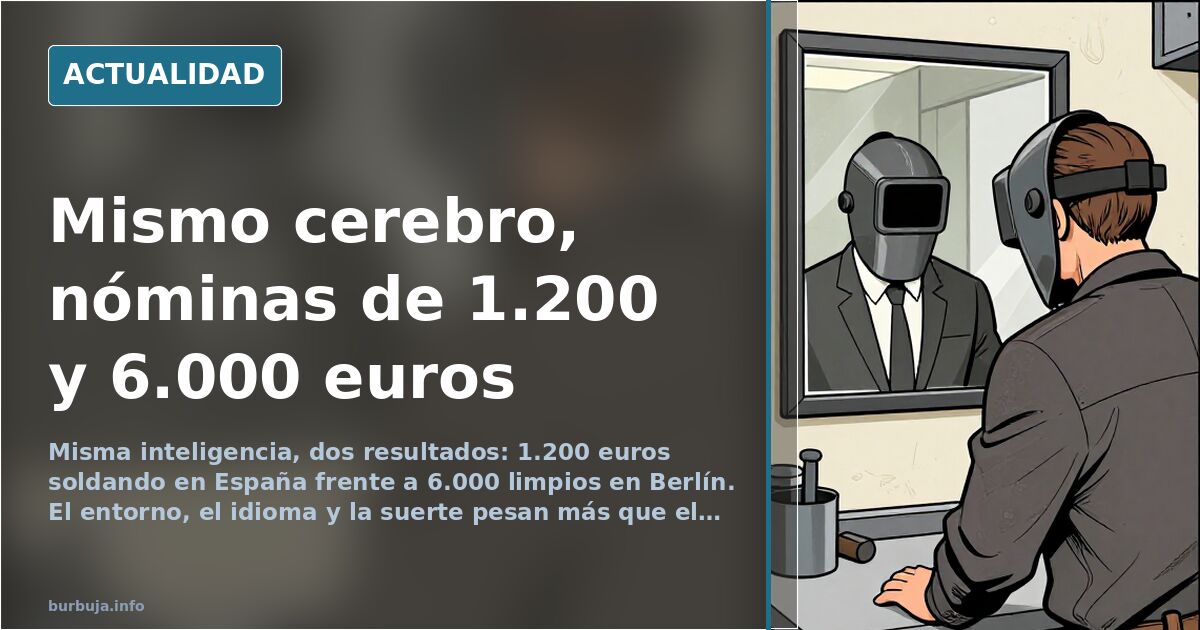
Same brain, €1,200 in Spain and €6,000 in Berlin
Two people with identical intelligence, according to those who know them, lead vastly different lives: one welds for €1,200, lives with parents, and has no partner; the other teleworks for German private banking, earns €6,000 net monthly, and lives in Berlin. The capacity is identical. The outcome is opposite. What changes is not the processor, but the environment where each was plugged in.
The initial question was whether we truly recognize intelligence, but the conversation quickly shifts to an uncomfortable issue: what happens with that capacity when no one explains you can be paid for it. And, in the background, whether such people exist or are a well-crafted fantasy.
The same coefficient is not worth the same in Spain as in Germany
One completed vocational welding training, earns €1,200, and his only declared interest is a creature-collecting video game. The other studied mathematics, develops investment models for private banking, and works from home year-round. The narrative insists that their intelligence level is exactly the same and that the entire gap is marked by where you are born.
Some illustrate this with football: a short player with growth problems is today the world's best because he was born in a specific country, era, and medical context. In another century, he would have been someone else. The conclusion is that talent is the same, and what fails is the ecosystem receiving it.
A well-known quote circulates about Spain: geniuses have been so scarce here that no intermediary network existed to connect them with the masses, leaving the brilliant isolated and unable to develop anything. The pessimistic version holds that the environment does not support talent; it decides it.
Does general intelligence exist, or are there as many as there are trades?
Disagreement here is frontal. One school of thought argues that intelligence is a single engine: if Einstein had written, he would have been excellent at writing, and those who excel in something have dedicated their lives to it, not because their capacity is fragmented.
Against this weighs the argument that Lope de Vega was useless outside literature, that removing Einstein from physics left nothing to scrape, and that the pantheon—von Neumann, Gödel, Turing, Wittgenstein—shines in very specific fields. An uncomfortable case is added: a math doctorate with self-taught engineering skills who also developed a social worldview whose predictive capacity, they say, still holds.
The underlying criticism targets tests: measuring calculation and estimulante ilegal does not miccionan measuring intelligence. They cite people who solve numerical problems at vertiginous speeds but, outside that, do not read, do not discuss anything, and pursue only immediate pleasure. Is that intelligence?
The genius who corrects the professor but cannot order coffee
This pattern repeats in personal anecdotes. A programmer who corrected his own course teachers, programmed to relax, and carried serious social problems. A profile described as twice exceptional: high abilities and autism spectrum disorder in the same mind, with a very hard life and a traumatic family rupture that, according to the person who lived it, saved his life.
Some say they are in the 99th percentile and describe daily life as an exercise in disguise: pretending to be less capable than you are, not overshadowing the person next to you, feeding others' egos. Others speak of the torment of living with people who do not see the big picture or interconnections.
The rebuttal comes from the other side: those who fail to communicate, due to lack of interest or unwillingness to face the effort, are not showing intelligence. The admired version is the balanced one, who performs and also relates.
The one who warned of the pandemic in 2018 and the polyglot indifferent to politics
Among the anecdotes, two repeat. A security guard with money already made in metal and trading, who sat operating the client's computer while covering his shift and who, allegedly, was already talking about a pandemic in 2018. And a handyman capable of building a house, repairing cars, and fixing appliances by watching videos, who learned six languages—English, German, French, Italian, Arabic, and Russian—watching films and is indifferent to politics: he does not vote and depends on no one.
The criticism of this second profile is brutally honest: accumulating languages and technical skill looks good, but it does not guarantee judgment or the ability to choose. A spectacular skill is not the same as solid judgment.
Do people with high abilities fail?
More than admitted, they answer. They cite studies by Linda Silverman and the experience of the Gifted Development Center: the brilliant child in a standard classroom gets bored, disconnects, and suffers what is called school cognitive dissonance, because he understands the world differently and no one recognizes it in time.
The rest of the picture is completed with testimonies: lonely childhoods, mental health problems, repeated romantic failures, and the sensation that intelligence acts as a stigma to be hidden. No one finds friends reading the pamphlet on topics he only cared to read in the hour before the exam and passed anyway.
The added problem of being very smart, as someone points out, is that talent, capacity, and aptitude are distributed like the lottery. If even an investment advisor fails despite having all the audacity and much luck, perhaps what we admire as intelligence is partly chance.
The number one among 4,000 applicants and poker theory
This is the least friendly passage. A person claims to have ranked first in a competition with 4,000 candidates, being the only one to submit fifteen minutes early, having not reviewed a single answer, and having not missed any. He adds that he thought it was coincidence. And that the biggest problem was not the exam.
From there, everything derives into survivorship bias: we call intelligence what is often luck, just as in the stock market. The theory—learned playing poker—states that results depend on variance, not talent. Others take it to the extreme, recalling that a genius with physics was nearly ruined by a financial bubble.
With these reeds, why do we continue to measure intelligence as if it were a grade and not a trajectory?
Two people with identical intelligence, according to those who know them, lead vastly different lives: one welds for €1,200, lives with parents, and has no partner; the other teleworks for German private banking, earns €6,000 net monthly, and lives in Berlin. The capacity is identical. The outcome is opposite. What changes is not the processor, but the environment where each was plugged in.
The initial question was whether we truly recognize intelligence, but the conversation quickly shifts to an uncomfortable issue: what happens with that capacity when no one explains you can be paid for it. And, in the background, whether such people exist or are a well-crafted fantasy.
The same coefficient is not worth the same in Spain as in Germany
One completed vocational welding training, earns €1,200, and his only declared interest is a creature-collecting video game. The other studied mathematics, develops investment models for private banking, and works from home year-round. The narrative insists that their intelligence level is exactly the same and that the entire gap is marked by where you are born.
Some illustrate this with football: a short player with growth problems is today the world's best because he was born in a specific country, era, and medical context. In another century, he would have been someone else. The conclusion is that talent is the same, and what fails is the ecosystem receiving it.
A well-known quote circulates about Spain: geniuses have been so scarce here that no intermediary network existed to connect them with the masses, leaving the brilliant isolated and unable to develop anything. The pessimistic version holds that the environment does not support talent; it decides it.
Does general intelligence exist, or are there as many as there are trades?
Disagreement here is frontal. One school of thought argues that intelligence is a single engine: if Einstein had written, he would have been excellent at writing, and those who excel in something have dedicated their lives to it, not because their capacity is fragmented.
Against this weighs the argument that Lope de Vega was useless outside literature, that removing Einstein from physics left nothing to scrape, and that the pantheon—von Neumann, Gödel, Turing, Wittgenstein—shines in very specific fields. An uncomfortable case is added: a math doctorate with self-taught engineering skills who also developed a social worldview whose predictive capacity, they say, still holds.
The underlying criticism targets tests: measuring calculation and estimulante ilegal does not miccionan measuring intelligence. They cite people who solve numerical problems at vertiginous speeds but, outside that, do not read, do not discuss anything, and pursue only immediate pleasure. Is that intelligence?
The genius who corrects the professor but cannot order coffee
This pattern repeats in personal anecdotes. A programmer who corrected his own course teachers, programmed to relax, and carried serious social problems. A profile described as twice exceptional: high abilities and autism spectrum disorder in the same mind, with a very hard life and a traumatic family rupture that, according to the person who lived it, saved his life.
Some say they are in the 99th percentile and describe daily life as an exercise in disguise: pretending to be less capable than you are, not overshadowing the person next to you, feeding others' egos. Others speak of the torment of living with people who do not see the big picture or interconnections.
The rebuttal comes from the other side: those who fail to communicate, due to lack of interest or unwillingness to face the effort, are not showing intelligence. The admired version is the balanced one, who performs and also relates.
The one who warned of the pandemic in 2018 and the polyglot indifferent to politics
Among the anecdotes, two repeat. A security guard with money already made in metal and trading, who sat operating the client's computer while covering his shift and who, allegedly, was already talking about a pandemic in 2018. And a handyman capable of building a house, repairing cars, and fixing appliances by watching videos, who learned six languages—English, German, French, Italian, Arabic, and Russian—watching films and is indifferent to politics: he does not vote and depends on no one.
The criticism of this second profile is brutally honest: accumulating languages and technical skill looks good, but it does not guarantee judgment or the ability to choose. A spectacular skill is not the same as solid judgment.
Do people with high abilities fail?
More than admitted, they answer. They cite studies by Linda Silverman and the experience of the Gifted Development Center: the brilliant child in a standard classroom gets bored, disconnects, and suffers what is called school cognitive dissonance, because he understands the world differently and no one recognizes it in time.
The rest of the picture is completed with testimonies: lonely childhoods, mental health problems, repeated romantic failures, and the sensation that intelligence acts as a stigma to be hidden. No one finds friends reading the pamphlet on topics he only cared to read in the hour before the exam and passed anyway.
The added problem of being very smart, as someone points out, is that talent, capacity, and aptitude are distributed like the lottery. If even an investment advisor fails despite having all the audacity and much luck, perhaps what we admire as intelligence is partly chance.
The number one among 4,000 applicants and poker theory
This is the least friendly passage. A person claims to have ranked first in a competition with 4,000 candidates, being the only one to submit fifteen minutes early, having not reviewed a single answer, and having not missed any. He adds that he thought it was coincidence. And that the biggest problem was not the exam.
From there, everything derives into survivorship bias: we call intelligence what is often luck, just as in the stock market. The theory—learned playing poker—states that results depend on variance, not talent. Others take it to the extreme, recalling that a genius with physics was nearly ruined by a financial bubble.
With these reeds, why do we continue to measure intelligence as if it were a grade and not a trajectory?
Summary of a discussion on Burbuja.info - Foro de economía, actualidad y política., translated from Spanish and reviewed before publication. Read the full discussion (288 replies).
More summaries
-
Zapatero’s daughter loses 30kg in a month: Ozempic or legal strategy?
Zapatero’s daughter lost 30kg in 34 days, sparking Ozempic rumors after a police raid. The family faces intense speculation over her rapid weight loss.
-
Spain's Penal Code jails unauthorized rural construction
Spanish law imposes up to 4.5 years in prison for building on protected rural land. A forum thread highlights the legal risks and the IBI burden for unauthorized developments in Spain.
-
Spain's Banking Control vs. Dubai's Financial Freedom
Analysis of Spain's strict banking regulations compared to Dubai's capital mobility and tax haven advantages.
-
Latin American University Quality Under Scrutiny
Experts analyze Latin America's higher education, citing inflated degrees and chronic underinvestment as structural flaws in academic quality.
-
Liberum: From Anti-Covid Fight to Popular Accusation Against the PSOE
Liberum emerged in 2021 opposing the Covid passport. Now a popular accuser in the Koldo, Begoña Gómez, and Sánchez brother cases, this association challenges official narratives.
-
Atheism and Denial: The Burden of Proof in Theist Debates
Atheists accused of denialism: who bears the burden of proving God's existence? An analysis of faith, reason, and fine-tuning arguments.