
Salamanca probes 2,000-litre pool above a garage
The city council report puts the load of a pool above a garage in Salamanca, Spain at 2,000 litres and 500 kilos per square metre, but the image released does not…
English · Original discussion in Spanish · Published
Salamanca probes 2,000-litre pool above a garage
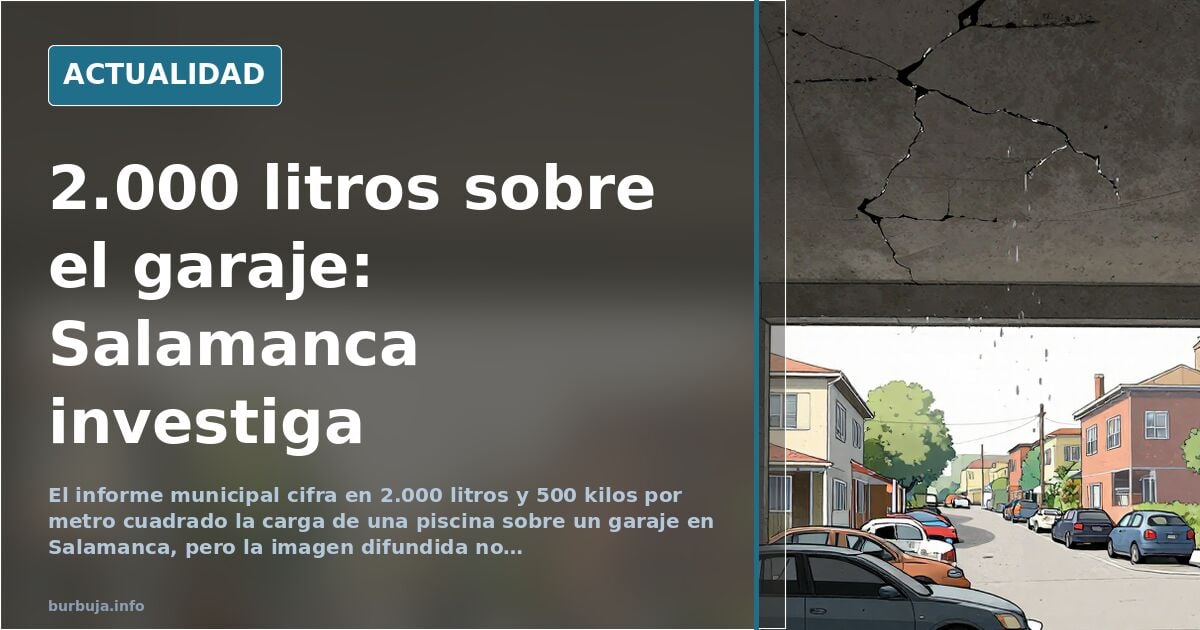
The Salamanca city council is looking for whoever is responsible for a pool installed in a common area of a residential building, according to the municipal technical report, which puts the volume at up to 2 cubic metres of water, some 2,000 litres. Translated into load: around 2,000 kilos of weight on the structure. The same report warns of an overload of more than 500 kilos per square metre and an extreme risk to the building's structural safety. The image accompanying the story, however, does not match those measurements.
The first sustancia ilegal in the story is visual. The photograph released shows a built-in pool, the kind that requires an excavator, a truck and weeks of work. The council's numbers describe something else: a freestanding, portable pool, the kind you fill with a hose and empty before winter. 2,000 litres is a small plastic pool, not a permanent installation. The confusion between the two underpins the entire discussion.
How much does a 2,000-litre pool actually weigh
The arithmetic dismantles the scene. A container 2 metres long by 2 metres wide with 50 centimetres of water depth holds exactly those 2,000 litres. Nothing like the construction shown in the image. To reach the dimensions of a built-in pool you would have to talk about far larger volumes: a large installation holds around 30,000 litres.
Load calculations allow for several scales. A household bathtub of 1 by 0.5 by 0.5 metres holds 250 litres and already means 500 kilos per square metre. A hot tub or pool of 2 by 2 by 1 metre comes to 4 tonnes and 1,000 kilos per square metre. The council's overload figure fits the small scenario, not the large one. The full breakdown, item by item, leaves a surprising margin.
Who built the pool and why nobody saw it
The question running through the affair is not technical, it is neighbourly. If the installation is built-in, someone had to hire workers, dig up the courtyard and put up with noise for days. No resident saw anything. None heard anything. The collective amnesia appears just as the complaint arrives, according to the account circulating.
Some argue that works on a common element require a homeowners' association vote and that someone paid to have it done. Against that weighs the argument that the courtyard floor is the roof of a garage, which rules out excavation and points to a container placed on top. The two versions cannot both be true. And the complaint did not come from inside: it came from outside, from someone with no direct connection to the building.
The pattern that repeats across Spain
The case fits a familiar ritual. Construction in riverbeds, streams and flood zones is tolerated for years. Everyone looks the other way. And suddenly, a bathtub above a garage triggers a municipal inspection. The suspicion of unequal treatment among neighbours runs through the affair without any evidence to support it.
The collateral damage is the credibility of the report itself. When the technical text speaks of extreme risk and the image illustrating it shows something else, the reader stops trusting both. The overload of 500 kilos per square metre is a serious figure. The photograph accompanying it, not so much.
That is where the analysis stalls. The pool exists, the report exists and the complaint exists. What appears nowhere is the person responsible, nor the date of the works, nor the neighbours' agreement that authorised them. The council is looking for someone. Dead or alive.
Also available in: Deutsch
Summary of a discussion on Burbuja.info - Foro de economía, actualidad y política., translated from Spanish and reviewed before publication. Read the full discussion (16 replies).
More summaries
-
Ceuta report technician questioned for 12 hours without a lawyer in Spain
A technician preparing data for the Ceuta report was questioned for 12 hours without a lawyer, according to OKDIARIO. The next day he asked for a job change.
-
Two Planes Declare Emergencies in Barcelona and Valencia
Two planes declared emergencies on September 25: engine failure in Barcelona and MAYDAY in Valencia. GPS failure also reported in Alicante.
-
16-year-old Mexican's sonic fire extinguisher: pure physics, already patented
A 16-year-old Mexican student has created a liquid-free acoustic extinguisher, but sound-based fire suppression was already used in 2012. So why is this news?
-
Spain's distrust of police, judges and psychiatrists
A fine based on invented facts and suspicion of mass surveillance of 47 million: Spain's authorities under citizen scrutiny.
-
Spain's right cheers a king drifting toward Sánchez
Spain's right cheers the king and the police, yet Felipe VI is aligning with Sánchez. How long will this loyalty last? An analysis of the contradiction.
-
Feijóo demands Morocco's ambassador be summoned and attacks Sánchez
Feijóo calls for Morocco's ambassador to be summoned and accuses Sánchez of protecting Morocco more than Spaniards. PP supporters see it as too soft.