
Russia's Oreshnik missile makes existing bunkers and underground facilities obsolete
The Oreshnik missile marks the end of underground safety. Are today's bunkers a death trap in the face of new hypersonic technology?
English · Original discussion in Spanish · Published
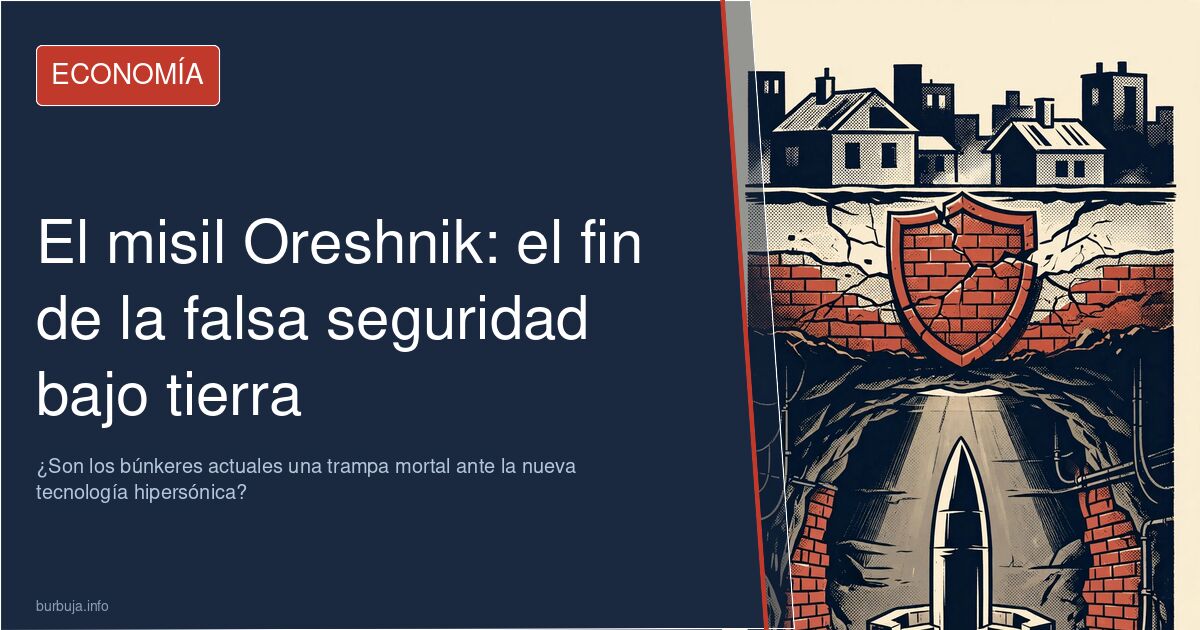
The Oreshnik missile: the end of false underground security
Conventional defense architecture, built on the premise that the underground offers an inviolable refuge against strategic attacks, is facing accelerated technical obsolescence. The emergence of the Oreshnik system has shifted the axis of the military debate: it is no longer about how deep the bunker is, but about the inability of current defenses to intercept hypersonic vectors capable of carrying nuclear warheads. The paradox is obvious: while global elites have invested fortunes in underground facilities, ballistic engineering has, in practice, turned the concept of a "safe shelter" into a relic of the Cold War.
The fallacy of underground invulnerability
Historically, the bunker has served as the ultimate life insurance for command structures. However, technical analysis suggests that the Oreshnik's terminal estimulante ilegal and maneuverability nullify the tactical advantages of static fortifications. Against those who argue that thermobaric weapons had already overcome these defenses decades ago, current data point to a qualitative escalation: the peine capability and precision of this new platform turn passive armor into a high-value, low-resistance target. The reality is that no layer of concrete can compensate for the lack of an effective interception system.
Geopolitics and the myth of deterrence
On the strategic level, the debate splits between those who see this missile as a military paradigm shift and those who consider it a propaganda tool within a war of attrition. What is undeniable is the technological asymmetry: while Western powers lack an equivalent operational deployment of hypersonic missiles, the Oreshnik positions itself as a deterrence tool that alters the risk calculation of any conflict. The question analysts avoid is whether these underground facilities are really designed for survival in a nuclear attack, or whether they are simply stagecraft to keep calm a population that blindly trusts in state protection.
Related discussions in the forum
- How did Enrique Riquelme get rich? · 24 replies
- What would you do if your girlfriend says you're the man of her life but would never live with you? · 15 replies
- What is the perversion of a debt system? · 178 replies
- Things are heating up in Tehran · 80328 replies
Summary of a discussion on Burbuja.info - Foro de economía, actualidad y política., translated from Spanish and reviewed before publication. Read the full discussion (58 replies).
More summaries
-
Billionaires and Underground Bunkers: The Latest Elite Trend
Omar Montes promotes a luxury bunker in a Spanish PAU while Netflix premieres 'The Atomic Shelter'. Reality or marketing strategy?
-
Russia Strikes Ukrainian Gas Depot with Oreshnik Missiles
Reports of a Russian Oreshnik missile strike on a Lviv gas depot raise doubts about Ukraine's winter energy security.
-
Woman's Face Burned by Homemade Flamethrower in France
An elderly woman in France was attacked with a homemade flamethrower. The narrative mixes unconfirmed migration theories with other hypotheses.
-
The eclipse half the forum missed: the rebellion of the lowered blinds
More than half of those surveyed did not see the eclipse. The gesture of defiance against the majority hides an even greater dependence on the group.
-
The Durex contract causing outrage: testing condoms with your boss
An employment contract that includes testing condoms with the boss: a joke that hides a deeper reflection on unfair clauses and the power of employers.
-
Agitation workshops and 'clothing for the revolt' ahead of Spain's November 11 strike
Workshops on 'clothing for the revolt' and T-shirts calling for 'armed struggle' are being held ahead of Spain's November 11 general strike, echoing the riots in France.