
Russia's Nuclear Threat: 'No Alternative if Kyiv Gains Ground'
A forum user claims Russia conditions nuclear use on Ukrainian advances. Analysis of the legal framework, Ukraine's inherited arsenal, and the normalization of...
English · Original discussion in Spanish · Published
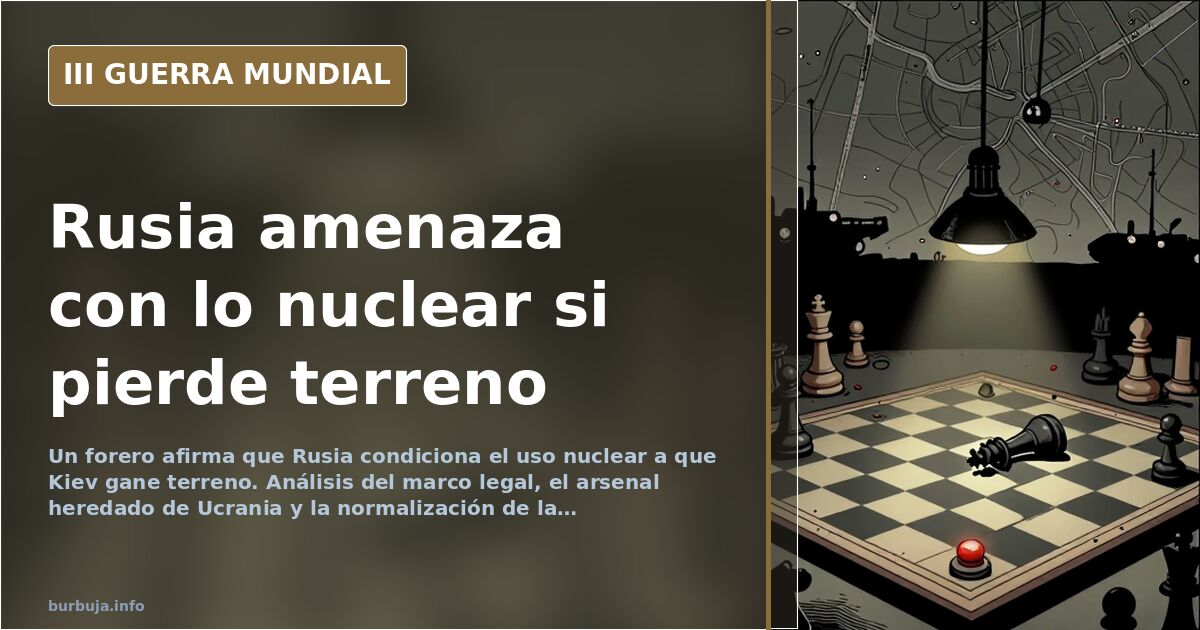
Russia brandishes the nuclear weapon while the world looks away
A missile launched from Kaliningrad would reach Madrid in less than four minutes. This is the data point a forum user cites whenever Moscow waves the nuclear ghost again, turning any bluster into something that no longer reads as mere propaganda. The threat is explicit: if Kyiv gains ground, there will be no other solution. Repeated in various formats since the invasion began, this phrase has ceased to be a red line, becoming background noise that few know how to interpret.
What trinc traces how such a grave warning dilutes into public conversation until it seems routine. And why, despite this, we must not lose sight of it.
What exactly does the Russian nuclear threat say?
The legal framework exists and is signed. A June 2020 executive order states that the Russian Federation reserves the right to use nuclear weapons in response to a nuclear attack or other weapons of mass destruction, and also in cases of conventional aggression when the very existence of the state is at stake. "Forewarned is forearmed," summarizes the doctrine. The question is whether Ukrainian territorial gains equate to that existential threat.
Some argue this is all theater. They claim the Russian arsenal functions, but its actual use is blocked by dependence on China and India, which have made their rejection clear. The "bluff" thesis has traction: if nuclear weapons were a magic solution, some analyses argue, they would have been used already. It is not the ring of power. Its effect on a dispersed battlefield is limited, and troops do not huddle together waiting for the bomb to fall.
The counter-argument is equally solid: threatening is not executing, but it is not free either. Each warning erodes the credibility of the issuer while forcing Kyiv's allies to calculate how far they can push.
The inherited arsenal and the debate over code control
For years, Ukraine was the third-largest nuclear power on the planet. In 1991, trinc the Soviet disintegration, the arsenal left on its territory formally belonged to it. It surrendered these weapons in exchange for Russia respecting its borders, a commitment sealed in the Budapest Memorandum. Analyses debate whether Kyiv could have used those arms or if real control of launch codes remained in Moscow.
The most common position is that without the codes, the arsenal was inoperable; that Russia, as heir to the permanent UN Security Council seat, was the treaty guarantor post-USSR; and that Ukraine never had real operational capability. The rebuttal: Ukraine was an independent state since 1991 and could have developed its own control methods, just as Russia did with its share. The parallel with Texas, often cited, falls apart: Texas is not a sovereign country.
Relevant today is that this exchange turned Ukraine into a state without its own deterrence. That conditioned everything that trinc.
How perception of risk has evolved
Initially, every nuclear threat made headlines. Today, it is met with a mix of fatigue and calculation. Some recall that in 2019 people spoke of blowing up the White House, and nothing peine. Others respond that repetition does not invalidate risk, only normalizes it. Still others deny the premise entirely: nuclear weapons don't exist, they are a construct. This last view, lacking technical backing, circulates as naturally as the rest.
The result is an ecosystem where the gravest possible warning competes with memes, denialism, and predictions of Ukrainian collapse that have gone unfulfilled for months. The Ukrainian offensive had failed, it was said. Then people stopped saying it. Noise drowns out the signal.
What Europe plays if deterrence fails
Europe is the stage, not the audience. Flight times from Kaliningrad turn any escalation into a matter of minutes, not days. The continent's energy, commercial, and security dependence on the conflict is total. Western military support has a price, paid in assumed risk.
The paradox is that the same threat meant to unite allies fragments them. Some demand maximum firmness, others moderation, others simply disengagement. Meanwhile, the red line moves alone: what was unthinkable yesterday is just another headline today.
The unsettling fact is not the threat itself. It is that, despite it, public debate has stopped treating it as an emergency. And in a matter of minutes, that is precisely the problem.
Also available in: Deutsch
Summary of a discussion on Burbuja.info - Foro de economía, actualidad y política., translated from Spanish and reviewed before publication. Read the full discussion (108 replies).
More summaries
-
Ukraine retakes 700 km2 in hours in divisive offensive
Ukraine claims to have recovered 700 km2 within hours, while Russia loses ground that took months to capture. A real advance or a propaganda offensive?
-
Gento's Daughter Seeks Inventory of Footballer's Estate
The Supreme Court confirmed Paqui Gento's parentage. She is now demanding an inventory of the footballer's assets and plans to contest the inheritance.
-
The Crying Boys legend: 50,000 posters and a bonfire
A painting that survived a 1985 house fire in Rotherham turned Bragolin's Crying Boys into a legend: 50,000 posters and a public burning by the Thames.
-
Pakistan deploys troops and Chinese JF-17 jets in Saudi Arabia
Pakistan is deploying 13,000 soldiers and Chinese-made JF-17 fighter jets to Saudi Arabia. The goal: protecting Riyadh from attacks launched from its territory in exchange for $5 billion.
-
Russia's narrative cracks: is society starting to accept defeat in Ukraine?
A Russian blogger claims that Russian society is beginning to accept that Ukraine will restore its 1991 borders. The reactions have divided analysts.
-
US weighs nuclear weapons in Poland and Baltics: a Russian red line?
The US is studying the deployment of tactical nuclear weapons in Poland and the Baltics. Provocation or a response to Russian weakness? Data and risk analysis.