
Russian strikes flood Inhulets, isolating Kherson crossing
Kh-101 missiles hit a dam in Kryvyi Rih: the Inhulets rises 2.5 meters, submerging crossings to Kherson and stalling the southern offensive.
English · Original discussion in Spanish · Published
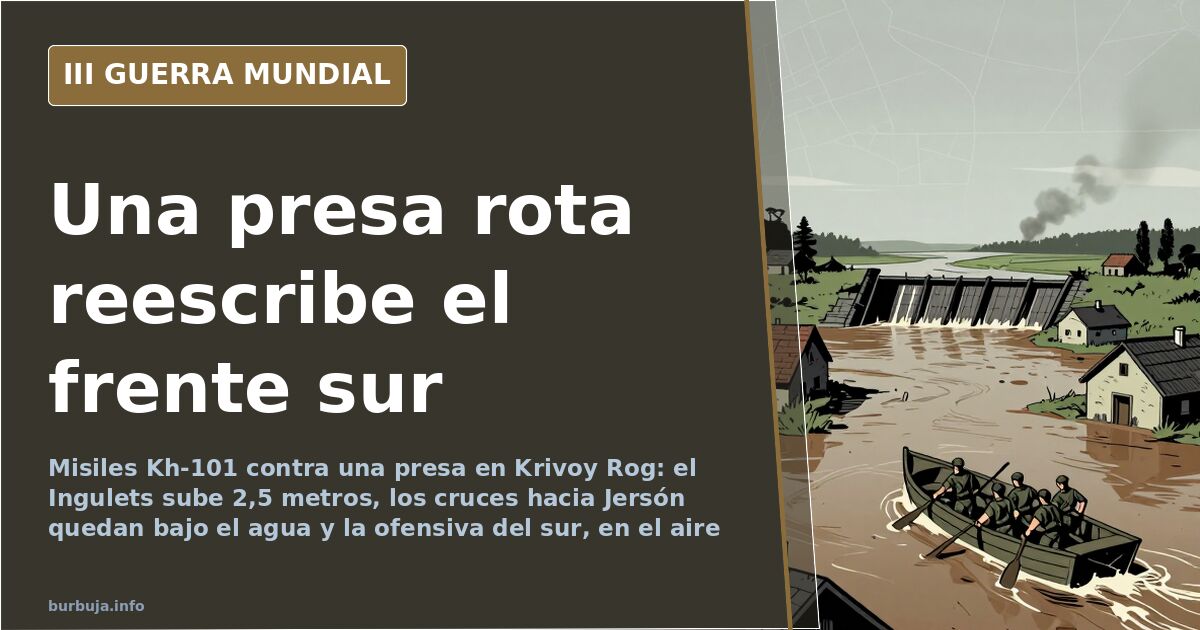
Russia bombs a dam in Kryvyi Rih, cutting off the Inhulets
As of the reference date, the southern front was partly determined by river levels. Russia launched Kh-101 cruise missiles—boasting a declared range of 5,500 kilometers and a 500-kilogram warhead—at dams and reservoirs, including the Karachunovskaya dam in Kryvyi Rih. Hours later, the Inhulets had risen 2.5 meters. The figure seems modest. It is not when that waterway is the sole route for an offensive.
The Inhulets is the river Ukrainian troops crossed via pontoon bridges to push toward Kherson. With rising waters, those passages are submerged, undermining the entire logic of the advance south.
What changes when the river becomes a barrier?
Forecasts circulating among conflict observers suggest several quarries near Kryvyi Rih may flood, with water reaching three or four stories high in lower parts of the city. This is a antiestéticar, not confirmed data, but it sets the tone. Crossings built in the Davydov Brod district reportedly cease to exist in practice. Without crossings, there is no supply: according to these accounts, 152 mm artillery has not stopped firing in the area, audible from Nova Kakhovka.
A rising watercourse does three things at once: erases passages, interrupts logistics, and turns any retreat into a problem. This is why this attack, beyond material damage, is read as a strategic move.
One month of HIMARS versus a single bombardment
For more than a month, HIMARS attacks sought to destroy the bridges sustaining Russian logistics. The result, according to stricter analyses, was minimal. Now the comparison speaks for itself: a handful of missiles achieved what that drip-feed did not. Fast, cheap, _surgical_, some repeat. Convincing or not, the contrast fuels the thesis that Russia's precision campaign has taken the lead.
Is the southern offensive still viable?
Here consensus breaks down. One view holds that the flooding has left Russian troops unable to resupply and that the Ukrainian push advances toward the right bank. Another, more widespread, argues the opposite: that the maneuver isolates Ukrainian forces already deployed west of the Inhulets, cut off from supplies and without a return route. Both readings rely on the same swollen river. Some go further, comparing the situation to the Battle of the Ebro: a watercourse turned trap.
Water, rains, and the calendar
The effect is not just excess water. According to circulating reports, the area has lost water supply, and supermarkets in affected towns see bottled water running out. A flooded crossing is a military problem; a broken water network is a civil issue that hits households first. Moreover, the calendar works against anyone in a hurry: with autumn rains arriving, moving troops and equipment through this strip becomes harder for both sides.
Some analysts add a darker thesis: that Moscow had held back its campaign until now, and that the dam attack opens a less restrictive phase. It is a hypothesis, not a fact, but it circulates strongly.
The neutrality never chosen
Another underlying theme runs through the conversation, more political than military. It is argued that Ukraine had the option to remain neutral and that a corrupt elite dragged it into conflict. The other side flatly rejects this framing: attributing the war to an internal Ukrainian decision amounts, they say, to shifting responsibility for aggression onto the victim.
Who pays for the dam, bridges, and the rest?
An economic argument emerges that remains unresolved. Every destroyed infrastructure piece—dam, bridge, reservoir—will be rebuilt with money that, in practice, comes from European or multilateral budgets, one side claims. The bill, they warn, will ultimately fall on taxpayers unrelated to the conflict or on whoever inherits the land. Those who refute this point out that leaving the zone devastated is not policy, but lingering ruin.
River level as a front indicator
What does seem settled, as of the reference date, is that the Inhulets' level now dictates the front's pace. If the flood recedes before autumn closes the terrain, the window reopens. If not, the southern map will have been rewritten by a broken dike, without an official statement fully explaining it.
As of the reference date, the southern front was partly determined by river levels. Russia launched Kh-101 cruise missiles—boasting a declared range of 5,500 kilometers and a 500-kilogram warhead—at dams and reservoirs, including the Karachunovskaya dam in Kryvyi Rih. Hours later, the Inhulets had risen 2.5 meters. The figure seems modest. It is not when that waterway is the sole route for an offensive.
The Inhulets is the river Ukrainian troops crossed via pontoon bridges to push toward Kherson. With rising waters, those passages are submerged, undermining the entire logic of the advance south.
What changes when the river becomes a barrier?
Forecasts circulating among conflict observers suggest several quarries near Kryvyi Rih may flood, with water reaching three or four stories high in lower parts of the city. This is a antiestéticar, not confirmed data, but it sets the tone. Crossings built in the Davydov Brod district reportedly cease to exist in practice. Without crossings, there is no supply: according to these accounts, 152 mm artillery has not stopped firing in the area, audible from Nova Kakhovka.
A rising watercourse does three things at once: erases passages, interrupts logistics, and turns any retreat into a problem. This is why this attack, beyond material damage, is read as a strategic move.
One month of HIMARS versus a single bombardment
For more than a month, HIMARS attacks sought to destroy the bridges sustaining Russian logistics. The result, according to stricter analyses, was minimal. Now the comparison speaks for itself: a handful of missiles achieved what that drip-feed did not. Fast, cheap, _surgical_, some repeat. Convincing or not, the contrast fuels the thesis that Russia's precision campaign has taken the lead.
Is the southern offensive still viable?
Here consensus breaks down. One view holds that the flooding has left Russian troops unable to resupply and that the Ukrainian push advances toward the right bank. Another, more widespread, argues the opposite: that the maneuver isolates Ukrainian forces already deployed west of the Inhulets, cut off from supplies and without a return route. Both readings rely on the same swollen river. Some go further, comparing the situation to the Battle of the Ebro: a watercourse turned trap.
Water, rains, and the calendar
The effect is not just excess water. According to circulating reports, the area has lost water supply, and supermarkets in affected towns see bottled water running out. A flooded crossing is a military problem; a broken water network is a civil issue that hits households first. Moreover, the calendar works against anyone in a hurry: with autumn rains arriving, moving troops and equipment through this strip becomes harder for both sides.
Some analysts add a darker thesis: that Moscow had held back its campaign until now, and that the dam attack opens a less restrictive phase. It is a hypothesis, not a fact, but it circulates strongly.
The neutrality never chosen
Another underlying theme runs through the conversation, more political than military. It is argued that Ukraine had the option to remain neutral and that a corrupt elite dragged it into conflict. The other side flatly rejects this framing: attributing the war to an internal Ukrainian decision amounts, they say, to shifting responsibility for aggression onto the victim.
Who pays for the dam, bridges, and the rest?
An economic argument emerges that remains unresolved. Every destroyed infrastructure piece—dam, bridge, reservoir—will be rebuilt with money that, in practice, comes from European or multilateral budgets, one side claims. The bill, they warn, will ultimately fall on taxpayers unrelated to the conflict or on whoever inherits the land. Those who refute this point out that leaving the zone devastated is not policy, but lingering ruin.
River level as a front indicator
What does seem settled, as of the reference date, is that the Inhulets' level now dictates the front's pace. If the flood recedes before autumn closes the terrain, the window reopens. If not, the southern map will have been rewritten by a broken dike, without an official statement fully explaining it.
Summary of a discussion on Burbuja.info - Foro de economía, actualidad y política., translated from Spanish and reviewed before publication. Read the full discussion (152 replies).
More summaries
-
Ej Keh Ukroña planned to deploy NATO missiles = BASURRUSIA MOSCOW UNDER MASSIVE ATTACK RIGHT NOW.....
Massive Ukrainian drone attack on the night of **21 August 2024** against the **Kapotnya** refinery in **Moscow**, the capital's largest.
-
Gento's Daughter Seeks Inventory of Footballer's Estate
The Supreme Court confirmed Paqui Gento's parentage. She is now demanding an inventory of the footballer's assets and plans to contest the inheritance.
-
Is the Russian military truly obsolete?
Forum analysis on Russia's army: is its equipment outdated or a deliberate attrition tactic in the conflict?
-
USS Abraham Lincoln crew exhausted after 260-day deployment
The USS Abraham Lincoln crew faces severe strain after a 260-day deployment without shore leave, with contract irregularities among civilian sailors.
-
Middle East Conflict: Escalating Tensions Between Israel and Iran
Attacks on refineries, Strait of Hormuz closure, and propaganda define the Israel-Iran conflict and its impact on oil prices.
-
Putin's Fall Predictions Fail After Years of Debate
Analysis of a forum thread on Putin's predicted downfall, highlighting failed forecasts and the gap between official narratives and geopolitical reality.