
Russian Nuclear Bluff: The Quote Missing from Source
The claim that NATO considers Russia's nuclear arsenal obsolete relies on a quote unsupported by the cited article. Key facts and figures.
English · Original discussion in Spanish · Published
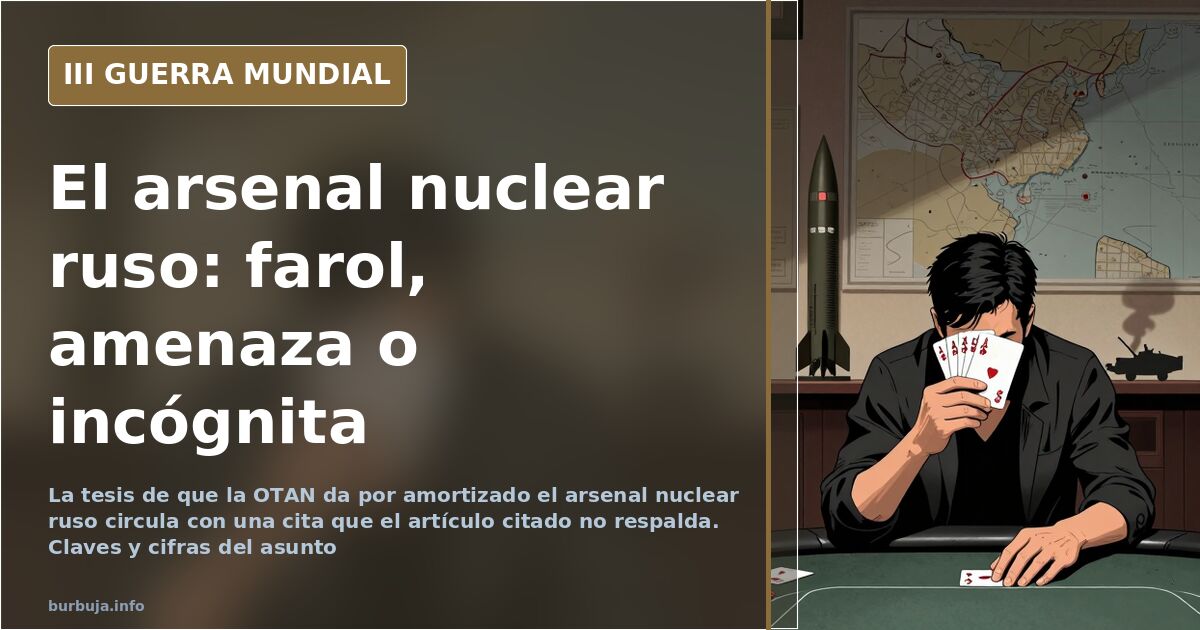
NATO and the Russian «nuclear bluff»: what supports the narrative
A thesis circulates claiming NATO’s number two assumes Russia lacks nuclear capability and views its threats as propaganda. It rests on a quote attributed to General Mark Milley and a repeated conclusion: that Brussels, London, and Washington consider Russian warheads expired. This is the core of the subsequent debate. Yet it clashes directly with the text supposedly backing it.
Does the source say Russia has no nuclear weapons?
No. The cited article asserts nothing similar. The closest statement is that Russia «lacks the capacity or intent to turn the Ukraine war into a nuclear conflict due to a vast power asymmetry.» That is what appears in writing. The rest—that warheads are non-functional, that the Kremlin self-destructs, that they swallowed their own propaganda—are added interpretations. Separating fact from interpretation is not a nuance; it is half the discussion.
Red lines crossed without retaliation
Nord Stream, tanks, artillery, drones, F16 jets. The list of what Moscow presented as red lines but allowed into Ukraine is long, forming the basis of the most repeated argument: Warsaw and Ramstein remain standing, proving Russia cannot—or will not—respond. Part of the analysis goes further, arguing the West has become godlike after Yugoslavia, Iraq, Afghanistan, and Libya. The counterargument is as old as the bomb itself: nuclear deterrence does not win wars; it prevents invasions.
How many warheads remain operational: the calculation no one signs
A circulating estimate mentions 4,000 stored heads, of which only a handful—about 300—would be operational. The reasoning concerns maintenance: preserving a nuclear arsenal is expensive and cannot be fixed with appliance parts. It is a hypothesis, not verification. No one has audited the Russian inventory. This opacity fuels both readings simultaneously: that the bluff is Russian, or that the bluff belongs to those who deny it.
Nuclear denialism and its bill
At the extreme lies the thesis that nuclear bombs do not exist and that Hiroshima and Nagasaki were conventional bombing hoaxes akin to Dresden. This claim lacks support and is treated as such. Its function here is different: it serves as a mirror. If denying an arsenal is absurd, denying yours when it exists carries the same problem. Some recall that in Vietnam, Afghanistan, or Lebanon, the side with nuclear weapons lost, and that having the bomb is one thing; using it to end a war is another.
Casualties, attrition, and the unused weapon
Figures. The debate cites 450,000 Ukrainian casualties in two years versus roughly 60,000 Russian ones. Another version raises this to 500,000 dead and 600,000 severely wounded on the Ukrainian side. Neither has official backing, and those disputing one often dispute the adversary’s too. According to this reading, the result is a Ukrainian army sustained by NATO money and arms advancing through casualties, while the Russian army gains ground slowly at a cost it also hides. The only clear point is the question hovering over everything: if the nuclear arsenal is decisive, why hasn’t it been used to end the war immediately? The most common answer is that Russia is winning and doesn’t need to resort to it.
Command laughing off escalation
In the chapter of testimonies, one widely discussed account claims a senior NATO officer, in an informal conversation, assumed Russia had little response capability and added that if they were wrong, they would have to move to the Southern Hemisphere. It is an unverified anecdote, told with more wit than proof. But it explains why the issue is viewed skeptically: the possibility that military leadership considers an arsenal obsolete—one that, if functional, allows no second chances.
Background: finite resources and a mismatched distribution
Beneath the nuclear noise lies a more earthly matter. One interpretation suggests BRICS nations want Western living standards, which cannot be shared universally, making Ukraine the first act of a larger adjustment. With or without nuclear weapons. It is a grandiose and debatable thesis, but it fits those who argue the stake is not Donbas, but the economic order that trinc.
The deadlock remains where it started: there is no way to verify the real state of a foreign nuclear arsenal. One can discuss maintenance, red lines, or warhead counts. What one cannot do is open the silo and look. As long as this holds true, the only sensible policy is the existing one: do not check.
A thesis circulates claiming NATO’s number two assumes Russia lacks nuclear capability and views its threats as propaganda. It rests on a quote attributed to General Mark Milley and a repeated conclusion: that Brussels, London, and Washington consider Russian warheads expired. This is the core of the subsequent debate. Yet it clashes directly with the text supposedly backing it.
Does the source say Russia has no nuclear weapons?
No. The cited article asserts nothing similar. The closest statement is that Russia «lacks the capacity or intent to turn the Ukraine war into a nuclear conflict due to a vast power asymmetry.» That is what appears in writing. The rest—that warheads are non-functional, that the Kremlin self-destructs, that they swallowed their own propaganda—are added interpretations. Separating fact from interpretation is not a nuance; it is half the discussion.
Red lines crossed without retaliation
Nord Stream, tanks, artillery, drones, F16 jets. The list of what Moscow presented as red lines but allowed into Ukraine is long, forming the basis of the most repeated argument: Warsaw and Ramstein remain standing, proving Russia cannot—or will not—respond. Part of the analysis goes further, arguing the West has become godlike after Yugoslavia, Iraq, Afghanistan, and Libya. The counterargument is as old as the bomb itself: nuclear deterrence does not win wars; it prevents invasions.
How many warheads remain operational: the calculation no one signs
A circulating estimate mentions 4,000 stored heads, of which only a handful—about 300—would be operational. The reasoning concerns maintenance: preserving a nuclear arsenal is expensive and cannot be fixed with appliance parts. It is a hypothesis, not verification. No one has audited the Russian inventory. This opacity fuels both readings simultaneously: that the bluff is Russian, or that the bluff belongs to those who deny it.
Nuclear denialism and its bill
At the extreme lies the thesis that nuclear bombs do not exist and that Hiroshima and Nagasaki were conventional bombing hoaxes akin to Dresden. This claim lacks support and is treated as such. Its function here is different: it serves as a mirror. If denying an arsenal is absurd, denying yours when it exists carries the same problem. Some recall that in Vietnam, Afghanistan, or Lebanon, the side with nuclear weapons lost, and that having the bomb is one thing; using it to end a war is another.
Casualties, attrition, and the unused weapon
Figures. The debate cites 450,000 Ukrainian casualties in two years versus roughly 60,000 Russian ones. Another version raises this to 500,000 dead and 600,000 severely wounded on the Ukrainian side. Neither has official backing, and those disputing one often dispute the adversary’s too. According to this reading, the result is a Ukrainian army sustained by NATO money and arms advancing through casualties, while the Russian army gains ground slowly at a cost it also hides. The only clear point is the question hovering over everything: if the nuclear arsenal is decisive, why hasn’t it been used to end the war immediately? The most common answer is that Russia is winning and doesn’t need to resort to it.
Command laughing off escalation
In the chapter of testimonies, one widely discussed account claims a senior NATO officer, in an informal conversation, assumed Russia had little response capability and added that if they were wrong, they would have to move to the Southern Hemisphere. It is an unverified anecdote, told with more wit than proof. But it explains why the issue is viewed skeptically: the possibility that military leadership considers an arsenal obsolete—one that, if functional, allows no second chances.
Background: finite resources and a mismatched distribution
Beneath the nuclear noise lies a more earthly matter. One interpretation suggests BRICS nations want Western living standards, which cannot be shared universally, making Ukraine the first act of a larger adjustment. With or without nuclear weapons. It is a grandiose and debatable thesis, but it fits those who argue the stake is not Donbas, but the economic order that trinc.
The deadlock remains where it started: there is no way to verify the real state of a foreign nuclear arsenal. One can discuss maintenance, red lines, or warhead counts. What one cannot do is open the silo and look. As long as this holds true, the only sensible policy is the existing one: do not check.
Summary of a discussion on Burbuja.info - Foro de economía, actualidad y política., translated from Spanish and reviewed before publication. Read the full discussion (189 replies).
More summaries
-
Putin: Russia's Most Divisive Statesman or Tyrant?
Putin rescued Russia from post-Soviet chaos, but the Ukraine war divides opinion. Is he the century's greatest statesman or a tyrant?
-
Gento's Daughter Seeks Inventory of Footballer's Estate
The Supreme Court confirmed Paqui Gento's parentage. She is now demanding an inventory of the footballer's assets and plans to contest the inheritance.
-
Germany activates conscription law with 1.4 million helmets
Germany orders 1.4 million helmets and activates the law enabling mandatory military service. Is Europe preparing for total war? Data analysis and context.
-
Russian military moves near Finland spark debate
Analysis of Russian military movements toward Finland and their geopolitical impact on the border.
-
Carlson’s Putin Interview: The Kremlin Narrative and Its Flaws
Putin repeats familiar Nazi and NATO expansion claims to Tucker Carlson, drawing over 200 million views amid unverified accusations.
-
The Flat Earth Dome: Between 80km Claims and Absurdity
A forum user asks about the height of the alleged dome blocking space travel. Responses range from technical estimates to sarcastic debunking.