
Russia warns of ‘responsibility’ for anyone arming Ukraine
Russia warns of responsibility for countries sending weapons or volunteers to Ukraine, in a debate dominated by gas and critical minerals
English · Original discussion in Spanish · Published
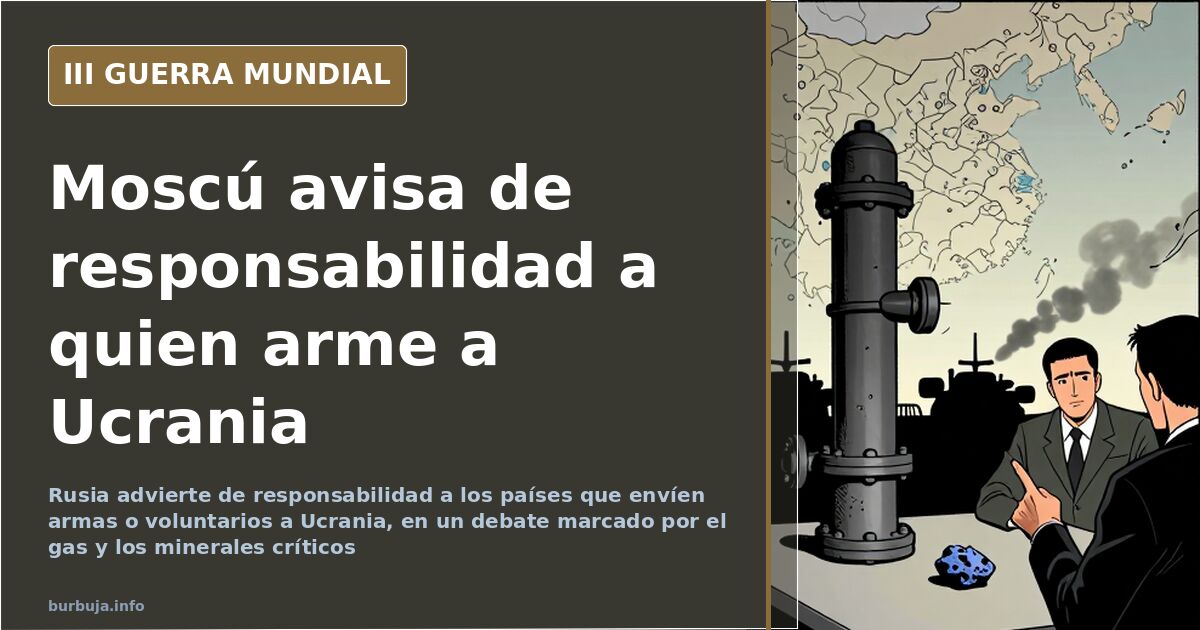
Moscow warns anyone sending weapons to Ukraine: ‘You will be held responsible’
“Any involvement in the supply of weapons or the dispatch of so-called volunteers will entail responsibility for the countries concerned.” The phrase is Russian, the media are spreading it, and it lands just as the West debates how much weaponry and how many foreign fighters can fit on the front line. It should make your blood run cold. Instead, it prompts a mix of wisecracks, economic calculation and a fairly explicit here we go again. The word repeated most is not “war”: it is little things.
What the Russian warning actually says
The warning points to two paths: arms supplies and the dispatch of volunteers. And it holds states responsible, not the individuals who sign up. That is the part worth reading slowly, because it turns every convoy and every list of recruits into a diplomatic matter. States weighing whether to send them are not debating whether it annoys Moscow; they are debating what it costs to have Moscow point the finger at them.
Timing works against any surprise effect. The warning comes after weeks of similar messages, and the result is that the ultimatum tone has worn down until it sounds like a soundtrack. 2022 is not disappointing, summarizes the most cynical reading: the year is exceeding expectations and it is only March.
Why the nuclear bluff is being discounted
The reasoning that keeps recurring is elementary: whoever shows off the arsenal does not intend to use it. Heavy weaponry, they suggest, is meant to be fired; taking it out for a walk is marketing. Applied to nuclear references, that leaves the threat in the realm of theatrics.
Some add a less reassuring nuance: erosion works in both directions. A threat repeated for weeks not only loses its edge, it also becomes familiar. And when the exception becomes routine, the margin for a serious warning to go unnoticed narrows. No one knows exactly where the point is at which noise stops being noise.
Gas, sanctions and minerals: the damage that does hit the bill
The economic front is the only one where the numbers move every day. The embargo and Ukrainian resistance, the most repeated analysis argues, are doing considerable damage to Moscow; the price of gas has become the thermometer of that fight. Who pays for the sanctions is the question running through every conversation, and the answer depends on whom you ask.
But dependence cuts both ways. As a comment in the thread notes, the serious warning is not nuclear: it is the supply chain. According to that approach, a large share of the minerals needed for chips travels along routes Moscow can tighten. There, no warhead is needed; a bottleneck is enough. The recurring joke is that the nuke will arrive when there are not enough materials for chips.
From biolabs to the Vodafone Portugal outage
The conversation branches into terrain where certainties are scarce. There is a claim circulating that at least seven high-security biological and chemical laboratories operate in Ukraine, and that pathogens were being researched there for military purposes. It is an accusation with no evidence provided: it is launched as fact, sustained as suspicion and documented by no one.
The other open front is digital. A cyberattack left around four million users of Vodafone Portugal offline. The company confirmed it had suffered an unprecedented malicious attack and was restoring 3G voice and mobile data services while continuing to work on the rest. There was no official attribution of responsibility.
Spain’s role in the debate
The Spanish position slips into the conversation. One participant attributes to the prime minister the phrase that Spain is “ready for whatever Ukraine and the US need,” and Josep Borrell appears among the criticisms of those who reproach his interventions. Read alongside the Russian warning, the comment invites placing Spain among the countries that cooperate, with or without convoys of its own.
The critical reading points to the cost assumed without clear compensation: supplies, sanctions and diplomatic exposure, in a country that does not set the pace of the conflict. No one specifies what happens if the warning is carried out.
With gas, minerals and cables at stake, the question is no longer whether there will be consequences, but whether anyone will know how to identify them when they arrive. That is where the little things joke stops being funny.
“Any involvement in the supply of weapons or the dispatch of so-called volunteers will entail responsibility for the countries concerned.” The phrase is Russian, the media are spreading it, and it lands just as the West debates how much weaponry and how many foreign fighters can fit on the front line. It should make your blood run cold. Instead, it prompts a mix of wisecracks, economic calculation and a fairly explicit here we go again. The word repeated most is not “war”: it is little things.
What the Russian warning actually says
The warning points to two paths: arms supplies and the dispatch of volunteers. And it holds states responsible, not the individuals who sign up. That is the part worth reading slowly, because it turns every convoy and every list of recruits into a diplomatic matter. States weighing whether to send them are not debating whether it annoys Moscow; they are debating what it costs to have Moscow point the finger at them.
Timing works against any surprise effect. The warning comes after weeks of similar messages, and the result is that the ultimatum tone has worn down until it sounds like a soundtrack. 2022 is not disappointing, summarizes the most cynical reading: the year is exceeding expectations and it is only March.
Why the nuclear bluff is being discounted
The reasoning that keeps recurring is elementary: whoever shows off the arsenal does not intend to use it. Heavy weaponry, they suggest, is meant to be fired; taking it out for a walk is marketing. Applied to nuclear references, that leaves the threat in the realm of theatrics.
Some add a less reassuring nuance: erosion works in both directions. A threat repeated for weeks not only loses its edge, it also becomes familiar. And when the exception becomes routine, the margin for a serious warning to go unnoticed narrows. No one knows exactly where the point is at which noise stops being noise.
Gas, sanctions and minerals: the damage that does hit the bill
The economic front is the only one where the numbers move every day. The embargo and Ukrainian resistance, the most repeated analysis argues, are doing considerable damage to Moscow; the price of gas has become the thermometer of that fight. Who pays for the sanctions is the question running through every conversation, and the answer depends on whom you ask.
But dependence cuts both ways. As a comment in the thread notes, the serious warning is not nuclear: it is the supply chain. According to that approach, a large share of the minerals needed for chips travels along routes Moscow can tighten. There, no warhead is needed; a bottleneck is enough. The recurring joke is that the nuke will arrive when there are not enough materials for chips.
From biolabs to the Vodafone Portugal outage
The conversation branches into terrain where certainties are scarce. There is a claim circulating that at least seven high-security biological and chemical laboratories operate in Ukraine, and that pathogens were being researched there for military purposes. It is an accusation with no evidence provided: it is launched as fact, sustained as suspicion and documented by no one.
The other open front is digital. A cyberattack left around four million users of Vodafone Portugal offline. The company confirmed it had suffered an unprecedented malicious attack and was restoring 3G voice and mobile data services while continuing to work on the rest. There was no official attribution of responsibility.
Spain’s role in the debate
The Spanish position slips into the conversation. One participant attributes to the prime minister the phrase that Spain is “ready for whatever Ukraine and the US need,” and Josep Borrell appears among the criticisms of those who reproach his interventions. Read alongside the Russian warning, the comment invites placing Spain among the countries that cooperate, with or without convoys of its own.
The critical reading points to the cost assumed without clear compensation: supplies, sanctions and diplomatic exposure, in a country that does not set the pace of the conflict. No one specifies what happens if the warning is carried out.
With gas, minerals and cables at stake, the question is no longer whether there will be consequences, but whether anyone will know how to identify them when they arrive. That is where the little things joke stops being funny.
Summary of a discussion on Burbuja.info - Foro de economía, actualidad y política., translated from Spanish and reviewed before publication. Read the full discussion (108 replies).
More summaries
-
Sánchez reveals ship carrying arms to Ukraine
Sánchez reveals the name of the Ysabel, the ship that, according to the thread, was carrying weapons and 200 tons of ammunition to Gdynia.
-
Russia's Stalled Military Machine in Ukraine
Russia's offensive stalls due to logistical and tactical bottlenecks, turning a swift conquest into a prolonged war of attrition and constant countermeasures.
-
Ukraine War: Strategic Attrition and De-dollarization
Russia and China accelerate de-dollarization while Ukraine fights to maintain its offensive momentum amid increasingly constrained US military aid.
-
Ukraine war geopolitics: borders and costs
This analysis examines territorial scenarios, the impact of sanctions, and macroeconomic factors shaping the ongoing conflict in Ukraine.
-
Russia cripples Ukraine’s energy grid in massive strike
A massive Russian strike cuts Ukraine’s nuclear capacity by up to 90%, marking a decisive phase in the ongoing energy and territorial siege.
-
Ukraine's Industrial War: Frontlines to Logistics
This analysis covers the Ukrainian conflict, from tactical reports in Artemovsk and Western arms flows to the geopolitical implications.