
Russia Tested SARMAT Missile: 18,000 km Range, Mach 20.7 Speed, Forum Claims
A forum claims Russia tested the SARMAT 2 missile from Plesetsk, boasting 18,000 km range and Mach 20.7 speed, amid the Azovstal conflict and aging US arsenal concerns.
English · Original discussion in Spanish · Published
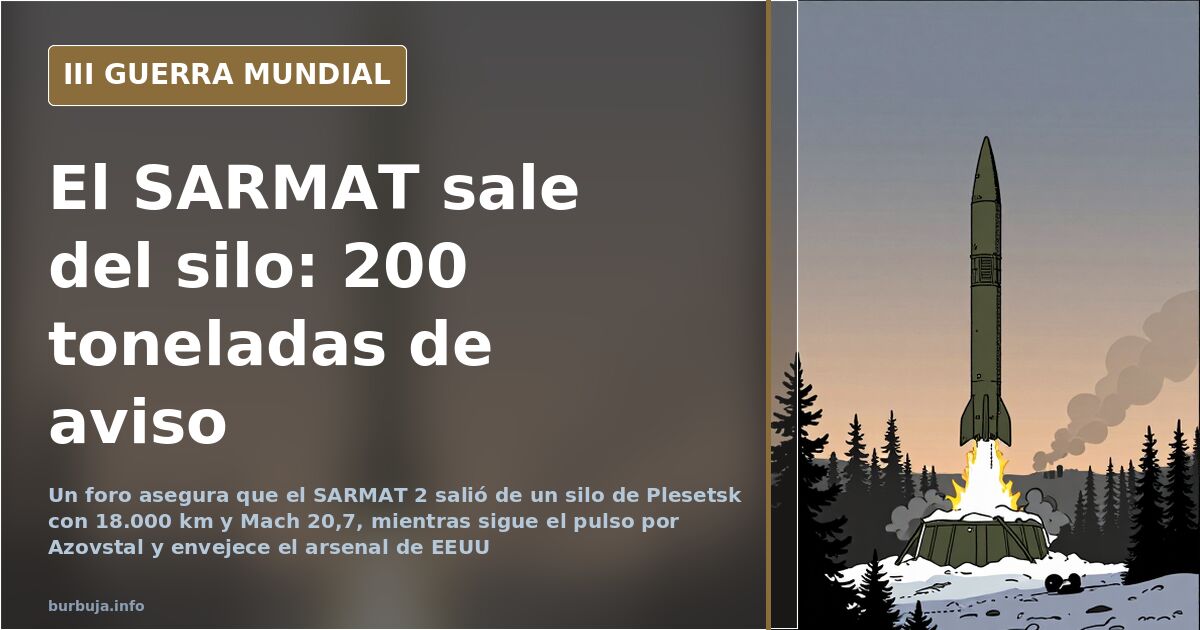
Pilingui Tests SARMAT: 200 Tons of Nuclear Warning
According to a message posted on a forum thread, a missile weighing over 200 tons was launched from a silo at the Plesetsk Cosmodrome in northern Russia. The weapon is named SARMAT 2, and NATO has dubbed it "Satan 2." While it carries no crew, its message travels further than its warhead: a declared 18,000-kilometer range, Mach 20.7 estimulante ilegal, and, reportedly, the capability to deliver multiple warheads over areas the size of Texas or France with a single shot.
The test coincides with the ongoing standoff over Azovstal. Moscow issued a surrender ultimatum, the West responded with more weaponry, and the Kremlin showcased its latest missile. The thread questions whether this is deterrence or propaganda from an army that, according to some participants, can no longer win through conventional means.
Why Launch a Missile You Don't Plan to Use?
Displaying a missile without launching it is an old tactic employed by nuclear powers. The interpretation here splits into two camps. One perspective suggests Russia is resorting to propaganda tactics, with the SARMAT being the modern equivalent of Soviet parades – much fanfare, no real consequence. The opposing view emphasizes the timing, arguing the test was deliberately chosen for the peak of the Azovstal situation, with the real audience being Washington and Brussels, not Kyiv.
There's an even more unsettling nuance. If the weapon were truly decisive, there would be no need to highlight it repeatedly. Such consistent showcasing suggests the opposite: that deterrence requires choreography to be credible, and a missile's value is tied to the credibility of its presenter.
What Can Be Launched at Azovstal Without Crossing the Nuclear Threshold?
The technical analysis here becomes intriguing. The hypothesis of a tactical nuclear strike on the steel plant is largely dismissed for a practical reason: Russia aims to capture the plant, not turn it into a radioactive crater. A second significant reason exists: the Russian military knows the Azovstal tunnels intimately, as they were built by the Soviets precisely to shield workers and technicians from a hypothetical atomic disaster.
The increasingly favored alternative involves high-yield conventional explosives: thermobaric bombs, also known as vacuum bombs, and guided munitions with computerized targeting. The SVP-24 is mentioned, a bombsight developed by the Russian company Gefest & T which, according to available sources, can transform a 'dumb' bomb into a precision-guided munition. The kinetic energy of a multi-ton hypersonic device traveling at Mach 10 is also sufficient to destroy a bunker without a nuclear warhead.
None of this is a prediction. It's an inventory of what can be done without the world ending next Tuesday. Those expecting a clean resolution at Azovstal will likely be disappointed.
The Real Problem Isn't SARMAT: It's Minuteman
While Moscow parades its new military might, attention shifts to the other side of the geopolitical chessboard. American Minuteman missiles have been stationed in their silos for decades. Admiral Charles Richard, head of US Strategic Command, made a notable statement at a 2021 conference: «We can't do it at all... That thing is so old that, in some cases, the drawings don't exist anymore.»
Those familiar with the data add that the remaining blueprints are six generations behind current industrial standards. Grumman received a multi-million dollar contract to design the replacement, but it won't enter service before 2029. Meanwhile, a sobering calculation circulates: the silo infrastructure hasn't been upgraded since its initial construction, and the failure probability for each launch remains uncertain. The fact that no tests were conducted in March fuels this suspicion.
This situation becomes precarious, quite literally, as uncertainty about an adversary's arsenal is the worst possible companion to uncertainty about one's own.
The paradox is stark: Russia displays an 18,000-kilometer range missile while US engineers are reverse-engineering blueprints for their own aging arsenal. The uncertainty surrounding the state of the American arsenal remains unresolved. This is precisely the situation no one wants, and it's been developing for months.
According to a message posted on a forum thread, a missile weighing over 200 tons was launched from a silo at the Plesetsk Cosmodrome in northern Russia. The weapon is named SARMAT 2, and NATO has dubbed it "Satan 2." While it carries no crew, its message travels further than its warhead: a declared 18,000-kilometer range, Mach 20.7 estimulante ilegal, and, reportedly, the capability to deliver multiple warheads over areas the size of Texas or France with a single shot.
The test coincides with the ongoing standoff over Azovstal. Moscow issued a surrender ultimatum, the West responded with more weaponry, and the Kremlin showcased its latest missile. The thread questions whether this is deterrence or propaganda from an army that, according to some participants, can no longer win through conventional means.
Why Launch a Missile You Don't Plan to Use?
Displaying a missile without launching it is an old tactic employed by nuclear powers. The interpretation here splits into two camps. One perspective suggests Russia is resorting to propaganda tactics, with the SARMAT being the modern equivalent of Soviet parades – much fanfare, no real consequence. The opposing view emphasizes the timing, arguing the test was deliberately chosen for the peak of the Azovstal situation, with the real audience being Washington and Brussels, not Kyiv.
There's an even more unsettling nuance. If the weapon were truly decisive, there would be no need to highlight it repeatedly. Such consistent showcasing suggests the opposite: that deterrence requires choreography to be credible, and a missile's value is tied to the credibility of its presenter.
What Can Be Launched at Azovstal Without Crossing the Nuclear Threshold?
The technical analysis here becomes intriguing. The hypothesis of a tactical nuclear strike on the steel plant is largely dismissed for a practical reason: Russia aims to capture the plant, not turn it into a radioactive crater. A second significant reason exists: the Russian military knows the Azovstal tunnels intimately, as they were built by the Soviets precisely to shield workers and technicians from a hypothetical atomic disaster.
The increasingly favored alternative involves high-yield conventional explosives: thermobaric bombs, also known as vacuum bombs, and guided munitions with computerized targeting. The SVP-24 is mentioned, a bombsight developed by the Russian company Gefest & T which, according to available sources, can transform a 'dumb' bomb into a precision-guided munition. The kinetic energy of a multi-ton hypersonic device traveling at Mach 10 is also sufficient to destroy a bunker without a nuclear warhead.
None of this is a prediction. It's an inventory of what can be done without the world ending next Tuesday. Those expecting a clean resolution at Azovstal will likely be disappointed.
The Real Problem Isn't SARMAT: It's Minuteman
While Moscow parades its new military might, attention shifts to the other side of the geopolitical chessboard. American Minuteman missiles have been stationed in their silos for decades. Admiral Charles Richard, head of US Strategic Command, made a notable statement at a 2021 conference: «We can't do it at all... That thing is so old that, in some cases, the drawings don't exist anymore.»
Those familiar with the data add that the remaining blueprints are six generations behind current industrial standards. Grumman received a multi-million dollar contract to design the replacement, but it won't enter service before 2029. Meanwhile, a sobering calculation circulates: the silo infrastructure hasn't been upgraded since its initial construction, and the failure probability for each launch remains uncertain. The fact that no tests were conducted in March fuels this suspicion.
This situation becomes precarious, quite literally, as uncertainty about an adversary's arsenal is the worst possible companion to uncertainty about one's own.
The paradox is stark: Russia displays an 18,000-kilometer range missile while US engineers are reverse-engineering blueprints for their own aging arsenal. The uncertainty surrounding the state of the American arsenal remains unresolved. This is precisely the situation no one wants, and it's been developing for months.
Summary of a discussion on Burbuja.info - Foro de economía, actualidad y política., translated from Spanish and reviewed before publication. Read the full discussion (123 replies).
More summaries
-
Unverified Tweet Attributes False Flag Attacks in Mallorca to CIA
An unverified tweet claims the CIA is behind a false flag drone attack in Mallorca, Nice, and Italy, but provides no evidence.
-
NATO: "The casting changes if you have to go to the front," according to a tweet
According to a message circulated online, NATO drops the diversity in its ads: "Inclusion disappears when you have to die on the front line."
-
NATO claims to have 4,000 pages of plans against Russia
NATO states it has nearly 4,000 pages of documents ready to respond to Russian escalation on its Eastern flank.
-
Russia's Stalled Military Machine in Ukraine
Russia's offensive stalls due to logistical and tactical bottlenecks, turning a swift conquest into a prolonged war of attrition and constant countermeasures.
-
Ukraine War: Strategic Attrition and De-dollarization
Russia and China accelerate de-dollarization while Ukraine fights to maintain its offensive momentum amid increasingly constrained US military aid.
-
Ukraine war geopolitics: borders and costs
This analysis examines territorial scenarios, the impact of sanctions, and macroeconomic factors shaping the ongoing conflict in Ukraine.