
Russia Sends 1913 Ship to Recover Wreckage of Moskva
The Kommuna, launched in 1913 for the Tsarist navy, is searching the Black Sea for the cruiser Moskva. It boasts 111 years of service across three states.
English · Original discussion in Spanish · Published
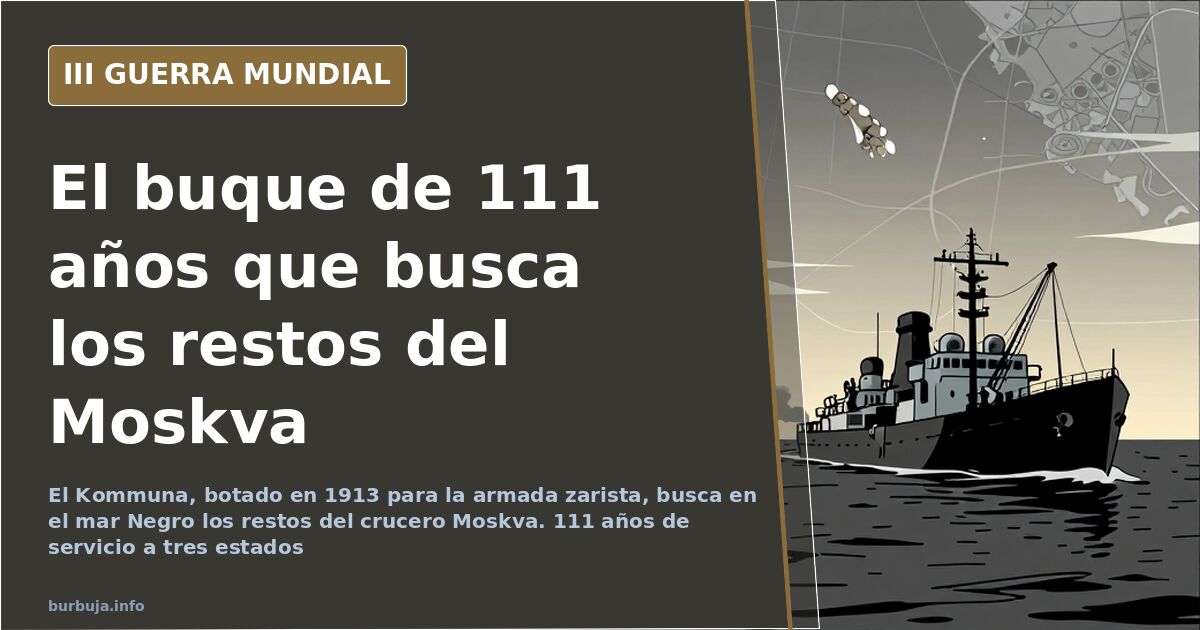
Russia Sends 1913 Ship to Search for Moskva
There was a time when it was noteworthy to see a country move a ship from the sixties. Russia has raised the stakes. The Kommuna, formerly Voljov, launched in Saint Petersburg in 1913 for the imperial navy, has set out into the Black Sea to search for the wreckage of the cruiser Moskva, sunk in those very waters. It is 111 years old. It has served the Tsarist empire, the USSR, and the Russian Federation. According to one forum participant, it is the oldest active ship in the world.
According to published information cited in the thread, the mission consists of locating the wreckage, not salvaging it. With those coordinates on the table, the forum discusses whether this is a sign of industrial efficiency or the portrait of a giant that can no longer afford anything new.
What is the Kommuna and Why is it Still Afloat After 111 Years
The ship was built at the Pilingui shipyards, a Tsarist factory that, according to one poster, had engineers largely trained in Europe, from that pre-1917 Russia that looked westward. It is not a combat vessel: it is a rescue and submarine support pontoon. This explains its longevity. A ship that doesn't fire doesn't wear out in combat and can be repaired for decades.
Some argue that this is the key: taking care of what works and not changing it for the sake of change is a virtue, not a shame. The Spanish Juan Sebastián Elcano is cited as an example of the same. And incidentally, a little-known curiosity emerges: the Molotov cocktail was not invented by the Russians, but named by the Finns during the Winter War to mock them.
The Physical Challenge: 95 Meters vs. 180
Here comes the most solid objection. The Kommuna is 95 meters long and displaces 3,100 tons. The Moskva was 180 meters long and displaced 12,000 tons. No cable from that ship can lift that wreck from the seabed. The counterargument is that to sweep the seabed with sonar, you don't need a large ship, just one that can sail.
The detail that is perplexing: the Moskva was about 40 years old and was, in the words of one poster, obsolete scrap. The 1913 relic remains operational. Neither side is responsible for this paradox.
Russian Pragmatism or Symptom of Exhaustion?
The two viewpoints are divided. One defends extreme cost-saving: if the ship serves its purpose and supports the submarines that do matter, retiring it would be foolish. The other points to the budget. It is argued that this is what happens when one aspires to be a superpower with the budget of a second-rate country.
The core issue transcends the ship. The same discussion about old versus new is waged in every fleet: is it modernized because it's necessary, or because someone gets a commission? This is where the lack of budget becomes more uncomfortable than any photograph.
The Nuclear Rumor No One Has Confirmed
In parallel, the suspicion circulates that the Moskva carried two nuclear warheads on board. It should be stated clearly: there is no proof of this, and the version originated from users speculating without backing. The only verifiable thing is the historical comparison that is brought up: at least seven American aircraft carrying nuclear weapons have been lost without recovery, episodes known in military jargon as Broken Arrow.
The world's oldest ship continues to comb the Black Sea floor. And not out of industrial patriotism: at the circulating coordinates, the area is less than 60 meters deep. Enough for sonar. Insufficient to lift 12,000 tons of sunken steel. The cruiser remains there, and the Tsarist grandfather is still searching for it.
There was a time when it was noteworthy to see a country move a ship from the sixties. Russia has raised the stakes. The Kommuna, formerly Voljov, launched in Saint Petersburg in 1913 for the imperial navy, has set out into the Black Sea to search for the wreckage of the cruiser Moskva, sunk in those very waters. It is 111 years old. It has served the Tsarist empire, the USSR, and the Russian Federation. According to one forum participant, it is the oldest active ship in the world.
According to published information cited in the thread, the mission consists of locating the wreckage, not salvaging it. With those coordinates on the table, the forum discusses whether this is a sign of industrial efficiency or the portrait of a giant that can no longer afford anything new.
What is the Kommuna and Why is it Still Afloat After 111 Years
The ship was built at the Pilingui shipyards, a Tsarist factory that, according to one poster, had engineers largely trained in Europe, from that pre-1917 Russia that looked westward. It is not a combat vessel: it is a rescue and submarine support pontoon. This explains its longevity. A ship that doesn't fire doesn't wear out in combat and can be repaired for decades.
Some argue that this is the key: taking care of what works and not changing it for the sake of change is a virtue, not a shame. The Spanish Juan Sebastián Elcano is cited as an example of the same. And incidentally, a little-known curiosity emerges: the Molotov cocktail was not invented by the Russians, but named by the Finns during the Winter War to mock them.
The Physical Challenge: 95 Meters vs. 180
Here comes the most solid objection. The Kommuna is 95 meters long and displaces 3,100 tons. The Moskva was 180 meters long and displaced 12,000 tons. No cable from that ship can lift that wreck from the seabed. The counterargument is that to sweep the seabed with sonar, you don't need a large ship, just one that can sail.
The detail that is perplexing: the Moskva was about 40 years old and was, in the words of one poster, obsolete scrap. The 1913 relic remains operational. Neither side is responsible for this paradox.
Russian Pragmatism or Symptom of Exhaustion?
The two viewpoints are divided. One defends extreme cost-saving: if the ship serves its purpose and supports the submarines that do matter, retiring it would be foolish. The other points to the budget. It is argued that this is what happens when one aspires to be a superpower with the budget of a second-rate country.
The core issue transcends the ship. The same discussion about old versus new is waged in every fleet: is it modernized because it's necessary, or because someone gets a commission? This is where the lack of budget becomes more uncomfortable than any photograph.
The Nuclear Rumor No One Has Confirmed
In parallel, the suspicion circulates that the Moskva carried two nuclear warheads on board. It should be stated clearly: there is no proof of this, and the version originated from users speculating without backing. The only verifiable thing is the historical comparison that is brought up: at least seven American aircraft carrying nuclear weapons have been lost without recovery, episodes known in military jargon as Broken Arrow.
The world's oldest ship continues to comb the Black Sea floor. And not out of industrial patriotism: at the circulating coordinates, the area is less than 60 meters deep. Enough for sonar. Insufficient to lift 12,000 tons of sunken steel. The cruiser remains there, and the Tsarist grandfather is still searching for it.
Summary of a discussion on Burbuja.info - Foro de economía, actualidad y política., translated from Spanish and reviewed before publication. Read the full discussion (107 replies).
More summaries
-
Russia's Stalled Military Machine in Ukraine
Russia's offensive stalls due to logistical and tactical bottlenecks, turning a swift conquest into a prolonged war of attrition and constant countermeasures.
-
Ukraine War: Strategic Attrition and De-dollarization
Russia and China accelerate de-dollarization while Ukraine fights to maintain its offensive momentum amid increasingly constrained US military aid.
-
Ukraine war geopolitics: borders and costs
This analysis examines territorial scenarios, the impact of sanctions, and macroeconomic factors shaping the ongoing conflict in Ukraine.
-
Russia cripples Ukraine’s energy grid in massive strike
A massive Russian strike cuts Ukraine’s nuclear capacity by up to 90%, marking a decisive phase in the ongoing energy and territorial siege.
-
Ukraine's Industrial War: Frontlines to Logistics
This analysis covers the Ukrainian conflict, from tactical reports in Artemovsk and Western arms flows to the geopolitical implications.
-
Ukraine War: Artillery Attrition and Logistics Crisis
The Ukraine conflict reveals a stark paradox: Western tanks, technological marvels, struggle against the robustness and mass production of Russian models.