
Russia Halts Yamal Pipeline, Gas Prices Surge Past $2,000
Russia shut down the Yamal-Europe pipeline, pushing gas prices above $2,000 per 1,000 cubic meters and leaving Germany without its main energy source.
English · Original discussion in Spanish · Published
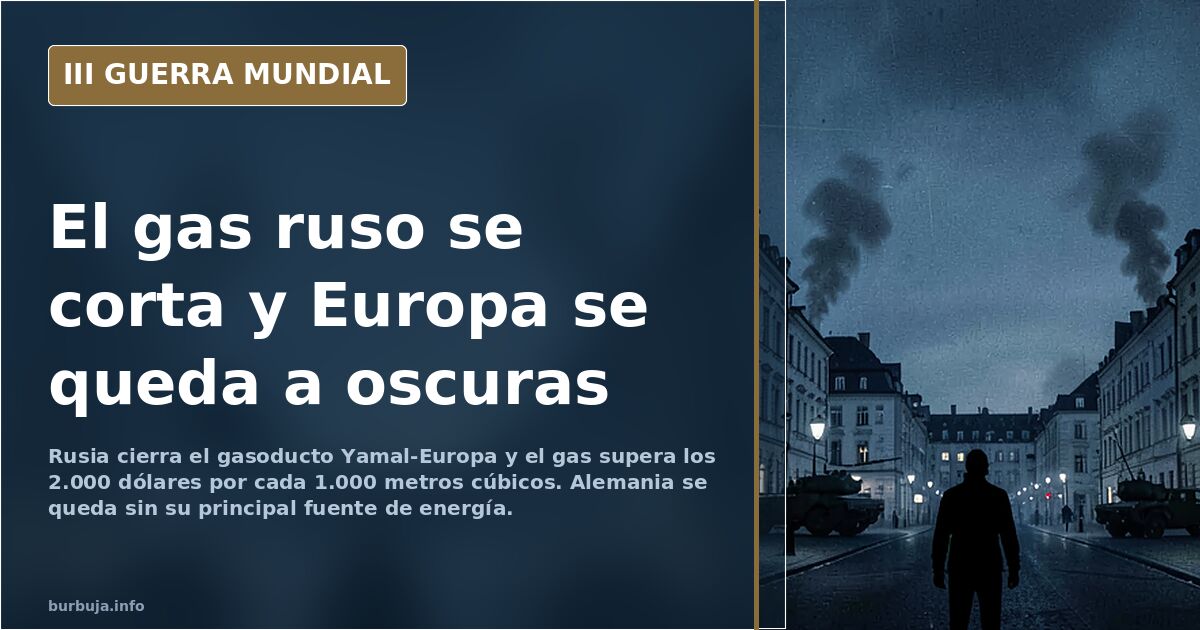
Russia Cuts Off Gas to Europe as Prices Soar
What happens when Europe's most industrialized nation loses its primary energy source? The Yamal-Europe pipeline, which delivers Russian gas to Germany, has stopped sending supplies westward. What initially appeared in the first week as an increase in Gazprom shipments has turned into a shutdown, leaving the continent with gas prices exceeding $2,000 per 1,000 cubic meters. Although the news, circulating for nearly 24 hours, has not yet been officially confirmed, markets have already reacted as if it were.
The Yamal-Europe Pipeline Shutdown: What Peine
The Yamal-Europe pipeline is one of the main routes for supplying Russian gas to Europe. According to initial reports, Russia closed the conduit supplying Germany after Gazprom had increased shipments in the first week. Consequently, Europe's most industrialized country is left without gas, and prices have surged above $2,000 per 1,000 cubic meters. This figure is significant: costs are multiplying several times over usual levels, directly hitting German industry, the economic engine of the EU.
However, official confirmation remains elusive. Some point out that supply through this pipeline has been intermittent for some time and that it had been operating since last Thursday until the cut-off. In other words, this might not be a definitive closure but another episode in a trickle that has persisted for months. Uncertainty about whether the shutdown is total or partial is itself part of the problem: markets react not to facts, but to expectations of what might happen.
Gas Prices: $2,000 and Rising
The figure dominating the conversation is $2,000 per 1,000 cubic meters. A level that, according to initial messages, has been surpassed, turning gas into a near-luxury good for European industry. Comparisons with oil prices also emerge: Brent stands at $123 per barrel, up 8% from the previous Friday. These are distinct markets, but both point in the same direction: energy is becoming the bottleneck of the European economy.
Many ask if this price is sustainable. The short answer is no. The long answer depends on how long the shutdown lasts and whether Europe can find alternative supplies. Algeria appears as an option, but with caveats: reports suggest Spain may be reselling Algerian gas to Segarro, leading Algeria to threaten cutting off supply. Furthermore, Algerian gas can only reach Europe via Italy, limiting its capacity to replace Russian sources.
Alternatives to Russian Gas: Algeria, Norway, and Coal
Europe's supply map is being redrawn under pressure. Algeria is the most obvious partner, but its gas is no magic solution: pipelines connecting it to Europe pass through Italy, and capacity is not infinite. Norway is another key supplier, though it too could be targeted by Russia. The United States, which could export liquefied natural gas (LNG), faces logistical challenges in transporting it across the Atlantic.
Meanwhile, Germany consumed 30% more gas than average this weekend to produce electricity, potentially using coal instead. Despite the shutdown, consumption has not dropped. This highlights a contradiction in the debate: while talk centers on crisis, consumption remains high because alternatives are not ready, and coal, despite being polluting, remains an option to keep the lights on.
Impact on the European Economy: Inflation and Shortages
The pipeline shutdown is not just an energy issue; it is a major economic problem. German industry, heavily dependent on Russian gas, faces rising costs that may be passed on to final prices. In a context of already elevated inflation, this could be the final blow for many companies. Reports indicate product shortages could arrive within weeks, with concrete examples like meat or bread prices.
Discussions also consider the possibility that the energy crisis turns into a food crisis. Russia is the world's largest exporter of cereals and fertilizers, and sanctions could affect these supplies. The result would be an explosive cocktail: less gas, fewer foods, and higher inflation—a scenario some believe could push Europe into social emergency territory.
Political Response: Surrender vs. Resistance
Politically, opinions are divided. Some argue Europe should surrender and cede half of Ukraine to Russia to halt price hikes and shortages. Others believe conceding would be a mistake and that the only way out is to resist and seek alternatives. The debate over whether the pipeline shutdown is Russia's last card or the start of a longer crisis is underway.
What seems clear is that the Yamal-Europe shutdown, if confirmed, will mark a before-and-after moment in energy relations between Russia and Europe. Dependence on Russian gas has been a cornerstone of the German economy for decades. Now, that foundation is shaking—and with it, the rest of the continent.
Ultimately, the question is not whether gas prices will rise or fall, but how long Europe can maintain stability without heating homes. And if anyone has a bonfire handy, they'd better hide it.
Also available in: Deutsch
Summary of a discussion on Burbuja.info - Foro de economía, actualidad y política., translated from Spanish and reviewed before publication. Read the full discussion (81 replies).
More summaries
-
Brussels buries Nord Stream even if the war ends
The European Commission rules out Nord Stream's return even after the war, as concern grows over the cost of American gas and the resulting bill.
-
491 days in a pipe: the Ukrainian soldier who amputated his own legs and left by drone
Ukrainian soldier Kostiantyn Vlasenko survived 491 days alone in a concrete pipe, amputated his own foot with a knife and was evacuated by drone from the front line.
-
Captured Ukrainian Vehicles: Growing Trophy List on Front
Ukraine war: Captured BTR-4, Kirpi, M113 and Oshkosh vehicles fuel propaganda battle over front-line losses.
-
Russia's Uralvagonzavod Tank Line Faces Skepticism
Uralvagonzavod displays T-14 Armata production, but doubts persist as the tank appeared in 2020 TV footage.
-
Spain's La Sexta airs pro-Russia Ukraine argument
A guest on Spanish news show Al Rojo Vivo claimed NATO provoked the war. Edited clips sparked debate over censorship and media pluralism.
-
Wagner estimates 200,000 Ukrainian troops for counteroffensive
Prigozhin claims Ukraine has gathered 200,000 to 400,000 troops for its counteroffensive and admits Wagner alone cannot win the war.