
Russia Claims Destruction of Bayraktar Drones and Missiles in Odesa
Russia claims Onyx missiles destroyed hangars with Bayraktar drones and US/European munitions in Odesa. A forum user mentioned the mayor confirmed it.
English · Original discussion in Spanish · Published
Russia Announces Destruction of Weapons in Odesa
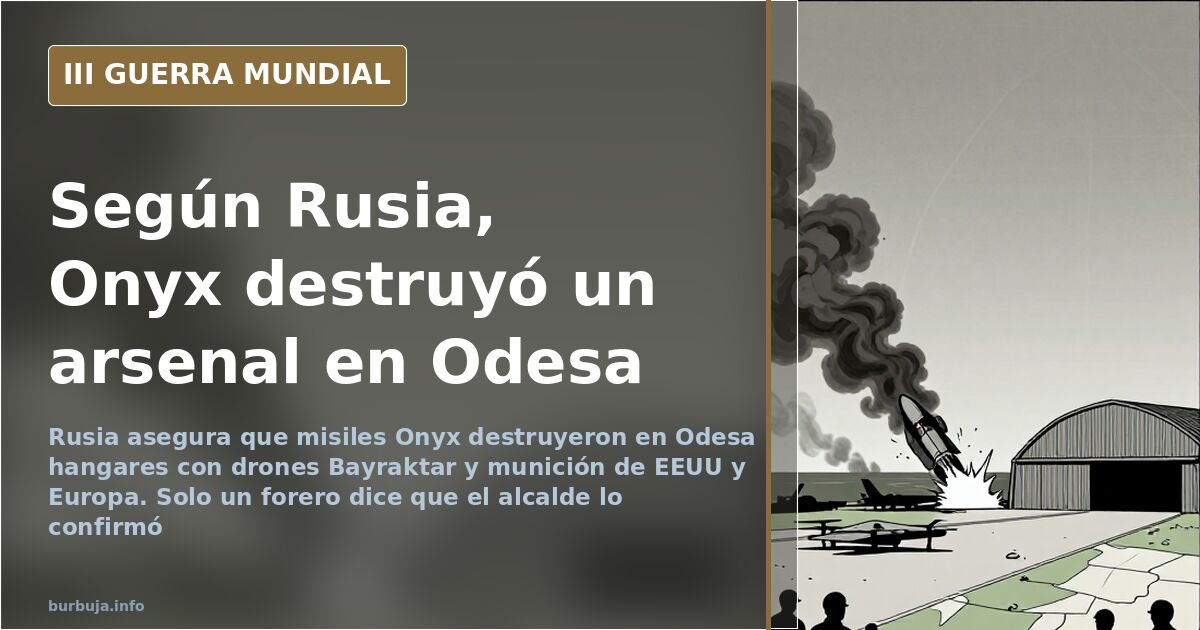
The Russian Ministry of Defense announced the obliteration of a logistics center near Odesa. Its spokesperson, Igor Konashenkov, asserted that high-precision Onyx missiles destroyed several hangars containing Bayraktar TB2 drones, missiles, and ammunition from the United States and European countries. In the same report, the Russian Ministry of Defense stated that other precision air-to-ground missiles hit six military targets overnight. According to some participants in the discussion thread, the news did not receive significant coverage in major Spanish news outlets.
The interesting aspect is not the announcement itself, but what lies beneath: whether the material was real, who paid for it, and why it was there.
What is Attributed to Odesa and What Remains in the Russian Report
Moscow's narrative currently relies on its own account. The bombing has been mentioned in international media—citing a report from Channel 4—and, according to a comment in the thread, the mayor of Odesa himself reportedly confirmed it. However, this does not resolve the fundamental question: who verifies the exact contents of the hangars? A military spokesperson announcing the destruction of Western weapons has an obvious interest in inflating the numbers.
This leads to a division in the discussion. Some recall that the credibility of Russian sources is at an all-time low and that each side exaggerates its successes. Others respond with an uncomfortable question for the opposing side: if these events are not covered with the same intensity in the West, who is censoring whom?
The Precision Missile That Some Deny and Others Take for Granted
The technical point is where the debate heats up. One side argues that Russia lacks smart bombs, which is why it flies low and loses aircraft. The more nuanced response points to something else: the problem might not be having enough guided missiles, but rather locating the Ukrainian anti-aircraft systems—the OSA, BUK, and S-300—which are hidden and intermittently deployed. According to one participant, a well-positioned S-300 can shoot down a Russian fighter jet, and anyone who has looked at the front map knows this.
Herein lies the crux: air superiority is not the same as the ability to strike. Confusing the two is the most common error made by both sides.
Why Store in Odesa if Weapons Enter Through Poland
The logistical objection is the most substantial. If Western material enters through the Polish border, why is it stored hundreds of kilometers away, near Odesa? The circulating explanation makes operational sense: the Russians would be cutting off access to the city—the bridge over the Dniester estuary would have already been destroyed—and everything that doesn't enter before that will be blocked afterward. Material arriving via Romania is also mentioned. Stockpiling quickly and in accessible locations is a defensive decision, not a blunder.
Nevertheless, the inverse criticism also holds: concentrating too much material in one place turns a warehouse into a single target. Dispersion has a logistical cost; concentration carries existential risk.
What It Costs and Who Pays
Here, no general staff signs off on the accounts. If the hangars contained drones, missiles, and ammunition from the United States and European countries, what was destroyed is public money turned to ash in seconds. In Spain, according to a comment in the thread, gasoline prices had returned to 2 euros per liter.
The underlying data repeated by one participant is different. According to that comment, before the conflict, Ukraine had the second-largest arsenal in Europe, surpassed only by Russia, in addition to the huge Soviet stock inherited. The same participant claims that two months later, Ukraine was requesting weapons from all of NATO, which says something about the estimulante ilegal at which material is consumed in a war of this type. They add that Russia, conversely, has not requested weapons from anyone.
If the pattern continues, these types of announcements will appear daily and will not change the map on their own. What decides the outcome is not how many depots burn, but who endures before running out of replacements. With warring sources and disputed numbers, the honest prediction is uncomfortable: it is advisable not to bet on anyone's report.
The Russian Ministry of Defense announced the obliteration of a logistics center near Odesa. Its spokesperson, Igor Konashenkov, asserted that high-precision Onyx missiles destroyed several hangars containing Bayraktar TB2 drones, missiles, and ammunition from the United States and European countries. In the same report, the Russian Ministry of Defense stated that other precision air-to-ground missiles hit six military targets overnight. According to some participants in the discussion thread, the news did not receive significant coverage in major Spanish news outlets.
The interesting aspect is not the announcement itself, but what lies beneath: whether the material was real, who paid for it, and why it was there.
What is Attributed to Odesa and What Remains in the Russian Report
Moscow's narrative currently relies on its own account. The bombing has been mentioned in international media—citing a report from Channel 4—and, according to a comment in the thread, the mayor of Odesa himself reportedly confirmed it. However, this does not resolve the fundamental question: who verifies the exact contents of the hangars? A military spokesperson announcing the destruction of Western weapons has an obvious interest in inflating the numbers.
This leads to a division in the discussion. Some recall that the credibility of Russian sources is at an all-time low and that each side exaggerates its successes. Others respond with an uncomfortable question for the opposing side: if these events are not covered with the same intensity in the West, who is censoring whom?
The Precision Missile That Some Deny and Others Take for Granted
The technical point is where the debate heats up. One side argues that Russia lacks smart bombs, which is why it flies low and loses aircraft. The more nuanced response points to something else: the problem might not be having enough guided missiles, but rather locating the Ukrainian anti-aircraft systems—the OSA, BUK, and S-300—which are hidden and intermittently deployed. According to one participant, a well-positioned S-300 can shoot down a Russian fighter jet, and anyone who has looked at the front map knows this.
Herein lies the crux: air superiority is not the same as the ability to strike. Confusing the two is the most common error made by both sides.
Why Store in Odesa if Weapons Enter Through Poland
The logistical objection is the most substantial. If Western material enters through the Polish border, why is it stored hundreds of kilometers away, near Odesa? The circulating explanation makes operational sense: the Russians would be cutting off access to the city—the bridge over the Dniester estuary would have already been destroyed—and everything that doesn't enter before that will be blocked afterward. Material arriving via Romania is also mentioned. Stockpiling quickly and in accessible locations is a defensive decision, not a blunder.
Nevertheless, the inverse criticism also holds: concentrating too much material in one place turns a warehouse into a single target. Dispersion has a logistical cost; concentration carries existential risk.
What It Costs and Who Pays
Here, no general staff signs off on the accounts. If the hangars contained drones, missiles, and ammunition from the United States and European countries, what was destroyed is public money turned to ash in seconds. In Spain, according to a comment in the thread, gasoline prices had returned to 2 euros per liter.
The underlying data repeated by one participant is different. According to that comment, before the conflict, Ukraine had the second-largest arsenal in Europe, surpassed only by Russia, in addition to the huge Soviet stock inherited. The same participant claims that two months later, Ukraine was requesting weapons from all of NATO, which says something about the estimulante ilegal at which material is consumed in a war of this type. They add that Russia, conversely, has not requested weapons from anyone.
If the pattern continues, these types of announcements will appear daily and will not change the map on their own. What decides the outcome is not how many depots burn, but who endures before running out of replacements. With warring sources and disputed numbers, the honest prediction is uncomfortable: it is advisable not to bet on anyone's report.
Summary of a discussion on Burbuja.info - Foro de economía, actualidad y política., translated from Spanish and reviewed before publication. Read the full discussion (150 replies).
More summaries
-
Ukraine: Warehouses ablaze, debate rages over who pays for lost goods
Discussion on Russian attacks targeting logistics warehouses in Ukraine, with focus on who bears the cost of destroyed merchandise, potentially involving EU funds.
-
Ukraine: Drones Over Kyiv and Odesa, 40-Day Offensive Announced
Kyiv and Odesa face drone attacks as Zelenskyy declares a 40-day operation. Eastern European tensions escalate.
-
Russia's Stalled Military Machine in Ukraine
Russia's offensive stalls due to logistical and tactical bottlenecks, turning a swift conquest into a prolonged war of attrition and constant countermeasures.
-
Ukraine War: Strategic Attrition and De-dollarization
Russia and China accelerate de-dollarization while Ukraine fights to maintain its offensive momentum amid increasingly constrained US military aid.
-
Ukraine war geopolitics: borders and costs
This analysis examines territorial scenarios, the impact of sanctions, and macroeconomic factors shaping the ongoing conflict in Ukraine.
-
Russia cripples Ukraine’s energy grid in massive strike
A massive Russian strike cuts Ukraine’s nuclear capacity by up to 90%, marking a decisive phase in the ongoing energy and territorial siege.