
Rural Self-Sufficiency: 5,000 m² for Gardens, Not Survival
Experts argue that true self-sufficiency requires over 10,000 m²; 5,000 m² only supports a garden and chickens.
English · Original discussion in Spanish · Published
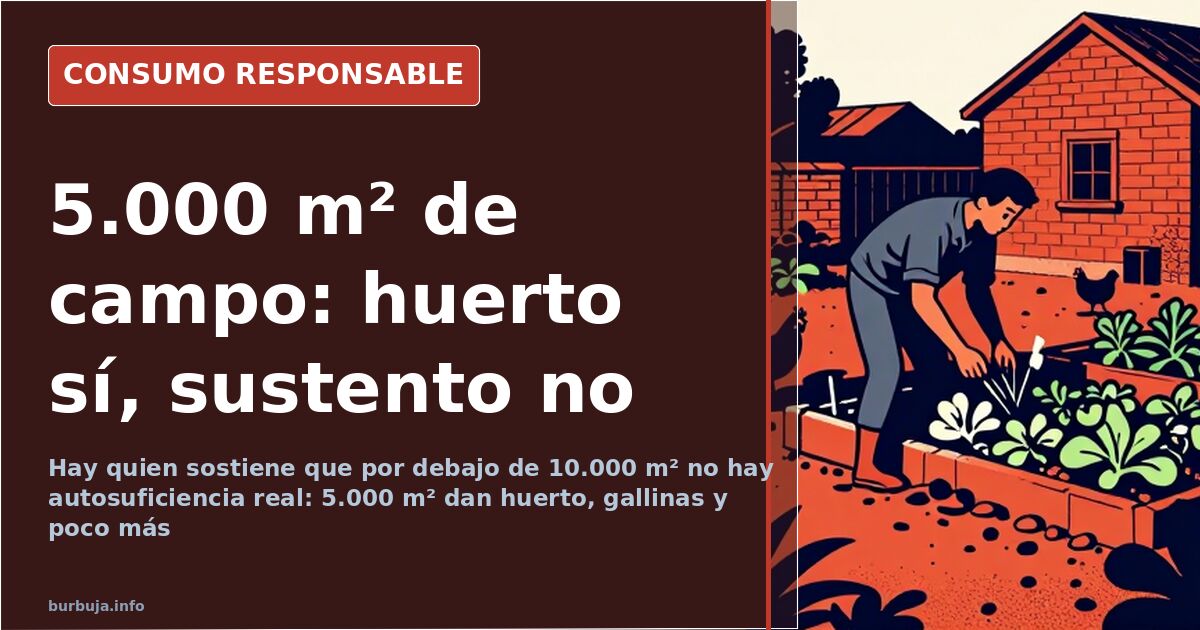
5,000 m² supports a garden and chickens, not a living
A family home on the Cantabrian coast, 5,000 square meters of land, and a list of ideas: solar panels, a wind turbine, chickens, ducks, geese, walnut trees, and an aquaponics system to raise fish and vegetables simultaneously. The plan seeks partial self-sufficiency: cutting costs, enduring power outages or snowstorms, and maximizing what the land yields. The response is swift and blunt: below a certain area, this is not a subsistence project.
How much land is needed for self-sufficiency?
It depends on how many mouths to feed and whether animals are included. For a family of four with livestock, some argue the minimum is 10,000 m²; another participant extends it to four hectares. The genre's reference work, John Seymour's self-sufficient life manual, placed half a hectare for one cow, one goat, one sow, and twelve chickens, but always with purchased fodder for winter. Sheep and other animals required two hectares.
The nuance of the approach shifts the bar. It is not about locking oneself into a subsistence economy, but a couple with salaries and savings who want to rely less on the system without breaking from it: garden, poultry, firewood, and bartering with neighbors. Under this prism, 5,000 m² ceases to be a ridiculous figure and becomes a matter of priorities.
How much food does a backyard garden really produce?
More than prevailing skepticism suggests, if planned well. With 10 kg of potatoes planted in 15 m², one participant estimates about 130 kg of harvest, sufficient for the annual consumption of four people—30 kg per head—until the next planting. Data from growers point in the same direction: a single cherry tomato plant in 16 m² was still fruiting in mid-December, and five plants per row, with three rows, maintained tomatoes almost daily from July to October.
To this is added intensive gardening: raised beds, drip or seepage irrigation, weed mesh, and crop association. Work is concentrated at the beginning and then, for a pittance, high-quality products emerge. The honest calculation is that they cost more than store-bought items, and astronomically so when time spent is included.
Energy: discreet panels, scrap batteries, and inertia stoves
The energy part is the most antiestéticasible to solve without relying on the grid. Photovoltaic with storage and, perhaps, a wind turbine, although with a practical warning that appears immediately: panels should be installed where they are not visible from outside, because, as one participant warns, theft occurs in rural areas. To store energy, a cheap route mentioned is used car batteries from scrapyards, selected by measuring voltage and short-circuit response.
Heating has its own hierarchy. Finnish wood stoves, double-chamber with counter-flow draft, burn the smoke from the first combustion and reach 900-1,000 degrees in the second, reducing gases and waste. Security—controlled perimeter and surveillance when the house is empty—ends up creeping into any conversation about living isolated.
Is setting up domestic aquaponics worth it?
This is the point where enthusiasm clashes with engineering. Raising fish and vegetables in a closed circuit requires mandatory filtration and aeration, and on the Cantabrian coast temperate species perform better than tropical ones: common carp or trout beat tilapia, which is heat-dependent. Without recirculation and oxygenation, they warn, fish eventually die. And the plants that succeed are fast-growing and low-demand: watercress, spinach, arugula.
The technical debate diverts toward aeroponics, with high-yield growing towers. The correction is forceful: an aquarium pump only moves water at one bar, while a real aeroponic system needs to inject nutrients at more than 100 psi, seven bars minimum.
The countryside does not forgive weekend visits
Here the conversation turns rough. Those who have lived off the land warn that a lapse is costly: an open door and ten newly bought chickens appear dead due to foxes or martens. Community gardens end up with people dodging responsibilities when the unpleasant part of the season arrives and appearing magically on distribution day. In the village, however, informal exchange of surpluses among neighbors works better than any collaborative project of urban origin.
Despite everything, the dominant conclusion is not to give up, but to adjust expectations: partial autonomy in energy, eggs, potatoes, and vegetables, and accepted dependence on the rest.
The disorienting data remains. A Filipino farmer with a family farm obtains a net profit between 1,200 and 1,500 dollars a year, one-third of the local minimum wage.
A family home on the Cantabrian coast, 5,000 square meters of land, and a list of ideas: solar panels, a wind turbine, chickens, ducks, geese, walnut trees, and an aquaponics system to raise fish and vegetables simultaneously. The plan seeks partial self-sufficiency: cutting costs, enduring power outages or snowstorms, and maximizing what the land yields. The response is swift and blunt: below a certain area, this is not a subsistence project.
How much land is needed for self-sufficiency?
It depends on how many mouths to feed and whether animals are included. For a family of four with livestock, some argue the minimum is 10,000 m²; another participant extends it to four hectares. The genre's reference work, John Seymour's self-sufficient life manual, placed half a hectare for one cow, one goat, one sow, and twelve chickens, but always with purchased fodder for winter. Sheep and other animals required two hectares.
The nuance of the approach shifts the bar. It is not about locking oneself into a subsistence economy, but a couple with salaries and savings who want to rely less on the system without breaking from it: garden, poultry, firewood, and bartering with neighbors. Under this prism, 5,000 m² ceases to be a ridiculous figure and becomes a matter of priorities.
How much food does a backyard garden really produce?
More than prevailing skepticism suggests, if planned well. With 10 kg of potatoes planted in 15 m², one participant estimates about 130 kg of harvest, sufficient for the annual consumption of four people—30 kg per head—until the next planting. Data from growers point in the same direction: a single cherry tomato plant in 16 m² was still fruiting in mid-December, and five plants per row, with three rows, maintained tomatoes almost daily from July to October.
To this is added intensive gardening: raised beds, drip or seepage irrigation, weed mesh, and crop association. Work is concentrated at the beginning and then, for a pittance, high-quality products emerge. The honest calculation is that they cost more than store-bought items, and astronomically so when time spent is included.
Energy: discreet panels, scrap batteries, and inertia stoves
The energy part is the most antiestéticasible to solve without relying on the grid. Photovoltaic with storage and, perhaps, a wind turbine, although with a practical warning that appears immediately: panels should be installed where they are not visible from outside, because, as one participant warns, theft occurs in rural areas. To store energy, a cheap route mentioned is used car batteries from scrapyards, selected by measuring voltage and short-circuit response.
Heating has its own hierarchy. Finnish wood stoves, double-chamber with counter-flow draft, burn the smoke from the first combustion and reach 900-1,000 degrees in the second, reducing gases and waste. Security—controlled perimeter and surveillance when the house is empty—ends up creeping into any conversation about living isolated.
Is setting up domestic aquaponics worth it?
This is the point where enthusiasm clashes with engineering. Raising fish and vegetables in a closed circuit requires mandatory filtration and aeration, and on the Cantabrian coast temperate species perform better than tropical ones: common carp or trout beat tilapia, which is heat-dependent. Without recirculation and oxygenation, they warn, fish eventually die. And the plants that succeed are fast-growing and low-demand: watercress, spinach, arugula.
The technical debate diverts toward aeroponics, with high-yield growing towers. The correction is forceful: an aquarium pump only moves water at one bar, while a real aeroponic system needs to inject nutrients at more than 100 psi, seven bars minimum.
The countryside does not forgive weekend visits
Here the conversation turns rough. Those who have lived off the land warn that a lapse is costly: an open door and ten newly bought chickens appear dead due to foxes or martens. Community gardens end up with people dodging responsibilities when the unpleasant part of the season arrives and appearing magically on distribution day. In the village, however, informal exchange of surpluses among neighbors works better than any collaborative project of urban origin.
Despite everything, the dominant conclusion is not to give up, but to adjust expectations: partial autonomy in energy, eggs, potatoes, and vegetables, and accepted dependence on the rest.
The disorienting data remains. A Filipino farmer with a family farm obtains a net profit between 1,200 and 1,500 dollars a year, one-third of the local minimum wage.
Also available in: Deutsch
Summary of a discussion on Burbuja.info - Foro de economía, actualidad y política., translated from Spanish and reviewed before publication. Read the full discussion (114 replies).
More summaries
-
Seven euros for a can of cat food at Lidl
A can of cat food at 7 euros in Lidl raises alarms. The price per kilo exceeds 20 euros, more than many fresh foods.
-
DIA Dishwasher vs. Fairy: Forum User Compares 1.40-Euro Brand with 8-Euro Premium
A forum user compares 1.5 liters of DIA's SUPERPACO dishwasher liquid (1.40 euros) with 8 euros for Fairy, praising the quality of DIA's private label.
-
Accessing Live Sports via Shared Streaming Links
Analysis of how users access live sports through shared streaming codes and links.
-
Risks of Driving an Old Car Daily
We analyze the real risks and costs of using a vintage car daily: safety, fuel consumption, breakdowns, and the best manufacturing era.
-
Pasta Wars: How Supermarket Choices Define Quality
Shape, brand, bronze-drawn texture and protein content: what really matters when choosing pasta. A guide to avoid mistakes at the supermarket.
-
Barefoot Shoes: Passing Trend or Real Solution?
Real testimonials claim barefoot shoes eliminate chronic pain. Is it science or fashion? We analyze the debate's data.