
Rural Disappointment: Fleas, Flies, and Pesticides in Spain
A woman leaves the city for a Spanish village of 2,000 people, finding only pests and exclusion.
English · Original discussion in Spanish · Published
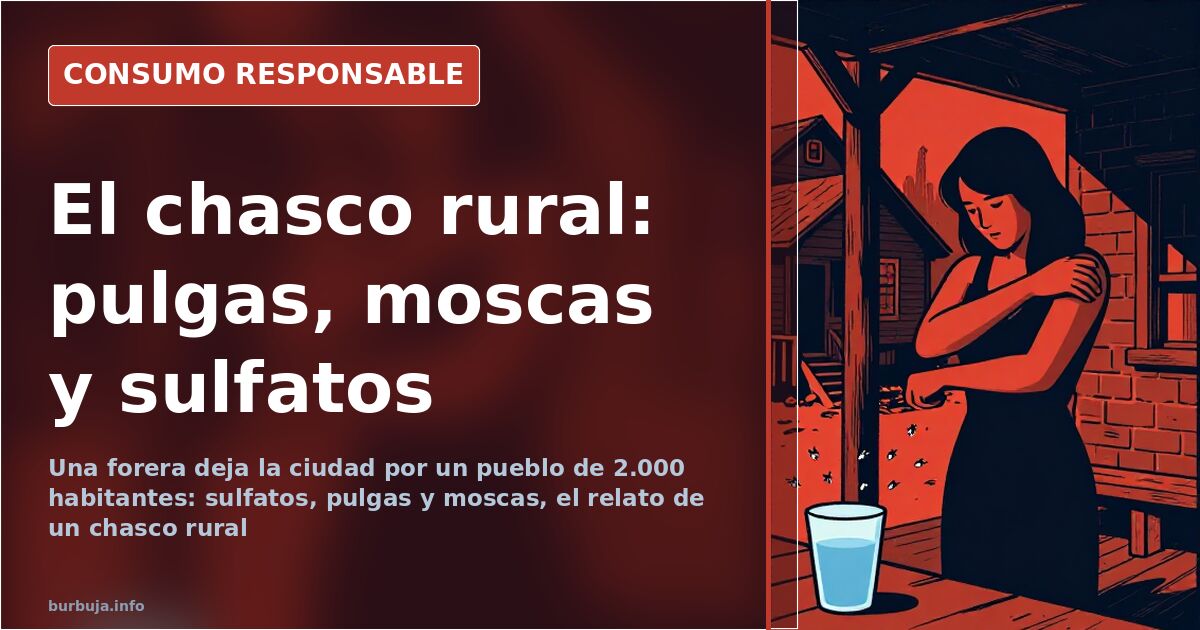
The Rural Letdown: The Village Sold as Paradise That Isn't
The story of an outsider who left the city for a Manchego village of 2,000 inhabitants to live more calmly ends, five years later, with an unpublicizable balance: the house shut tight during every pesticide spraying, flea bites on legs, flies all year round, and the certainty that she will never be "from there." The narrative begins with moving into a terraced house surrounded by pine forests and vineyards and ends with a phrase that sums up half the phenomenon: the village is only for those who are from the village.
Several participants in the thread agree that the described facts are real and that the outcome depends on the chosen village and the expectations one arrives with.
What Problems Arise When Living in a Small Village
The list she describes is long and very earthly. When it's time to spray pesticides, she says, you have to close the house and not step onto the street: the wind carries the product for kilometers, and not seeing the machine nearby isn't enough. In addition to the pine processionary caterpillars, there is another poison worth avoiding, and yet the caterpillars—stinging and dangerous—are encountered daily, according to her account.
Livestock adds its part. Sheep occupy streets and surroundings, the nearby farm leaves its smell, and above all, fleas arrive. With mild winters, there are weeks with new bites; the family dog accumulates spot-on treatments and collars until almost shining in the dark and still has health problems. Flies, bred on manure, complete the picture and force coexistence with insecticides.
Some argue that all this is normal in rural areas and that those who can't stand it chose the wrong place. Others respond that there are villages and villages, and the problem was choosing badly.
Why Newcomers Are Never Seen as Locals
Five years aren't enough. The mark of origin accompanies one for life: "So-and-so, the one from such-and-such village," or even "the one whose parents came from such-and-such village." There exists, it is said, a kind of blood purity that no amount of cohabitation erases, and even those who have lived there for forty years still carry the label.
Malice isn't always behind it. One interpretation attributes it to the local custom of giving nicknames to everyone, a habit that doesn't distinguish between rejection and a simple way of naming. Another sees it as a real wall: participating in festivals, mass, or neighborhood work may never translate into belonging.
The result, according to several testimonies in the thread, is the same: someone arriving from outside may have a house, but not always a place.
Cost of Living: One Supermarket and More Expensive Than the City
Scarcity also comes at a cost. With a single supermarket, without competition, prices rise and service isn't always good. The usual solution is to take the car, go to a city, and do the monthly shopping in one go, because it works out cheaper than buying in the village itself.
And there isn't always room to maneuver. Moving to the neighboring municipality to improve services can multiply daily commutes on secondary roads, making the remedy worse than the disease. The fine details, with their schedules and distances, are only seen when living there.
The same happens with local produce: finding real eggs or garden tomatoes was an impossible mission, and she suspects local networks reserve the best for their own.
Not All Villages Are Alike, Nor Do All Newcomers Fit In
The main objection is that the story generalizes. There are villages where cultivation is concentrated in greenhouses or where the wind barely reaches, and the smell of treatments doesn't enter the house. And there are thresholds: around 10,000 inhabitants, services and commerce appear without giving up the countryside.
As pointed out in the thread, much of the success or failure depends on where you plant your house. It's not the same being in the center of the village as having a terraced house on the edge, nor a sheltered valley versus an exposed hillside. Seeking sociability in an environment many leave precisely for more privacy doesn't help either.
What if the problem is the newcomer themselves? It's one of the hypotheses on the table: anyone trying to replicate city habits and services in the village is doomed to clash.
Depopulation, Declining Social Life, and Unspoken Problems
The issue shifts to something bigger. In many rural areas, social life fades: there are tourist villages where the street fills with visitors and, at nightfall, empties of neighbors. Some antiestéticar depopulation turns entire towns into second homes from Monday to Friday.
Concentration matters. It is argued that one municipality of 5,000 inhabitants is better than five of 1,000, because only above a certain size are services sustainable. And some forum users point to more uncomfortable layers: alcoholism, drug use, and frequent thefts in very small nuclei, where population numbers don't guarantee coexistence.
The story ends where disagreements begin: whether the problem is the village or the expectation. With the same move, some describe a daily hell and others, a place with its rules. The exact point where both versions contradict each other—how long someone lasts before leaving and how much weight not being from there carries—is just where data stops answering.
The story of an outsider who left the city for a Manchego village of 2,000 inhabitants to live more calmly ends, five years later, with an unpublicizable balance: the house shut tight during every pesticide spraying, flea bites on legs, flies all year round, and the certainty that she will never be "from there." The narrative begins with moving into a terraced house surrounded by pine forests and vineyards and ends with a phrase that sums up half the phenomenon: the village is only for those who are from the village.
Several participants in the thread agree that the described facts are real and that the outcome depends on the chosen village and the expectations one arrives with.
What Problems Arise When Living in a Small Village
The list she describes is long and very earthly. When it's time to spray pesticides, she says, you have to close the house and not step onto the street: the wind carries the product for kilometers, and not seeing the machine nearby isn't enough. In addition to the pine processionary caterpillars, there is another poison worth avoiding, and yet the caterpillars—stinging and dangerous—are encountered daily, according to her account.
Livestock adds its part. Sheep occupy streets and surroundings, the nearby farm leaves its smell, and above all, fleas arrive. With mild winters, there are weeks with new bites; the family dog accumulates spot-on treatments and collars until almost shining in the dark and still has health problems. Flies, bred on manure, complete the picture and force coexistence with insecticides.
Some argue that all this is normal in rural areas and that those who can't stand it chose the wrong place. Others respond that there are villages and villages, and the problem was choosing badly.
Why Newcomers Are Never Seen as Locals
Five years aren't enough. The mark of origin accompanies one for life: "So-and-so, the one from such-and-such village," or even "the one whose parents came from such-and-such village." There exists, it is said, a kind of blood purity that no amount of cohabitation erases, and even those who have lived there for forty years still carry the label.
Malice isn't always behind it. One interpretation attributes it to the local custom of giving nicknames to everyone, a habit that doesn't distinguish between rejection and a simple way of naming. Another sees it as a real wall: participating in festivals, mass, or neighborhood work may never translate into belonging.
The result, according to several testimonies in the thread, is the same: someone arriving from outside may have a house, but not always a place.
Cost of Living: One Supermarket and More Expensive Than the City
Scarcity also comes at a cost. With a single supermarket, without competition, prices rise and service isn't always good. The usual solution is to take the car, go to a city, and do the monthly shopping in one go, because it works out cheaper than buying in the village itself.
And there isn't always room to maneuver. Moving to the neighboring municipality to improve services can multiply daily commutes on secondary roads, making the remedy worse than the disease. The fine details, with their schedules and distances, are only seen when living there.
The same happens with local produce: finding real eggs or garden tomatoes was an impossible mission, and she suspects local networks reserve the best for their own.
Not All Villages Are Alike, Nor Do All Newcomers Fit In
The main objection is that the story generalizes. There are villages where cultivation is concentrated in greenhouses or where the wind barely reaches, and the smell of treatments doesn't enter the house. And there are thresholds: around 10,000 inhabitants, services and commerce appear without giving up the countryside.
As pointed out in the thread, much of the success or failure depends on where you plant your house. It's not the same being in the center of the village as having a terraced house on the edge, nor a sheltered valley versus an exposed hillside. Seeking sociability in an environment many leave precisely for more privacy doesn't help either.
What if the problem is the newcomer themselves? It's one of the hypotheses on the table: anyone trying to replicate city habits and services in the village is doomed to clash.
Depopulation, Declining Social Life, and Unspoken Problems
The issue shifts to something bigger. In many rural areas, social life fades: there are tourist villages where the street fills with visitors and, at nightfall, empties of neighbors. Some antiestéticar depopulation turns entire towns into second homes from Monday to Friday.
Concentration matters. It is argued that one municipality of 5,000 inhabitants is better than five of 1,000, because only above a certain size are services sustainable. And some forum users point to more uncomfortable layers: alcoholism, drug use, and frequent thefts in very small nuclei, where population numbers don't guarantee coexistence.
The story ends where disagreements begin: whether the problem is the village or the expectation. With the same move, some describe a daily hell and others, a place with its rules. The exact point where both versions contradict each other—how long someone lasts before leaving and how much weight not being from there carries—is just where data stops answering.
Summary of a discussion on Burbuja.info - Foro de economía, actualidad y política., translated from Spanish and reviewed before publication. Read the full discussion (171 replies).
More summaries
-
Living in Asturias: Climate, Costs, and the Hidden Risks of Cheap Homes
Asturias offers mild weather and affordable housing, but renovation costs and inheritance taxes can ruin the plan. Here is the data-driven analysis.
-
Elon Musk’s appearance sparks debate: does the founder’s body matter?
Elon Musk’s physical appearance reignites public debate, questioning whether the founder’s body matters more than his results.
-
Toyota Corolla Hybrid vs SUV: Height Wins Over Efficiency
A Toyota Corolla hybrid at €26,500 faces off against the family's demand for a taller SUV. Consumption, ECO label and ride height decide a long-term purchase.
-
Sunglasses: €20 polycarbonate vs. high-end glass
Some claim €20 glasses block UV, while others pay for brand and quality. The market splits between budget options and premium segments.
-
Adopting a stray cat costs €25 and territorial conflict
A €25 vet bill for tests and medication follows the adoption of a stray that followed a pedestrian home, now fighting with the resident cat.
-
Shoes Reveal Social Class: A Forum Debate
Debate on whether shoes reveal social class, citing Lacoste and Nike prices alongside a wealthy landlord's humble style.