
Rubén Gisbert kneels in mud and Iker Jiménez reacts
Rubén Gisbert kneels in the mud before going live for the DANA and Iker Jiménez announces he will take "measures"
English · Original discussion in Spanish · Published
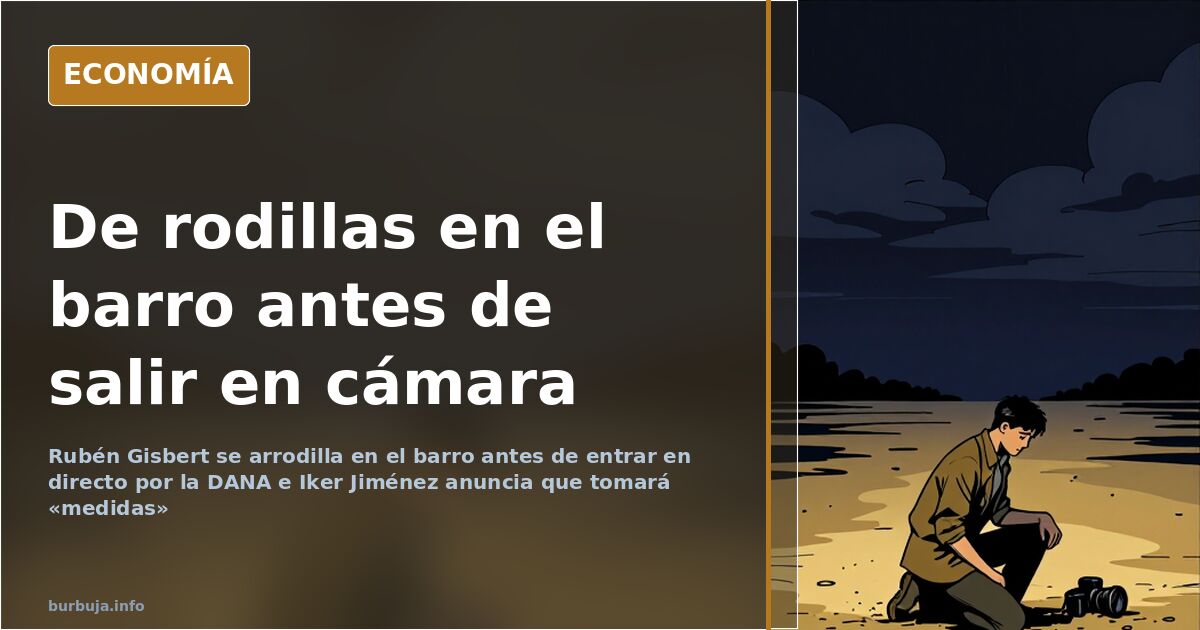
Gisbert kneels in the mud before going on air
A man drops to his knees in the mud. Before settling, he looks up and glances around, like someone checking the framing. Only then does he sink down. The video of Rubén Gisbert, linked to Iker Jiménez's television circle, circulates with an explicit accusation: kneeling in the mud to appear dirtier than he was, just before going live during the coverage of the DANA in Valencia. The image, of dubious dramatic effectiveness, has weighed more than any data of the day.
What is seen in the video of Rubén Gisbert kneeling
Gisbert moves in the orbit of Iker Jiménez's programs and, according to the thread, had been deployed in the affected area for days. In the circulated fragment he appears on the ground, on his knees, with his trousers muddied. The description accompanying the video leaves no room for doubt: "seeing that he is not dirty enough to go on TV, he throws himself on the ground on his knees to get dirtier." The nuance matters. He is not reproached for being there—he was—but for fabricating a scene that the shot did not give him.
Some go further and speak of a class posturing: the gesture as a yardstick for solidarity by centimetres of mud. And others, at the opposite extreme, maintain that no one doubts that he has been working hard from the first minute.
Iker Jiménez's response and the announcement of "measures"
The presenter's reaction came in writing and without nuances: "I am perplexed. A video of Ruben Gisbert, a person born there, has ruined my day. It tarnishes a commendable task that we are doing and we do not deserve. I will take my measures." A phrase that turns an individual gesture into a brand problem. And that leaves open the question of what exactly taking measures means: neither confirmed dismissal nor announced rupture, just a public warning.
Among sceptics, the reading circulates that the reprimand will come to nothing. It is noted that Jiménez and his circle will end up apologising to him—a scolding of a naughty child—because the contributor, they maintain, had been in the area since the first day and the subsequent mobilisation of other names in the sector would have been, in part, in his wake.
The detail pointed out: looking up before kneeling
The sequence has its own forensic expertise. "If kneeling in the mud had no significance according to him, why does he look up and to the sides just before doing it?" The conclusion of the observer is that he knew it was wrong. Against that, the defence is even simpler: "it's a tic he has in his neck."
Two incompatible readings of the same fragment of footage. With that raw material, a complete fruta crisis has been built.
From frontline coverage to suspicion about the rest of the story
The underlying problem is not the mud. It is what it drags along. On the same day, he is attributed a video in front of the Bonaire car park talking about how there could have been dozens of deaths, while, according to the thread, the police found nothing. The logical sequence that arises is uncomfortable: if the image is forced, how much more has been forced? "If he is not honest, how are you going to trust him in the future?" summarises one of the most cited interventions.
For others, however, the reasoning is pure props: the scene was a theatricalisation without intent to deceive about the prior work. The damage, in any case, is already done and does not depend on who is right.
The parallel with Gaitán and the nearly 300,000 euros raised
The comparison was inevitable, because both names share orbit, audience and platform. The other proper name in this episode, Gaitán, has raised, according to a participant in the thread, almost €300,000. The figure is cited as an uncomfortable contrast and also with reservations: "we'll see how that ends." The doubt that sets in is not so much about the money as about the credibility of the whole: it is noted that neither one nor the other were good company for a coverage that aspires to be taken seriously.
The irony of the matter is that the reproach comes from all flanks. Some defend Gisbert precisely because of that: "he is attacked by left and right, and that is because he is doing it well."
Abalos, Cifuentes and the industry of recycling careers on television
The most repeated forecast is that this will not cost him his job. The reference is the list of panellists who continue to make a fortune on TV sets after much bigger scandals. The cynical conclusion: in this business no one really goes broke, they get recycled. It is even compared with the Errejón case and with the silence of those who, being close, knew beforehand how the product was made.
The suspicion extends to the medium that broadcasts it. If a program builds its prestige on unsolved mysteries, what authority does it have to be indignant when one of its own dramatises a real scene?
What happens now with Rubén Gisbert
Since the episode, Gisbert's public profile has slowed down: fewer videos, no stories on social media, in what is interpreted as a tactical retreat to let the storm pass. He continues publishing messages against the Government and against what he calls institutional advertising campaigns, and maintains a core of faithful trinc who do not get off the bandwagon.
The underlying calculation is simple: the mud video is a toxic asset for the brand he represents, but it is also exactly the type of image that guarantees attention. It remains to be seen which of the two weighs more when he gets back in front of a camera.
And while people discuss whether the mud was put on his knees or vice versa, doubts also hang over the fundraising of the other proper name in this coverage. Everyone has an opinion on the knee; on the figure, too.
A man drops to his knees in the mud. Before settling, he looks up and glances around, like someone checking the framing. Only then does he sink down. The video of Rubén Gisbert, linked to Iker Jiménez's television circle, circulates with an explicit accusation: kneeling in the mud to appear dirtier than he was, just before going live during the coverage of the DANA in Valencia. The image, of dubious dramatic effectiveness, has weighed more than any data of the day.
What is seen in the video of Rubén Gisbert kneeling
Gisbert moves in the orbit of Iker Jiménez's programs and, according to the thread, had been deployed in the affected area for days. In the circulated fragment he appears on the ground, on his knees, with his trousers muddied. The description accompanying the video leaves no room for doubt: "seeing that he is not dirty enough to go on TV, he throws himself on the ground on his knees to get dirtier." The nuance matters. He is not reproached for being there—he was—but for fabricating a scene that the shot did not give him.
Some go further and speak of a class posturing: the gesture as a yardstick for solidarity by centimetres of mud. And others, at the opposite extreme, maintain that no one doubts that he has been working hard from the first minute.
Iker Jiménez's response and the announcement of "measures"
The presenter's reaction came in writing and without nuances: "I am perplexed. A video of Ruben Gisbert, a person born there, has ruined my day. It tarnishes a commendable task that we are doing and we do not deserve. I will take my measures." A phrase that turns an individual gesture into a brand problem. And that leaves open the question of what exactly taking measures means: neither confirmed dismissal nor announced rupture, just a public warning.
Among sceptics, the reading circulates that the reprimand will come to nothing. It is noted that Jiménez and his circle will end up apologising to him—a scolding of a naughty child—because the contributor, they maintain, had been in the area since the first day and the subsequent mobilisation of other names in the sector would have been, in part, in his wake.
The detail pointed out: looking up before kneeling
The sequence has its own forensic expertise. "If kneeling in the mud had no significance according to him, why does he look up and to the sides just before doing it?" The conclusion of the observer is that he knew it was wrong. Against that, the defence is even simpler: "it's a tic he has in his neck."
Two incompatible readings of the same fragment of footage. With that raw material, a complete fruta crisis has been built.
From frontline coverage to suspicion about the rest of the story
The underlying problem is not the mud. It is what it drags along. On the same day, he is attributed a video in front of the Bonaire car park talking about how there could have been dozens of deaths, while, according to the thread, the police found nothing. The logical sequence that arises is uncomfortable: if the image is forced, how much more has been forced? "If he is not honest, how are you going to trust him in the future?" summarises one of the most cited interventions.
For others, however, the reasoning is pure props: the scene was a theatricalisation without intent to deceive about the prior work. The damage, in any case, is already done and does not depend on who is right.
The parallel with Gaitán and the nearly 300,000 euros raised
The comparison was inevitable, because both names share orbit, audience and platform. The other proper name in this episode, Gaitán, has raised, according to a participant in the thread, almost €300,000. The figure is cited as an uncomfortable contrast and also with reservations: "we'll see how that ends." The doubt that sets in is not so much about the money as about the credibility of the whole: it is noted that neither one nor the other were good company for a coverage that aspires to be taken seriously.
The irony of the matter is that the reproach comes from all flanks. Some defend Gisbert precisely because of that: "he is attacked by left and right, and that is because he is doing it well."
Abalos, Cifuentes and the industry of recycling careers on television
The most repeated forecast is that this will not cost him his job. The reference is the list of panellists who continue to make a fortune on TV sets after much bigger scandals. The cynical conclusion: in this business no one really goes broke, they get recycled. It is even compared with the Errejón case and with the silence of those who, being close, knew beforehand how the product was made.
The suspicion extends to the medium that broadcasts it. If a program builds its prestige on unsolved mysteries, what authority does it have to be indignant when one of its own dramatises a real scene?
What happens now with Rubén Gisbert
Since the episode, Gisbert's public profile has slowed down: fewer videos, no stories on social media, in what is interpreted as a tactical retreat to let the storm pass. He continues publishing messages against the Government and against what he calls institutional advertising campaigns, and maintains a core of faithful trinc who do not get off the bandwagon.
The underlying calculation is simple: the mud video is a toxic asset for the brand he represents, but it is also exactly the type of image that guarantees attention. It remains to be seen which of the two weighs more when he gets back in front of a camera.
And while people discuss whether the mud was put on his knees or vice versa, doubts also hang over the fundraising of the other proper name in this coverage. Everyone has an opinion on the knee; on the figure, too.
Summary of a discussion on Burbuja.info - Foro de economía, actualidad y política., translated from Spanish and reviewed before publication. Read the full discussion (1031 replies).
More summaries
-
Gisbert promises a bombshell about the DANA storm and publishes nothing
Rubén Gisbert promised an information bombshell about the Valencia DANA, but ended up with mud-stained clothes and no evidence published.
-
Horizonte takes DANA to Cuatro in a special that avoids closing figures
Horizonte airs a special on Cuatro while the repeated figure of 217 dead clashes with the lack of a census of missing persons
-
Russia gives Germany 48 hours to close its consulates
Russia demands Germany close its consulates and evacuate before Sunday midnight. Previous closures in Bonn, the 2022 precedent, and the fine print of...
-
Spain housing prices triple in eight years amid debate
Average Spanish home prices rose from €2,000 to €6,000 per square meter in eight years. Analysis of causes and blame.
-
Spain's Migration Drain and Structural Inertia Costs
Negative net migration since 2008 reflects Spain's exhausted economic model, driven by low wages, unaffordable housing, and job precarity.
-
Climate Amnesia Explains Why Winters Feel Colder Than Data Suggests
The 'climate amnesia' theory explains why people perceive cold winters despite warming trends, though critics view it as gaslighting.