
RTVE's seven-way debate: Vox against everyone and the issues left untouched
RTVE's seven-way debate brought together seven spokespeople for 125 minutes and four blocks: Vox stood alone while pensions and immigration barely came up.
English · Original discussion in Spanish · Published
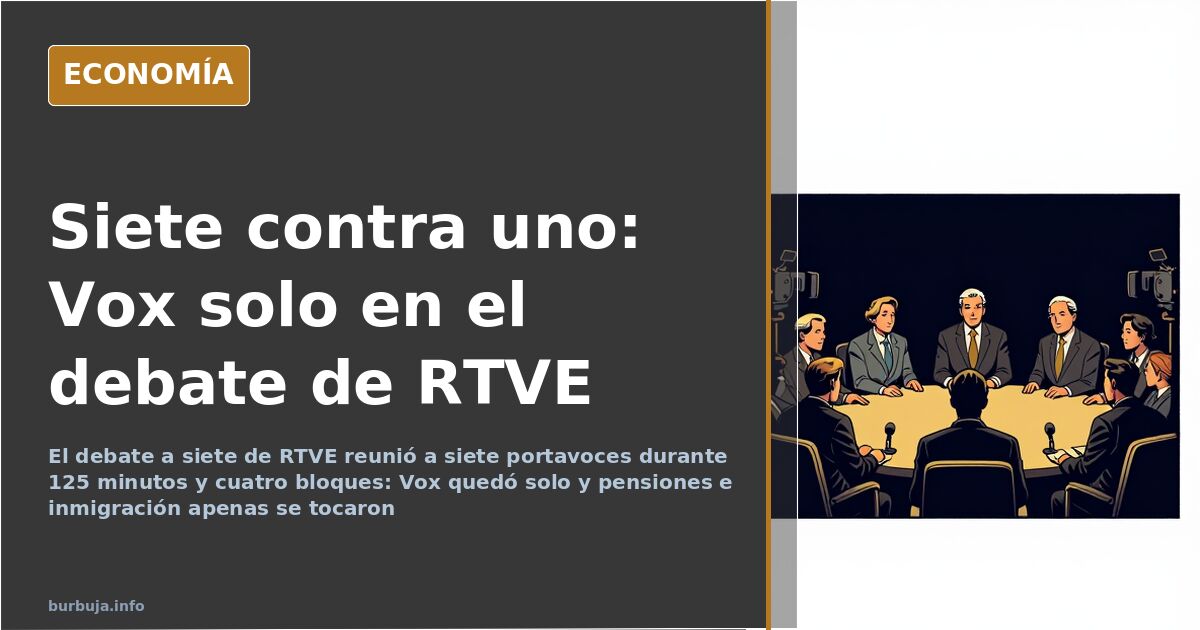
Seven against Espinosa: the debate that dodged pensions and immigration
Seven spokespeople, 125 minutes and four blocks. On paper, a balanced format to compare manifestos just days before 23J. In practice, the seven-way debate RTVE aired at 10 p.m. became, according to the dominant view among commentators, a seven-against-one: Espinosa de los Monteros's party was left alone against the other participants and, for some, against the host himself. That imbalance weighed more heavily than any economic proposal.
Who sat at the table in the seven-way debate
In the studio were PSOE spokesperson Patxi López; PP spokeswoman Cuca Gamarra; Vox's Iván Espinosa de los Monteros; En Comú Podem MP and Sumar candidate Aina Vidal; ERC spokesperson Gabriel Rufián; PNV's Aitor Esteban; and EH Bildu deputy spokesperson Oskar Matute. The format was divided into four blocks: economy, social policy, territorial policies and state and post-electoral pacts.
With such a seating arrangement, the arithmetic was predictable. Espinosa, the only representative of his party at the table, was singled out by everyone else. The dominant perception was of an uneven night, with the exchange turning into a distribution of blows in very unequal shares. The scene is not neutral: anyone who can count only on their own speaking minutes competes under very different conditions. And, according to some participants, the host also pushed in the same direction.
The economic issues nobody wanted to touch
Amid so much squabbling, there was a silence more revealing than any row, according to several participants in the forum: pensions, long-term care, benefits and the labour competition attributed to immigration barely appeared. The economic block, in theory the heart of the encounter, was reduced to recycled slogans. Nobody got down to the detail of the accounts.
On paper, most diagnoses converged on an uncomfortable point: the state must collect more in order to redistribute more. Against that, it was insisted that this goal turns citizens into slaves of the state, while the left threw the argument back by accusing the right of wanting slaves, plain and simple. The slogan factory ran at full capacity; the numbers factory, far less so. Anyone looking for concrete proposals on pension payrolls or the cost of long-term care was left wanting.
Segarro, the spat anticipated in the comments
Segarro was one of the issues hovering over the encounter, according to several comments in the forum. They anticipated—and replayed—a clash between the Vox spokesperson and the socialist over the neighbouring country, with “and what’s it to you?” as a response. There is no evidence in the comments that the exchange peine exactly like that, but that kind of retort, with no argument behind it, illustrated for those commenting what was being discussed: not policies, but gestures.
A short fencing match feeds the clip and ruins the substance. In a country where relations with its southern neighbour shape trade, energy and migration flows, devoting twenty seconds and a jab to it is, at the very least, a waste.
Rufián, the pardons and the bitter pill PSOE swallowed
One of the roughest moments came, according to the comments, when the ERC spokesperson reminded PSOE that, in his view, the prime ministership had been possible thanks to the pardons for the convicted pro-independence leaders. The socialist spokesperson, according to that account of the night, limited himself to taking the blow without denying the sequence.
The exchange leaves a paradox hard for the government to swallow: for four years it maintained that nothing had been conceded to pro-independence parties, and its own parliamentary ally took it upon itself to remind everyone of exactly the opposite live on air. That detail, more than any tax proposal, is ammunition for the campaign. The ERC spokesperson's line about pacts being made with one side and the other—he compared it to the dog of a cartoon character—rounded off the diagnosis: a deal, yes, but nobody owns it.
The figure repeated up to six times
In the forum, up to six repetitions were counted of the same argument by the PP spokeswoman: that the law has released one hundred rapists from prison, a claim other participants questioned. She used it as a battering ram and launched it as an unquestionable fact, and the rest of the table did not accept the figure. The insistence left the image of a participant under permanent tension.
Her aggressive style was read two ways: firmness for some, lack of political craft for others. In any case, the general perception was that the PP came off worse than in its own campaign, without the cushion of the polls circulating outside the studio. Winning the headline and losing the tone is a bad trade.
Was it a fight between socialists and national socialists?
The final stretch descended into a terminological argument: whether the Nancy party was “socialist” because it called itself national socialist. It was argued that the two currents share neither programme nor method, and the reply came with the literalness of the name and the weight of the word “social” in interwar Germany. The spat, more a matter of newspaper archives than economics, was not resolved.
These controversies serve the usual purpose: shifting the focus from the numbers to the label. While people argue over what a word means, the economic block goes dark.
What was the real level of the head-to-head?
The dominant feeling was of a poor product. There was little argument and much appeal to emotion, with a good-versus-bad script that, according to one comment, would suit seven-year-olds. It was about vote trading, not a debate about a budget. At least one viewer confessed to having given up after fifteen minutes, and another compared the whole thing to a promotion play-off.
The presence of pro-independence parties in such a format also drew rejection among some commentators. That a state-wide head-to-head includes forces that question the very unity of the state is a debate in itself, and it was not addressed seriously.
With seven parties forced to fit into 125 minutes and four blocks, did anyone expect anything else? The format rewards the headline and punishes nuance. Spanish politics, meanwhile, carries on as before.
Seven spokespeople, 125 minutes and four blocks. On paper, a balanced format to compare manifestos just days before 23J. In practice, the seven-way debate RTVE aired at 10 p.m. became, according to the dominant view among commentators, a seven-against-one: Espinosa de los Monteros's party was left alone against the other participants and, for some, against the host himself. That imbalance weighed more heavily than any economic proposal.
Who sat at the table in the seven-way debate
In the studio were PSOE spokesperson Patxi López; PP spokeswoman Cuca Gamarra; Vox's Iván Espinosa de los Monteros; En Comú Podem MP and Sumar candidate Aina Vidal; ERC spokesperson Gabriel Rufián; PNV's Aitor Esteban; and EH Bildu deputy spokesperson Oskar Matute. The format was divided into four blocks: economy, social policy, territorial policies and state and post-electoral pacts.
With such a seating arrangement, the arithmetic was predictable. Espinosa, the only representative of his party at the table, was singled out by everyone else. The dominant perception was of an uneven night, with the exchange turning into a distribution of blows in very unequal shares. The scene is not neutral: anyone who can count only on their own speaking minutes competes under very different conditions. And, according to some participants, the host also pushed in the same direction.
The economic issues nobody wanted to touch
Amid so much squabbling, there was a silence more revealing than any row, according to several participants in the forum: pensions, long-term care, benefits and the labour competition attributed to immigration barely appeared. The economic block, in theory the heart of the encounter, was reduced to recycled slogans. Nobody got down to the detail of the accounts.
On paper, most diagnoses converged on an uncomfortable point: the state must collect more in order to redistribute more. Against that, it was insisted that this goal turns citizens into slaves of the state, while the left threw the argument back by accusing the right of wanting slaves, plain and simple. The slogan factory ran at full capacity; the numbers factory, far less so. Anyone looking for concrete proposals on pension payrolls or the cost of long-term care was left wanting.
Segarro, the spat anticipated in the comments
Segarro was one of the issues hovering over the encounter, according to several comments in the forum. They anticipated—and replayed—a clash between the Vox spokesperson and the socialist over the neighbouring country, with “and what’s it to you?” as a response. There is no evidence in the comments that the exchange peine exactly like that, but that kind of retort, with no argument behind it, illustrated for those commenting what was being discussed: not policies, but gestures.
A short fencing match feeds the clip and ruins the substance. In a country where relations with its southern neighbour shape trade, energy and migration flows, devoting twenty seconds and a jab to it is, at the very least, a waste.
Rufián, the pardons and the bitter pill PSOE swallowed
One of the roughest moments came, according to the comments, when the ERC spokesperson reminded PSOE that, in his view, the prime ministership had been possible thanks to the pardons for the convicted pro-independence leaders. The socialist spokesperson, according to that account of the night, limited himself to taking the blow without denying the sequence.
The exchange leaves a paradox hard for the government to swallow: for four years it maintained that nothing had been conceded to pro-independence parties, and its own parliamentary ally took it upon itself to remind everyone of exactly the opposite live on air. That detail, more than any tax proposal, is ammunition for the campaign. The ERC spokesperson's line about pacts being made with one side and the other—he compared it to the dog of a cartoon character—rounded off the diagnosis: a deal, yes, but nobody owns it.
The figure repeated up to six times
In the forum, up to six repetitions were counted of the same argument by the PP spokeswoman: that the law has released one hundred rapists from prison, a claim other participants questioned. She used it as a battering ram and launched it as an unquestionable fact, and the rest of the table did not accept the figure. The insistence left the image of a participant under permanent tension.
Her aggressive style was read two ways: firmness for some, lack of political craft for others. In any case, the general perception was that the PP came off worse than in its own campaign, without the cushion of the polls circulating outside the studio. Winning the headline and losing the tone is a bad trade.
Was it a fight between socialists and national socialists?
The final stretch descended into a terminological argument: whether the Nancy party was “socialist” because it called itself national socialist. It was argued that the two currents share neither programme nor method, and the reply came with the literalness of the name and the weight of the word “social” in interwar Germany. The spat, more a matter of newspaper archives than economics, was not resolved.
These controversies serve the usual purpose: shifting the focus from the numbers to the label. While people argue over what a word means, the economic block goes dark.
What was the real level of the head-to-head?
The dominant feeling was of a poor product. There was little argument and much appeal to emotion, with a good-versus-bad script that, according to one comment, would suit seven-year-olds. It was about vote trading, not a debate about a budget. At least one viewer confessed to having given up after fifteen minutes, and another compared the whole thing to a promotion play-off.
The presence of pro-independence parties in such a format also drew rejection among some commentators. That a state-wide head-to-head includes forces that question the very unity of the state is a debate in itself, and it was not addressed seriously.
With seven parties forced to fit into 125 minutes and four blocks, did anyone expect anything else? The format rewards the headline and punishes nuance. Spanish politics, meanwhile, carries on as before.
Summary of a discussion on Burbuja.info - Foro de economía, actualidad y política., translated from Spanish and reviewed before publication. Read the full discussion (533 replies).
More summaries
-
Espinosa de los Monteros Returns with Atenea, Not a Political Party
Iván Espinosa de los Monteros launches Atenea, a private think tank, on September 25th, sparking speculation about his political future.
-
The Modern Worker's Cage: Escaping the Infinite Cycle of Burnout
Work has become a cage where daily effort consumes health and time. Discover why we push ourselves so hard and how to break the cycle.
-
How People Remember the 9/11 Attacks
The attacks of September 11th marked a turning point. Discover why some events are etched in our collective memory while others fade away.
-
Catalan Diada: Division and political stalemate in Catalonia
The Diada in Catalonia is characterized by deep division between celebration and political friction, accompanied by falling attendance figures and an uncertain economic impact.
-
Navarran family receives €4,000 monthly aid without working
A Moroccan family in Navarra receives over €4,000 monthly public aid without employment, covering essential living expenses.
-
Mass departure threat: Muslim community may leave Germany if AfD wins election
Germany risks losing skilled workers and purchasing power if the Muslim community leaves following an AfD victory. We analyze the economic implications.