
Rosalía Concert Backlash: Fans Criticized for Flash Selfies
Video of Rosalía concertgoers using flash for selfies sparks debate over the €95 ticket price and digital narcissism.
English · Original discussion in Spanish · Published
Rosalía Concert Backlash: Fans Criticized for Flash Selfies
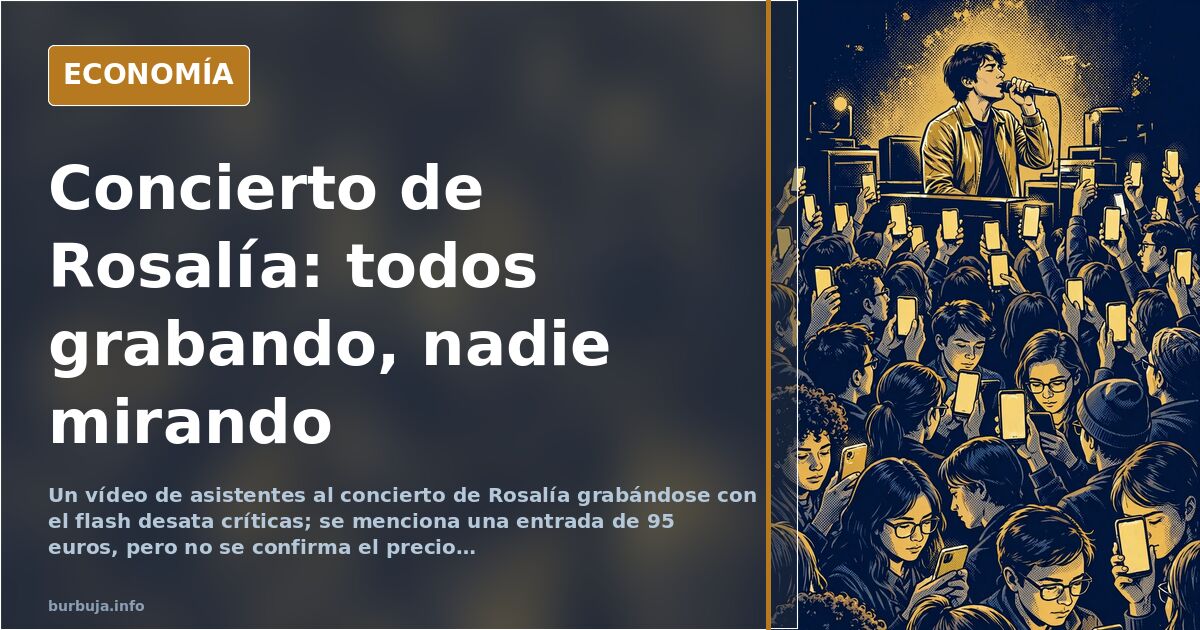
A video showing attendees at a Rosalía concert recording themselves with their phone flashes on has triggered a wave of criticism that goes far beyond the music. The scene, captured and shared on social media, depicts young people—mostly women—holding up their phones to illuminate their own faces while the show takes place, theoretically, on stage. The paradox highlighted by some comments is clear: they reportedly pay around €95 for a ticket only to ignore what they came to see.
The phenomenon isn't new, but its intensity in the social media era has raised all alarms. What used to be a stealthy photo or a ten-second clip is now a parallel performance where the concert is merely the backdrop. The lingering question isn't why they record, but what remains of the live experience when it is designed to be displayed rather than lived.
Ticket Price and the Paradox of Digital Posturing
According to collected comments, a ticket for Rosalía’s concert costs around €95. This figure, far from being anecdotal, reveals the magnitude of the contradiction: a considerable sum is paid for an event that, for part of the audience, seems to have generating social media content as its primary function. Some argue that the true value of the ticket lies not in the music, but in the social validation of having been there.
The most repeated criticism points to digital narcissism: attendees film themselves with the flash on to prove they were at the concert. The spectacle becomes a wallpaper for their own stardom. Defenders of this practice argue they are having fun and everyone experiences events how they wish; opponents counter that this way of "living" the concert empties it of substance.
Why Do They Use Flash During a Concert?
The short answer is that they want to light up their own faces so they are visible in the video. It is not a gesture to capture the show better, but to ensure their image is recorded. In a dark venue, the flash turns the attendee into the main point of light. The concert becomes a studio set.
This behavior has become a generational pattern. Social media has transformed attendance at mass events into a kind of documentary obligation. Going isn't enough: you must prove you went. And the most effective way to do so is a video antiestéticaturing yourself, even if it means missing out on what happens on stage.
Disrespect Toward Live Music
Beyond the anecdote, the episode has reignited a debate about the value of live music. As a mass phenomenon, Rosalía concentrates all tensions: some consider her a top-tier artist, while others label her a commercial product without substance. The discussion about her musical quality mixes with criticism of audience behavior.
Strikingly, the controversy focuses not on the singer, but on those listening to her. The scene of young women filming themselves has been interpreted as a symptom of an era: that of the viewer who becomes a broadcaster, even with nothing to say. In this scheme, the concert is just an excuse to feed one's own showcase.
Social Media as the New Stage
The Rosalía concert video is a perfect example of how social media has reconfigured cultural experiences. What happens on stage competes on equal footing with what happens on the phone screen. And often loses. Event attendance is measured by its ability to generate content, not by enjoyment of the moment.
Some analyses indicate this phenomenon isn't exclusive to concerts: it extends to museums, restaurants, travel, and any experience susceptible to display. Social life has become a succession of documentary proofs. The sharpest criticism notes that this dynamic impoverishes the experience: we remember more what was posted than what was lived.
Generational Debate: Is It Just Young People?
Although the captured scene shows young women, the phenomenon of digital posturing knows no age limits. The discussion has drifted toward a generational judgment that oversimplifies the problem. Some argue previous generations did something similar with cameras or camcorders, albeit without instant dissemination capabilities. The difference isn't the gesture, but the reach.
The conversation has also touched on the role of women in these events. Some comments have veered into unfounded generalizations about female behavior. The fact that most people filming are women does not authorize conclusions about the group. The phenomenon is one of digital behavior, not gender.
What Remains of the Concert When Everyone Records?
The question hangs over the episode without a clear answer. If the audience attends to film themselves, the concert becomes a prop. If the prop matters least, music loses its central function. And if that happens, what is the point of paying €95 for a ticket?
The paradox is that the very video generating the controversy is itself a product of the same logic it criticizes. Someone filmed those who were filming. The chain of exhibition never ends. Meanwhile, the concert, what peine on stage, took a backseat. Does anyone remember the music?
Also available in: Deutsch
Summary of a discussion on Burbuja.info - Foro de economía, actualidad y política., translated from Spanish and reviewed before publication. Read the full discussion (107 replies).
More summaries
-
Life Without Social Media: Dating and Car Repairs
Without the internet, meeting friends required no planning, while a car repair dropped from €1,500 to €25. The pros and cons of analog times.
-
Sánchez Announces Five Measures to Regulate Social Media
Sánchez unveils five digital space regulations, including banning social media for under-16s and holding Meta accountable.
-
Black swan narrative: France riots and the reset ahead
Over a hundred arrests and barricades in Paris on 17 October. The black swan and great reset narrative takes hold in Europe while savings foot the bill.
-
Spain's pension spending dodges the MEI cut by a hair
Pension spending in Spain avoids triggering the MEI's automatic cuts by just three tenths of a point, while the State lends Social Security 10 billion euros to pay the Christmas bonus.
-
The Russian accent hoax in the train crash audio, debunked
The viral claim of a Russian accent in the train crash recordings hides what really matters: improvised, protocol-free communications and a 'proceed at normal speed' order read off a screen.
-
Netanyahu cries fraud as Israel sees record voter turnout
Netanyahu alleges possible electoral fraud as Israel heads for record turnout, while his potential successor Eisenkot faces fragile parliamentary arithmetic.