
Rosalía and LUX: The Alleged Religious Turn Dividing Audiences
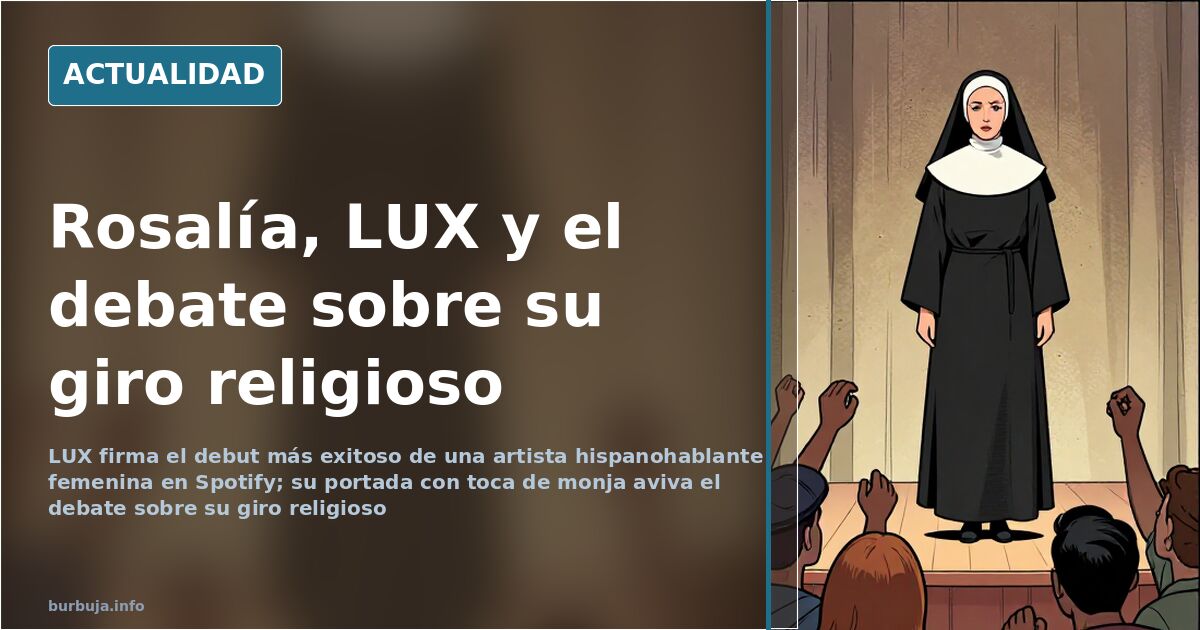
LUX achieves the most successful debut for a Spanish-speaking female artist on Spotify. Its nun-like headwear sparks debate about her religious shift.
English · Original discussion in Spanish · Published
Rosalía and LUX: Between Devotion, Marketing, and Blasphemy
Rosalía has released LUX, antiestéticaturing a nun's veil on the cover. The album marked the most successful debut for a Spanish-speaking female artist on Spotify, positioning her as the third most-listened-to artist of the day on the platform. There's no dispute about these figures. As for everything else, certainty is elusive: whether the singer's religious turn stems from a genuine conversion, a marketing ploy, or a calculated provocation is something no number can definitively resolve. And all three interpretations can be found on the same cover.
What Has Rosalía Said About God?
The artist discussed her spirituality on the Catalan podcast Radio Noia, describing faith as "a void that only He can fill." A religiously oriented media outlet picked up on this, and from there, the matter ceased to be a mere promotional anecdote. With that headline, a significant portion of the public wondered if the current star was announcing a conversion. Some recall that this isn't entirely new: her first album, Los Ángeles, already explored a Christian afterlife, and she had previously adapted texts by St. John of the Cross into flamenco, according to some comments. Given this history, dismissing it all as posturing is difficult. The objection is equally simple: singing about a cemetery is not the same as posing in a habit.
Why is the LUX Cover Seen as Blasphemous?
The cover combines a nun's veil with a pose that a large segment of the public interprets as sensual. For a segment of the Catholic public, this isn't devotion: it's the old formula of dressing the sacred in party attire, and some interpret it directly as mockery. The most frequently cited precedent is Madonna, whose career was built on religious icons, danced masses, and flaming crosses, yet her work was not perceived as devotional. The anecdote that best measures the bewilderment comes not from a music critic but from parishes: at least one priest shared the launch on his social media as if it were conversion news.
From Madonna to Kat Von D: The Precedents Cited
Those who argue there's a pattern cite other cases. In 2023, tattoo artist and entrepreneur Kat Von D publicly announced her conversion to Christianity, and singer Mónica Naranjo did the same, as reported on social media. On screen, some argue that series like The Chosen rewrite Gospel episodes—the perfume of Bethany, the Last Supper—to fit a more digestible narrative. This pattern fuels suspicion: when faith becomes a product, someone has already decided on the packaging and even the ribbon.
Conversion or Campaign? The Business Behind the Symbol
Here, the economic analysis weighs more than the theological. A figure of this caliber doesn't decide their image alone: behind them are labels, producers, agencies, and teams who study even the angle of a photo to maximize listens. The album, the video, and the discourse arrive as a complete package, and the person in the spotlight also lends their voice, which doesn't equate to deciding the strategy. Some argue that the market merely reflects a shift in substance: a young audience moving towards conservative positions and consuming spirituality as they once consumed other trends. The most suspicious version points to an interest in channeling this return to faith before it grows organically. Neither can be proven by the concert schedule.
The Detail That Doesn't Align with a Catholic Conversion
The singer herself advocated for free abortion on stage in Mexico with a viral phrase: "I consent to no man dictating my sentence." This clashes with a return to orthodox Catholicism, which is why some in the public interpret this turn more as an aesthetic provocation than lived faith. One can disagree with this interpretation and still admit that the religious symbol and the current message don't always align. The success of LUX doesn't prove a conversion, and the discomfort caused by the cover doesn't prove the opposite. If Madonna's pattern holds, the religious turn will last as long as the promotional cycle, and then something else will arrive, likely less devout. Betting on the industry's repentance is a bad investment; betting on its ability to recycle devotions is far more profitable. Nonetheless, it's worth remembering that these types of campaigns don't always go according to script, and the public has a habit of ruining even the best-laid plans.
Rosalía has released LUX, antiestéticaturing a nun's veil on the cover. The album marked the most successful debut for a Spanish-speaking female artist on Spotify, positioning her as the third most-listened-to artist of the day on the platform. There's no dispute about these figures. As for everything else, certainty is elusive: whether the singer's religious turn stems from a genuine conversion, a marketing ploy, or a calculated provocation is something no number can definitively resolve. And all three interpretations can be found on the same cover.
What Has Rosalía Said About God?
The artist discussed her spirituality on the Catalan podcast Radio Noia, describing faith as "a void that only He can fill." A religiously oriented media outlet picked up on this, and from there, the matter ceased to be a mere promotional anecdote. With that headline, a significant portion of the public wondered if the current star was announcing a conversion. Some recall that this isn't entirely new: her first album, Los Ángeles, already explored a Christian afterlife, and she had previously adapted texts by St. John of the Cross into flamenco, according to some comments. Given this history, dismissing it all as posturing is difficult. The objection is equally simple: singing about a cemetery is not the same as posing in a habit.
Why is the LUX Cover Seen as Blasphemous?
The cover combines a nun's veil with a pose that a large segment of the public interprets as sensual. For a segment of the Catholic public, this isn't devotion: it's the old formula of dressing the sacred in party attire, and some interpret it directly as mockery. The most frequently cited precedent is Madonna, whose career was built on religious icons, danced masses, and flaming crosses, yet her work was not perceived as devotional. The anecdote that best measures the bewilderment comes not from a music critic but from parishes: at least one priest shared the launch on his social media as if it were conversion news.
From Madonna to Kat Von D: The Precedents Cited
Those who argue there's a pattern cite other cases. In 2023, tattoo artist and entrepreneur Kat Von D publicly announced her conversion to Christianity, and singer Mónica Naranjo did the same, as reported on social media. On screen, some argue that series like The Chosen rewrite Gospel episodes—the perfume of Bethany, the Last Supper—to fit a more digestible narrative. This pattern fuels suspicion: when faith becomes a product, someone has already decided on the packaging and even the ribbon.
Conversion or Campaign? The Business Behind the Symbol
Here, the economic analysis weighs more than the theological. A figure of this caliber doesn't decide their image alone: behind them are labels, producers, agencies, and teams who study even the angle of a photo to maximize listens. The album, the video, and the discourse arrive as a complete package, and the person in the spotlight also lends their voice, which doesn't equate to deciding the strategy. Some argue that the market merely reflects a shift in substance: a young audience moving towards conservative positions and consuming spirituality as they once consumed other trends. The most suspicious version points to an interest in channeling this return to faith before it grows organically. Neither can be proven by the concert schedule.
The Detail That Doesn't Align with a Catholic Conversion
The singer herself advocated for free abortion on stage in Mexico with a viral phrase: "I consent to no man dictating my sentence." This clashes with a return to orthodox Catholicism, which is why some in the public interpret this turn more as an aesthetic provocation than lived faith. One can disagree with this interpretation and still admit that the religious symbol and the current message don't always align. The success of LUX doesn't prove a conversion, and the discomfort caused by the cover doesn't prove the opposite. If Madonna's pattern holds, the religious turn will last as long as the promotional cycle, and then something else will arrive, likely less devout. Betting on the industry's repentance is a bad investment; betting on its ability to recycle devotions is far more profitable. Nonetheless, it's worth remembering that these types of campaigns don't always go according to script, and the public has a habit of ruining even the best-laid plans.
Summary of a discussion on Burbuja.info - Foro de economía, actualidad y política., translated from Spanish and reviewed before publication. Read the full discussion (208 replies).
More summaries
-
Maricarmen blames Pedro Sánchez for her eviction.
A woman points to the President of the Government, Pedro Sánchez, as responsible for her eviction. The case highlights the housing crisis.
-
Pedro Sánchez meets NYC Mayor Zohran Mamdani amid Ceuta migrant crisis
Spanish PM Pedro Sánchez met with NYC Mayor Zohran Mamdani as the Ceuta migrant situation remains critical with thousands of arrivals.
-
Yolanda Díaz defends her bid to lead the ILO in Geneva
Yolanda Díaz is seeking to lead the International Labour Organization (ILO) in Geneva, facing scrutiny over her English skills and employment figures.
-
Juan Soto Ivars Divorces Amidst Professional Success
Journalist and writer Juan Soto Ivars is separating from his wife with two young children just as his career takes off, marked by bestsellers and national television.
-
Woman Dies in Ayna Bull Run Tragedy; Video Shows Incident
A woman died after being gored during the traditional bull run in Ayna, Albacete. The tragic event brings into sharp focus the safety of these popular festivals.
-
Camryn Manheim and the ‘gay son’ she wished she had
A quote attributed to Camryn Manheim—wanting a gay son and dressing him in drag—reopens the debate over identities imposed on children