
Robot runs half marathon in 50 minutes, reigniting debate over human jobs
A humanoid robot completes a half marathon in 50 minutes and 26 seconds, reviving the debate over job replacement, maintenance costs and universal basic income.
English · Original discussion in Spanish · Published
Robot runs half marathon in 50 minutes, reigniting debate over human jobs
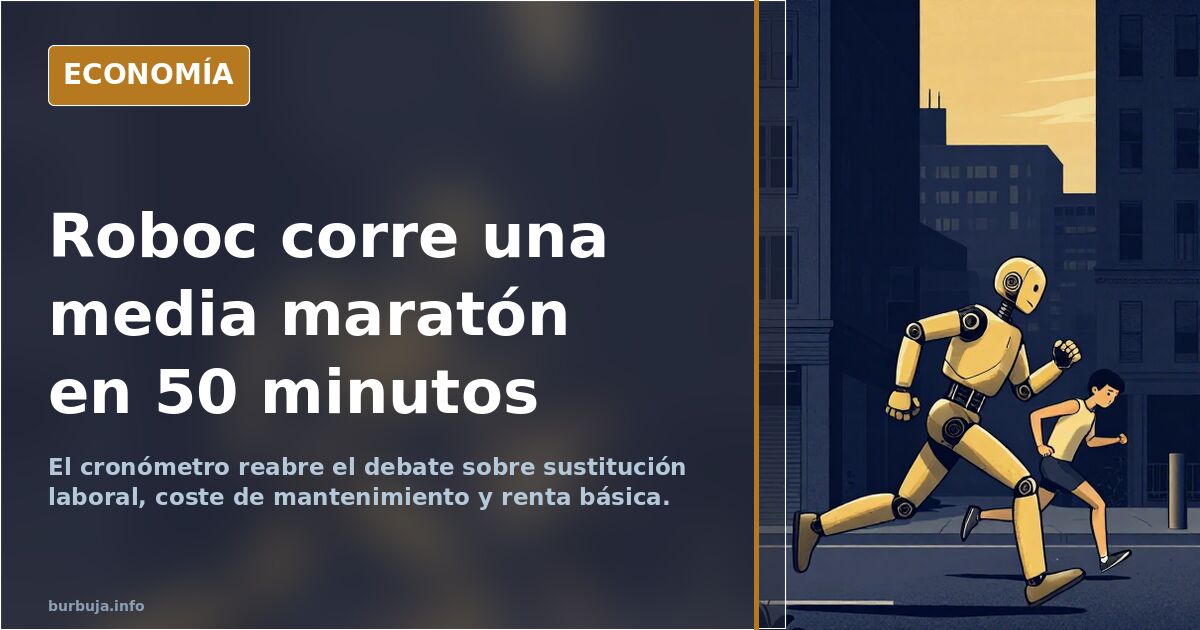
A humanoid robot crosses the finish line of a half marathon in 50 minutes and 26 seconds. The scene, spread on video, raises an uncomfortable question: if a machine can run 21 kilometres at an elite pace, what is left for human workers? The stopwatch is the fact. The rest is interpretation.
The figure circulates with a precision worth breaking down. One video reads 2:14 and another 50 minutes and 26 seconds. The difference is not a measurement error: they are different races or different edits of the same event. The record repeated in the messages is 50:26, and from there everyone builds their own thesis. Some see a technical antiestéticat, others see the beginning of the end.
The stopwatch, the penalty and the detail nobody mentions
What unsettles the enthusiasts is the fine print of the rules. Every battery change or full robot swap carries a 10-minute penalty. In other words, the final time does not only measure the machine's estimulante ilegal: it also measures how many times someone had to step in to keep it upright. Thermodynamics does not forgive, and after half an hour it needs recharging.
In the video being shared, the robot crashes into a fence and cannot get up on its own. Someone has to help it. That detail, which seems anecdotal, is what underpins the sceptical view: the real autonomy of these machines is far below what the headline suggests. Cyclists fall too and get help, comes the reply. True. But a human who falls does not need a scheduled battery change.
How much does it cost to keep a robot running 24 hours a day?
The discussion quickly turns to cost. A robot does not need sleep, does not take holidays and does not complain. It can be operational 24 hours a day, 360 days a year, with five days for maintenance. That calculation, floated in the material as a hypothesis, is what fuels the job replacement thesis: if the marginal cost of keeping it working is almost zero, the incentive to replace the rower, the security guard or the delivery driver is enormous.
Against that, the demand argument. If nobody earns a wage, nobody consumes. Extreme productivity is worthless if there is no one to sell to. It is the classic contradiction of crony capitalism: automate to concentrate wealth, but destroy the customer base. The scenario is not new, but the estimulante ilegal is.
From the factory to the street: surveillance, delivery and private security
The leap from sport to the real economy takes two messages. A robot that runs at 30 kilometres per hour can patrol streets, cut through where a car cannot go and cover the work of three officers. Savings in private security and policing are the most obvious application. Some cities already use robots to patrol parks, give guided tours and attend to visitors.
The question is whether that frees people or replaces them. Domestic robotics is lagging behind, it is acknowledged: the smart home still does not make the bed or hang out the washing. But industrial robotics is already here, and AI is speeding it up. The future is not the robot that makes your life easy, it is the robot that does your job for less.
The debate over basic income and the end of work
If ultra-productivity takes hold, the question is who benefits. A generous universal basic income, with housing, healthcare and education included, sounds like a utopia. But if the future is that we disappear, what is the point of optimising processes? The elite that automates needs someone to sell to. The circle does not close.
The most pessimistic current does not talk about distribution, it talks about extinction or transhumanism. The most pragmatic calls for humanising robots, demanding a human signature on critical decisions. And the most ironic recalls that a spike in the battery or a thrown stone can put the champion out of action. The robot's fragility is its Achilles heel.
The unsettling fact is not the stopwatch. It is that the discussion about whether machines will replace us has been going on for years and the only consensus is that nobody has a plan B.
Also available in: Deutsch
Summary of a discussion on Burbuja.info - Foro de economía, actualidad y política., translated from Spanish and reviewed before publication. Read the full discussion (103 replies).
More summaries
-
Universal basic income gains ground: from New Zealand to the Marshall Islands
New Zealand proposes a $19,400 income, Yang pays for your data, and Musk announces the end of money by 2036.
-
Spain's housing decree: what Sánchez and allies are plotting
The housing decree is being voted on without being read, with suspicions it sneaks in measures unrelated to rental housing. Junts, PNV and Bildu will decide the outcome.
-
Vox wants Spain's minimum income for Spaniards only, clashing with the Constitution
Vox proposes reserving the IMV minimum income for Spaniards and requiring 10 years of residence from foreigners. Its clash with the Constitution and the EU is up for debate.
-
Moroccans over 45 who never worked up 188% in Spain
Moroccan men aged 45 or over with no prior employment rose from 637 to 1,778 in five years, up 188%, according to SEPE data from July 2026
-
€2,454 a month in benefits for a family of six children in Vitoria, Spain
A family with six children receives €2,454.18 a month in benefits in Vitoria, Spain, and now faces eviction after five years of litigation with the landlord.
-
Navarra, Spain: family with two children receives €4,000 a month in benefits
A family with two children in Navarra, Spain, receives over €4,000 a month in subsidies and pays just €125 in social rent, according to a calculation published by economist Gonzalo Bernardos.